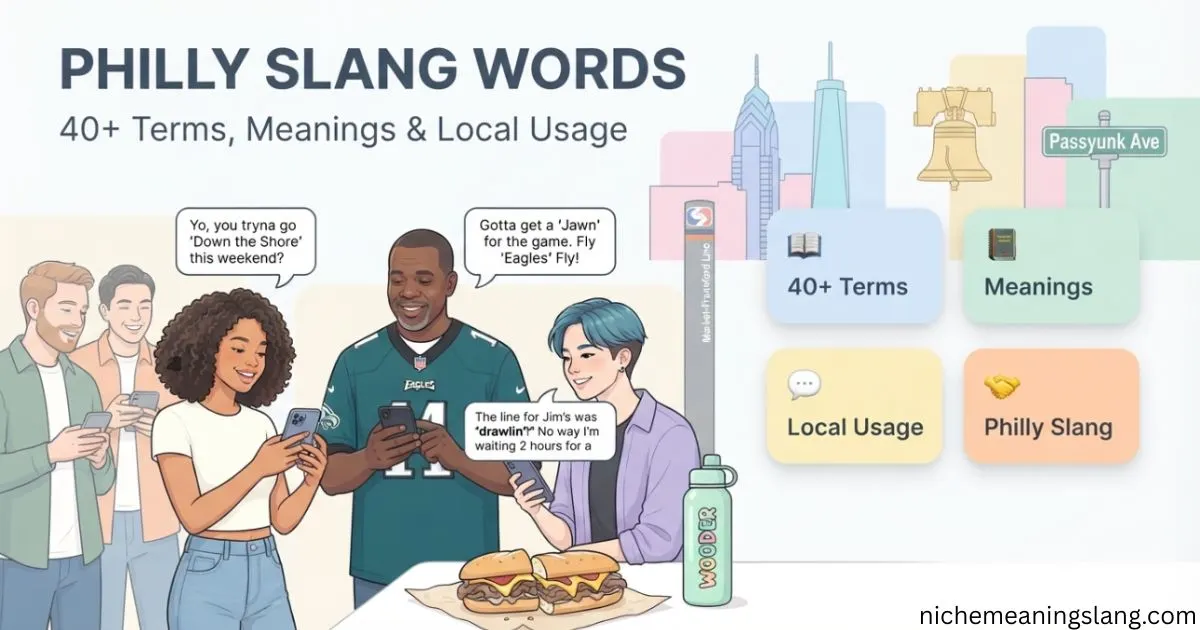
Philly Slang Words Terms, Meanings & Local Usage
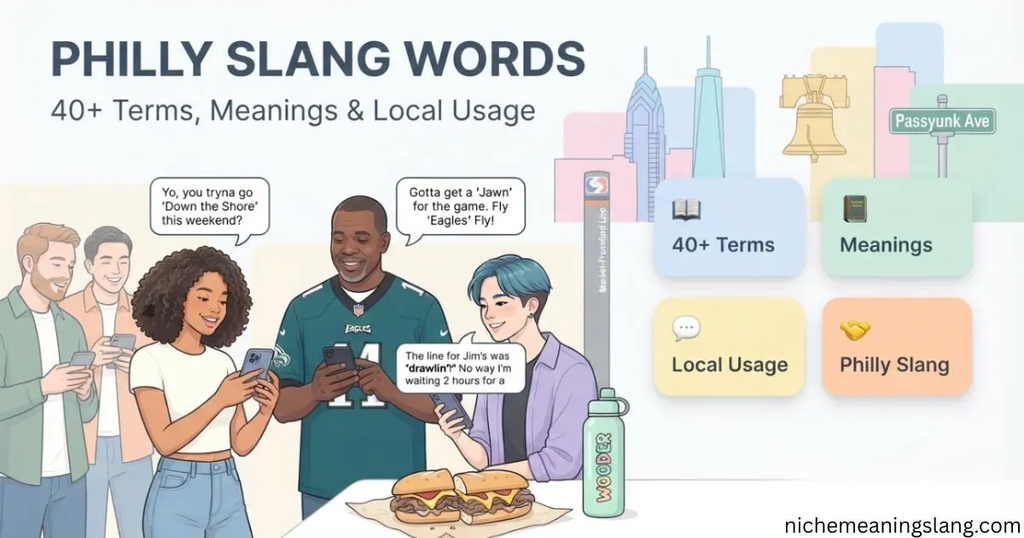
Philly slang words are the informal expressions, regional vocabulary, and distinctive pronunciations that make Philadelphia speech instantly recognizable. The best-known example is jawn, but local language also includes boul, drawlin’, ard, wooder, youse, hoagie, water ice, and Iggles. After researching Philadelphia vocabulary and the way locals actually use these expressions, one thing becomes clear: Philly speech is more than a list of funny words.
For visitors, newcomers, and anyone decoding a Philadelphia text, the hardest part is context. A word can sound playful in one conversation and disrespectful in another. Philadelphia English also reflects Black Philadelphia speech, regional dialect, immigrant communities, neighborhood culture, sports, food, texting, and social media. This guide separates those layers so you can understand the language without turning it into a stereotype.
What Does philly slang words Mean?
Philly slang words means the collection of informal terms, local expressions, regional vocabulary, and pronunciation patterns associated with Philadelphia. The phrase covers much more than traditional slang: jawn is vocabulary, wooder reflects pronunciation, and hoagie is regional food language. The boundaries are important because locals do not use every expression the same way.
Philadelphia also has no single uniform speech style. Age, neighborhood, community, and social setting can change what someone says and how a word sounds. Some expressions have particularly strong connections to Black Philadelphia and African American English, while others come from older regional or immigrant traditions. That mixture is what gives Philly slang its distinctive identity.
Jawn
Jawn is the signature Philly expression: a flexible noun that can refer to a person, place, thing, event, object, or situation. Context supplies the missing information. “Pass me that jawn” might mean a phone, while “that jawn was packed” could describe a party or location.
The word is strongly associated with Philadelphia, but its history is more interesting than the simple claim that Philly invented it. Linguistic sources connect its local development to joint, with the word becoming especially flexible in Philadelphia speech. That history helps explain why jawn can replace so many different nouns.
Boul
Boul generally means guy, boy, man, or person. You might hear, “Who that boul over there?” Spelling varies, including bul, bol, and other forms, because the expression developed primarily through speech rather than standardized writing.
Its social meaning can depend heavily on community and relationship. Philadelphia reporting has documented disagreements over how to spell it, while linguistic discussion connects the term with local Black Philadelphia speech. In other words, boul is not simply a universal replacement for “guy”; natural use depends on context.
Young Boul
Young boul refers to a younger guy or young man, but the tone can change dramatically. Among friends it may sound familiar or affectionate; from an older speaker it can identify someone’s age or position within a social group.
Philadelphia speech researchers and local reporting show why context matters here. The same phrase can carry warmth, teasing, or condescension. That makes young boul a good example of why learning Philly slang requires more than memorizing a dictionary definition.
Oldhead
An oldhead is an older person, often someone regarded as experienced or established. The word does not necessarily mean elderly. A teenager might call someone in their thirties an oldhead, while another speaker might reserve it for a much older person.
The term can also express respect. Saying “ask the oldhead” may suggest that the person knows the history or has experience. In a different conversation, “oldhead behavior” can be playful teasing. Age, relationship, and delivery determine the emotional meaning.
Drawlin’
Drawlin’ means acting out, doing too much, behaving strangely, being unreasonable, or crossing a social line. “You drawlin’” can be serious criticism, but among friends it may simply mean, “You’re being ridiculous.”
That flexibility is one reason the expression survives so well in conversation. A friend wearing shorts in freezing weather might hear “you drawlin’” as a joke; someone behaving disrespectfully may hear it as a genuine warning. The surrounding situation supplies much of the meaning.
Ard
Ard is a shortened form of “all right” and can mean okay, understood, agreed, or sounds good. A simple “Ard” can close a conversation just as effectively as “okay.”
It can also introduce another thought: “Ard, what we doing now?” Like many spoken slang forms, the spelling reflects pronunciation and texting habits. It is especially useful for understanding informal Philadelphia messages because it can communicate agreement without sounding formal.
Yamean, Yamsayin, and Nahmean
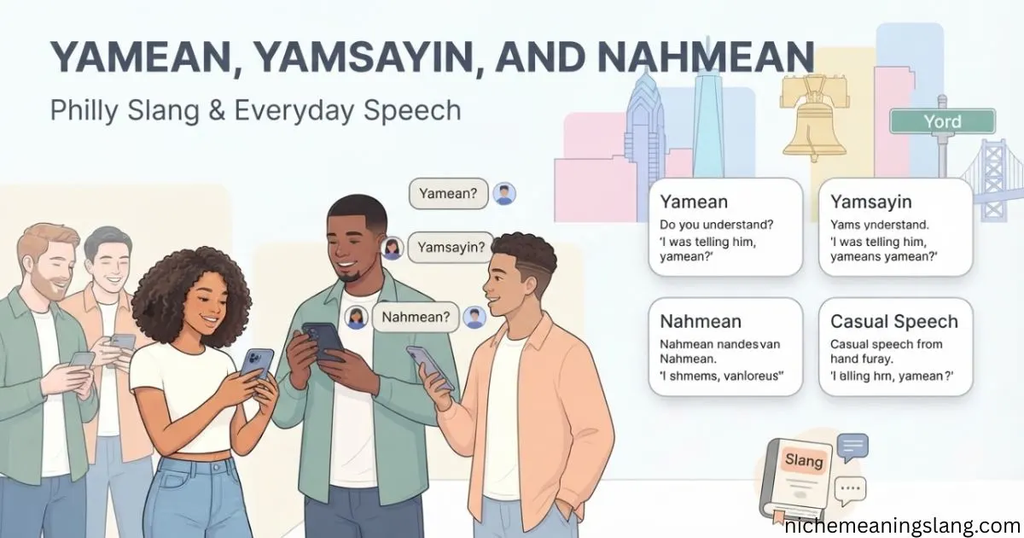
Yamean, yamsayin, and nahmean represent conversational phrases such as “you know what I mean?” or “you know what I’m saying?” There is no single standardized spelling because people are writing down sounds they normally learned by hearing.
This makes the terms particularly interesting in texting. One person may write “yamean,” another “yamsayin,” and another “nahmean,” while everyone understands the conversational function. The spelling itself becomes part of the informal identity of the expression.
Ocky
Ocky generally means fake, questionable, counterfeit, or inauthentic. If someone’s sneakers look suspiciously imitation, a speaker might describe them as “ocky.”
The word is more associated with younger informal speech than some older Philadelphia expressions, and its spelling and origin are not completely standardized. That uncertainty is worth preserving rather than pretending every slang word has a single documented etymology.
“Wooder” Yes, That’s Water
Wooder represents a well-known Philadelphia pronunciation of “water.” Unlike jawn or boul, it is better understood as an accent feature than as a completely different vocabulary item.
Philadelphia linguistics research specifically identifies “wooder” as one of the city’s recognizable pronunciation patterns. It becomes especially noticeable in expressions such as wooder ice, where visitors may initially think they are hearing a completely different word.
“Iggles”
Iggles is a playful representation of how “Eagles” may sound in a strong Philadelphia accent, referring to the Philadelphia Eagles. You are most likely to encounter it in conversations about football, local sports culture, memes, and fan identity.
Unlike a formal nickname created by the team, Iggles works primarily as a written representation of local pronunciation. That makes it a good example of how Philadelphia slang and Philadelphia accent features overlap.
“Jeet?”
Jeet? is a compressed version of “Did you eat?” It reflects the rapid, clipped quality that can appear in informal Philadelphia speech.
The phrase is usually practical rather than mysterious. Someone asking “Jeet?” is checking whether you have eaten. A natural response might continue the same conversational rhythm rather than switching into formal English. It is one of those expressions that becomes much easier once you hear it spoken.
“No Jawn” or “No Cap”
No jawn is presented in some contemporary Philly slang lists as meaning “for real,” “I’m serious,” or “I’m not joking.” No cap, meanwhile, is much broader American internet slang meaning that someone is telling the truth.
That distinction matters for semantic accuracy. A word being frequently heard in Philadelphia does not automatically make it uniquely Philadelphia. No cap, finna, bet, and similar expressions circulate nationally, while jawn has a much stronger Philadelphia identity.
“Slumped” or “Finished”
When someone says they are slumped, they generally mean exhausted, worn out, or completely done. “I worked a double today; I’m slumped” communicates physical or mental fatigue without needing a long explanation.
The term is not exclusive to Philadelphia, so it belongs in the broader category of slang used by Philly speakers rather than uniquely Philadelphia vocabulary. That distinction is useful when building a genuine list of Philly slang words instead of labeling every popular expression local.
“Dipset”
Dipset means leaving, bouncing, or heading out. “Aight, I’m dipset” essentially means, “All right, I’m leaving.”
It is a compact example of how Philadelphia conversations can blend local speech with wider American and hip-hop vocabulary. Because slang travels between cities, music, neighborhoods, and online communities, not every expression heard in Philly originated there.
“Wit”
Wit is the informal spelling or pronunciation of “with.” It becomes particularly recognizable in Philadelphia food-ordering language, especially around cheesesteaks.
For example, wit and witout are commonly associated with ordering onions: “wit” means with onions and “witout” means without. The expression is practical shorthand rather than a mysterious code, and understanding it can make a South Philly food conversation much easier to follow.
Hoagie
A hoagie is Philadelphia’s famous term for a long sandwich. Other parts of the United States may say sub, submarine sandwich, hero, or grinder, but hoagie is strongly associated with the Philadelphia region.
This is technically better described as regional vocabulary than youth slang. That distinction is important because Philadelphia language includes ordinary food words that carry strong local identity without functioning like internet slang.
Water Ice
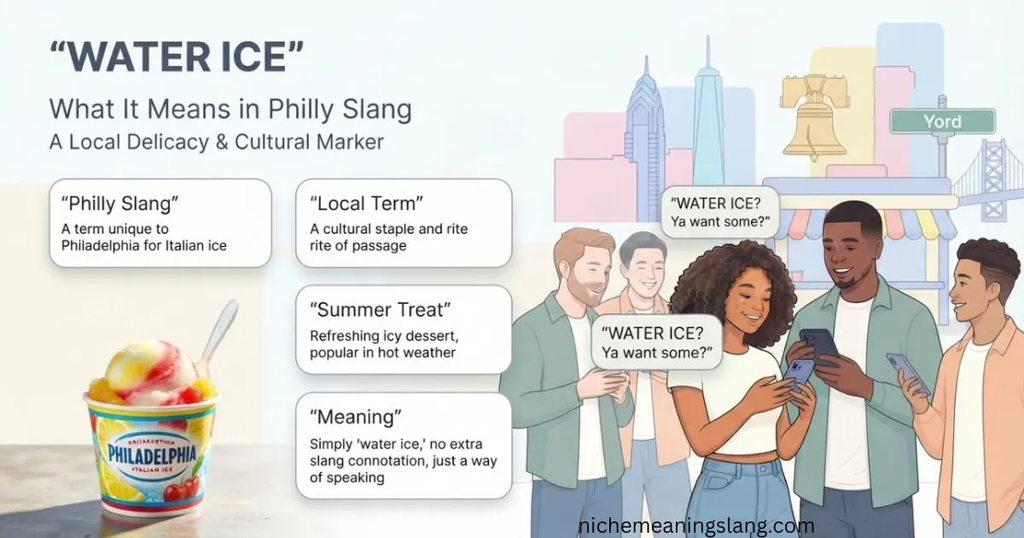
Water ice is the Philadelphia term for the frozen dessert often called Italian ice elsewhere. It is strongly connected with Philadelphia summer culture and neighborhood food traditions.
The expression becomes especially recognizable when paired with the Philadelphia pronunciation wooder. That combination illustrates how vocabulary and accent can reinforce each other, producing a phrase that sounds unmistakably local even when each individual element is understandable.
Youse
Youse is a plural form of “you,” serving a grammatical role similar to y’all in other parts of the United States. “What are youse doing tonight?” simply means “What are all of you doing tonight?”
It is associated with Philadelphia and other parts of the Northeast and Mid-Atlantic, so it is regional rather than exclusively Philadelphia. Its importance comes from showing that local speech includes grammar and pronouns, not just colorful slang words.
Wit or Witout
Wit or witout is practical Philadelphia ordering shorthand. In cheesesteak culture, “wit” generally means with onions, while “witout” means without onions. “Wiz” can refer to Cheez Whiz.
The phrase is less about street slang and more about a local ordering system. It demonstrates how Philadelphia vocabulary can emerge from everyday routines. Food, neighborhood businesses, sports, and transportation all contribute to the language people recognize as distinctly Philly.
MAC Machine
MAC machine is an older Philadelphia-area term for an ATM, derived from the Money Access Center network. It is much more generation-specific than jawn or boul.
That makes it particularly useful as a historical regional term. Someone who uses MAC machine may be revealing something about when and where they learned their Philadelphia vocabulary rather than trying to sound youthful.
Conclusion
Philly slang words are not one perfectly defined dictionary category. They include jawn, boul, drawlin’, ard, oldhead, youse, wooder, hoagie, water ice, Iggles, and practical expressions such as wit and witout, but these forms do not all work in the same linguistic way.
The most important lesson is context. Philadelphia speech reflects neighborhood identity, Black Philadelphia culture, regional pronunciation, food traditions, sports, generations, and changing online language. If you understand those relationships, Philly slang words stop sounding like random code and start revealing the personality of the city.
FAQs
What are 5 Philly slang words?
Five widely recognized examples are jawn, boul, drawlin’, ard, and oldhead. Other strongly associated Philadelphia forms include wooder, youse, Iggles, hoagie, and water ice.
What is Philly slang for hello?
Yo is a common casual Philadelphia greeting or attention-getter. It is informal rather than an exclusive Philadelphia word.
What does jawn mean in Philly slang?
Jawn is a flexible noun that can refer to a person, place, thing, event, or situation. The exact meaning comes from context.
What does boul mean in Philadelphia?
Boul generally means guy, boy, man, or person. You may also see spellings such as bul or bol.
What does drawlin’ mean in Philly?
Drawlin’ can mean acting out, doing too much, behaving strangely, or being unreasonable. Its exact tone depends on the situation.
Is wooder actually a Philly slang word?
It is more accurately described as a Philadelphia pronunciation of water rather than a completely separate slang word. Penn’s linguistics coverage identifies “wooder” as a recognizable Philadelphia pronunciation feature.
Is hoagie Philadelphia slang?
Hoagie is better classified as regional vocabulary. It refers to the long sandwich commonly called a sub or similar names elsewhere.
Do all Philadelphians use jawn?
No. Philadelphia has different neighborhoods, generations, communities, and social groups, so individual usage varies. Jawn is nevertheless strongly associated with Philadelphia.
Are no cap and finna Philly slang?
They are widely used beyond Philadelphia. Hearing them in Philly does not make them uniquely Philadelphia expressions.
Related Slang Words

Ryan Mitchell is a language enthusiast and writer who explores slang, modern expressions, and everyday language. At nichemeaningslang, he helps readers understand slang meanings, usage, and context in a simple and easy-to-follow way.