Gen Z Slang Translator: Meanings, Words & Examples
Ever read a text message or social media comment and wondered what it actually means? A Gen Z slang translator helps you understand modern slang by converting unfamiliar words, abbreviations, and internet expressions into plain English. Whether someone says “no cap,” “that’s giving,” “you’re cooked,” or “it’s a W,” understanding the meaning makes online conversations much easier to follow.
Gen Z slang is common across texting, TikTok, Instagram, gaming communities, and group chats. However, these expressions don’t always have one fixed meaning. Some are playful, some are sarcastic, and others depend on the situation. This guide explains how to translate Gen Z slang, explores popular words and phrases, and gives practical examples so you can understand what people mean without guessing.
What Is a Gen Z Slang Translator?
A Gen Z slang translator is a tool or reference guide that explains informal expressions commonly used in online conversations and everyday speech. It converts unfamiliar slang into clearer language, helping readers understand messages, memes, captions, comments, and abbreviations.
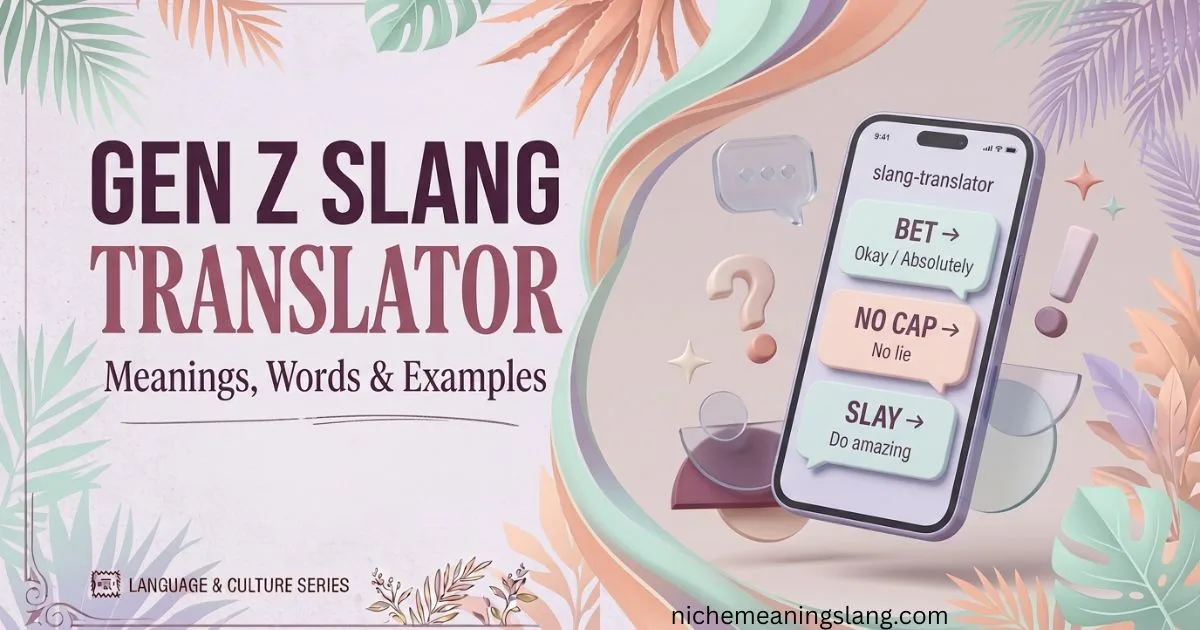
For example, if someone texts “That outfit ate,” they probably aren’t talking about food. In Gen Z slang, ate means someone did something exceptionally well or looked impressive. Similarly, “no cap” means “no lie” or “I’m being serious,” while “bet” can mean “okay” or “sounds good.”
A translator can be especially useful for people learning English, parents trying to understand messages, teachers, content creators, and anyone unfamiliar with current internet vocabulary.
The best translations do more than define a word. They explain its tone, show how it works in a sentence, and clarify whether the phrase is positive, negative, playful, or potentially rude.
How Does a Gen Z Slang Translator Work?
Most slang translators follow a straightforward process. You enter a word, phrase, or short message, and the tool explains its likely meaning in standard English.
Step 1: Enter the slang word or message
Copy the unfamiliar expression from a text, caption, comment, or conversation. For example, you might enter “lowkey this song is fire.”
Step 2: Read the plain-English translation
The phrase could be translated as “I secretly think this song is really good” or “This song is genuinely impressive.” The exact interpretation depends on context.
Step 3: Check the tone and context
Some expressions communicate enthusiasm, while others indicate sarcasm, disappointment, or humor. A useful translator should explain these possibilities instead of assuming every phrase is literal.
Step 4: Review an example
Example sentences help you understand how a word works naturally. They can also help you decide whether a phrase is appropriate for a casual chat, a public post, or a professional message.
Step 5: Verify confusing expressions
Slang changes quickly, and new meanings can spread through online communities. If a translation seems unusual, check the surrounding conversation or compare it with a reliable slang dictionary.
Popular Gen Z Slang Words and Their Meanings
Here is a quick Gen Z slang dictionary featuring widely recognized words and phrases. Usage varies across communities, and some expressions may become less popular over time.
| Gen Z slang | Plain-English meaning | Example |
| Rizz | Charisma, especially romantic charm | “He’s got rizz.” |
| No cap | No lie; seriously | “That movie was amazing, no cap.” |
| Cap | A lie or exaggeration | “That’s cap.” |
| Bet | Okay, agreed, or sounds good | “Meet at seven?” “Bet.” |
| Slay | Do something extremely well or look amazing | “You slayed that outfit.” |
| Ate | Did something impressively well | “She ate that performance.” |
| Mid | Average or disappointing | “The sequel was mid.” |
| Sus | Suspicious or questionable | “That explanation sounds sus.” |
| Bussin’ | Extremely good, often describing food | “These tacos are bussin’.” |
| Delulu | Playfully delusional or unrealistic | “I’m delulu about meeting my celebrity crush.” |
| Cooked | In trouble, exhausted, or unlikely to succeed | “I didn’t study. I’m cooked.” |
| Fire | Excellent, exciting, or impressive | “This playlist is fire.” |
| Lowkey | Somewhat, subtly, or secretly | “I lowkey love that song.” |
| Highkey | Openly, strongly, or obviously | “I’m highkey excited.” |
| Fr | For real | “That was funny fr.” |
| Ngl | Not gonna lie | “Ngl, I expected more.” |
| Ick | Something that suddenly causes attraction to fade | “That comment gave me the ick.” |
| Ghosting | Suddenly stopping communication without explanation | “He started ghosting me.” |
| Tea | Gossip or interesting information | “Spill the tea.” |
| W | A win or something positive | “Getting the job is a W.” |
| L | A loss, failure, or disappointing outcome | “That was a big L.” |
| Main character energy | Confidence or acting like the central character in a story | “She walked in with main character energy.” |
| It’s giving | It has the vibe or impression of something | “It’s giving summer vacation.” |
| Touch grass | Spend time offline or reconnect with reality | “You’ve been arguing online all day. Touch grass.” |
| GOAT | Greatest of all time | “She’s the GOAT.” |
| Brain rot | Internet content or habits perceived as mind-numbing or excessively absorbing | “I’ve been watching brain-rot videos all afternoon.” |
| NPC | A non-player character in a game; online, someone perceived as acting predictably | “He keeps repeating the same line like an NPC.” |
| Aura | Perceived coolness, confidence, or presence | “That entrance gained aura points.” |
| Ratio | A social media reply that gets more engagement than the original post | “The post got ratioed.” |
| Stan | To be an enthusiastic fan of someone or something | “I stan that artist.” |
Gen Z Slang Translator: Text Messages Explained
Individual words are useful, but complete messages can be more difficult to understand. These examples show how slang works in context.
Example 1: “Ngl, that fit ate.”
Plain-English translation: “Honestly, that outfit looks amazing.”
- Ngl means “not gonna lie.”
- Fit is short for outfit.
- Ate means performed or looked exceptionally well.
The message is generally a compliment.
Example 2: “Bro is cooked 💀”
Plain-English translation: “That person is in serious trouble,” or “That situation is hilariously bad.”
Cooked can mean defeated, exhausted, or in trouble. The skull emoji often indicates laughter or something extremely funny, although the exact tone depends on context.
Example 3: “It’s giving main character.”
Plain-English translation: “This person or situation has the confidence or dramatic vibe of a main character.”
The phrase often describes an outfit, a memorable moment, or someone acting confidently.
Example 4: “Bet, see you there.”
Plain-English translation: “Okay, agreed. I’ll see you there.”
In this context, bet is an affirmative response rather than a reference to gambling.
Example 5: “Lowkey, that was mid.”
Plain-English translation: “Honestly, I thought that was just average.”
Lowkey softens the statement or makes it feel less direct, while mid expresses a mediocre opinion. Depending on the relationship, the message might sound mildly critical.
Example 6: “She has mad rizz.”
Plain-English translation: “She’s very charming or good at flirting.”
Rizz refers to charisma, particularly the ability to attract or impress someone romantically.
Example 7: “It’s a W for sure.”
Plain-English translation: “That’s definitely a win.”
The letter W is commonly used to describe a positive outcome, success, or good decision.
Example 8: “I’m delulu, but let me dream.”
Plain-English translation: “I know my hope might be unrealistic, but I still want to imagine it happening.”
Delulu is often used humorously or self-deprecatingly rather than as a serious statement about someone’s mental health.
Gen Z Texting Abbreviations You Should Know
Gen Z slang translators also help decode shortened expressions used in text messages. Many of these abbreviations are used by people of different ages, not just Gen Z.
| Abbreviation | Full form | Meaning |
| LOL | Laughing out loud | Something is funny |
| LMAO | Laughing my ass off | Strong laughter; informal and mildly vulgar |
| BRB | Be right back | Returning shortly |
| BTW | By the way | Introducing an additional point |
| IDK | I don’t know | Expressing uncertainty |
| IMO | In my opinion | Sharing a personal view |
| IMHO | In my humble opinion | Introducing a personal opinion |
| TBH | To be honest | Giving an honest opinion |
| NGL | Not gonna lie | Emphasizing sincerity |
| FR | For real | Seriously or genuinely |
| RN | Right now | At this moment |
| WYD | What are you doing? | Asking what someone is up to |
| WYA | Where are you? | Asking someone’s location |
| HMU | Hit me up | Contact me |
| IYKYK | If you know, you know | Referring to shared knowledge or an inside joke |
| OOMF | One of my followers | Referring indirectly to a social media follower |
| FOMO | Fear of missing out | Anxiety about missing an experience |
| AF | As hell | Informal intensifier meaning “very”; can be vulgar |
| ONG | On God | Emphasizing sincerity or making a strong claim |
| ISTG | I swear to God | Emphasizing frustration, surprise, or sincerity |
Some abbreviations have multiple interpretations. For example, the same letters may stand for different phrases in gaming, work, or private group chats. Always use the surrounding sentence to determine the intended meaning.
How to Translate Gen Z Slang Without Getting It Wrong
A slang translation can be technically correct and still miss the speaker’s intention. These tips can help you interpret unfamiliar messages more accurately.
Pay attention to context
The word cooked can describe someone being in trouble, exhausted, or completely defeated. A message about an exam may suggest one meaning, while a message about a long workday suggests another.
Look at the tone
Emojis, punctuation, and the relationship between speakers can change how a phrase feels. “Okay 💀” might be a humorous reaction, while “okay.” could sound distant in a particular conversation. Neither interpretation is guaranteed without context.
Consider the platform
A phrase used in a TikTok comment may be ironic or exaggerated. A similar expression in a private message may carry a more personal meaning. Gaming communities, fandoms, and group chats can also develop their own vocabulary.
Don’t assume every trend is current
Slang moves through cycles. A word may become popular, spread widely, and then be used ironically or considered outdated. A good translator should explain established meanings while acknowledging that newer expressions may be uncertain.
Avoid translating every word literally
Internet language frequently uses metaphor, exaggeration, and humor. For example, “she ate” usually means that someone performed impressively, not that she consumed a meal. Translate the intended expression, not just its individual words.
Who Can Benefit From a Gen Z Slang Translator?
A Gen Z slang translator can help a variety of readers:
- Parents and families: Understand unfamiliar phrases in everyday conversations without immediately assuming the worst.
- Students and English learners: Learn informal vocabulary that traditional textbooks may not cover.
- Teachers: Recognize expressions students use online and understand their likely meanings.
- Content creators: Interpret comments, captions, and trends more accurately.
- Professionals and marketers: Understand internet language while deciding whether it fits their audience or brand.
- Social media users: Decode messages and memes without repeatedly asking friends what they mean.
The goal isn’t to copy every trendy expression. It’s to understand what people are communicating and respond in a way that feels natural.
Is a Gen Z Slang Translator Always Accurate?
No translator can interpret every slang phrase perfectly. Some expressions are highly context-dependent, and others originate in niche communities before spreading more widely.
Automated tools may misread sarcasm, unusual spelling, abbreviations, emojis, or references to a particular meme. A translator may also assign a confident definition to a phrase that is invented or being used in an unusual way.
For better results, provide the complete sentence when possible, remove private information, and compare uncertain meanings with a reliable dictionary or another explanation. If the message is important or sensitive, avoid making a serious judgment based on slang alone.
A translator should support understanding, not replace common sense or direct communication.
Conclusion
A Gen Z slang translator makes modern internet language easier to understand by explaining slang words, abbreviations, meanings, and examples in plain English. From rizz and no cap to delulu, cooked, and it’s giving, learning common expressions can help you follow texts, memes, comments, and everyday conversations.
Remember that context matters as much as the definition. Tone, emojis, relationships, and online communities can all influence what a phrase means. Use a translator as a starting point, check unfamiliar expressions when necessary, and choose words that feel natural for your own communication style.
FAQs
1. What is a Gen Z slang translator?
A Gen Z slang translator is a tool or guide that explains modern slang, internet expressions, and texting abbreviations in plain English. It can also provide example sentences and help clarify tone.
2. How do I translate Gen Z slang into English?
Enter or look up the unfamiliar word or message, read its likely definition, and check how it is used in context. For ambiguous phrases, compare more than one explanation before deciding what the speaker meant.
3. What are the most popular Gen Z slang words?
Commonly recognized expressions include rizz, no cap, bet, slay, ate, mid, sus, delulu, cooked, and lowkey. Their popularity and meanings can vary by community and over time.
4. What does “no cap” mean?
“No cap” means “no lie” or “I’m being serious.” People use it to emphasize that a statement is honest or genuine.
5. What does “rizz” mean?
Rizz means charisma, particularly the ability to attract or impress someone romantically. A person described as having rizz is considered charming or persuasive.
6. What does “cooked” mean in Gen Z slang?
Cooked can mean being in trouble, exhausted, defeated, or unlikely to succeed. The intended meaning depends on the sentence and situation.
7. What does “delulu” mean?
Delulu is a playful slang term derived from “delusional.” It often describes unrealistic hopes or beliefs, especially in humorous conversations about crushes, celebrities, or ambitions.
8. Is Gen Z slang the same as Gen Alpha slang?
There is overlap, but the terms are not identical. Different age groups and online communities may favor different expressions, and some words spread across generations.
9. Can I use a Gen Z slang translator for text messages?
Yes. A translator can help explain unfamiliar words and abbreviations in text messages. Remove personal information before entering private messages into third-party tools.
10. Why does Gen Z slang change so quickly?
Slang spreads rapidly through social media, gaming, music, and memes. Meanings may change as more people adopt a phrase, use it ironically, or move on to newer trends.
11. Is Gen Z slang appropriate for professional communication?
Some expressions work in relaxed workplaces or informal brand content, but many are too casual for formal communication. When unsure, use clear standard English.
12. Can an AI slang translator misunderstand a phrase?
Yes. AI tools can miss irony, cultural references, niche meanings, or newly invented words. Check the context and verify important interpretations rather than relying on one translation alone.

Ryan Mitchell is a language enthusiast and writer who explores slang, modern expressions, and everyday language. At nichemeaningslang, he helps readers understand slang meanings, usage, and context in a simple and easy-to-follow way.