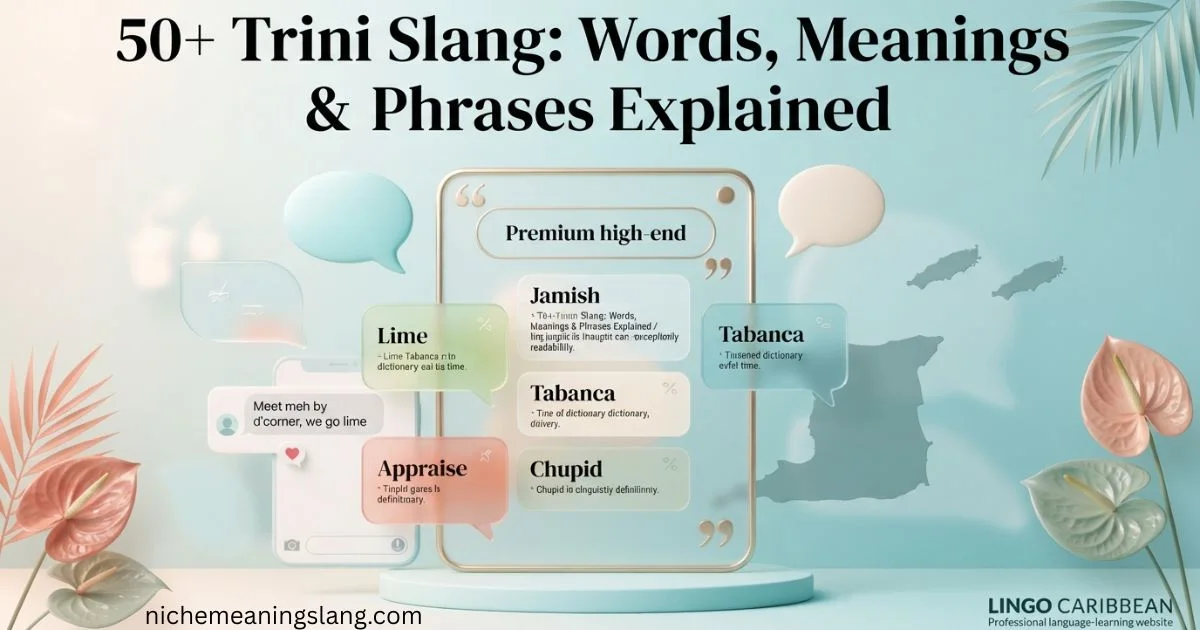
50+Trini Slang Words, Meanings & Phrases Explained
Trini slang refers to the informal words, expressions, spellings, and speech patterns commonly associated with Trinidad and Tobago. Popular examples include lime for hanging out, bacchanal for drama or chaotic fun, maco for a nosy person, dotish for foolish or silly, and allyuh for “you all.” These expressions are part of a broader Trinidadian English Creole tradition rather than simply a collection of slang terms.
For someone unfamiliar with Trinidadian speech, words such as yuh, doh, cyah, ah, allyuh, ent, and leh we can initially look confusing in writing. Their meaning becomes much clearer when you consider pronunciation, tone, context, and the rhythm of everyday conversation. Trini speech also reflects the country’s diverse linguistic history and cultural traditions.
Essential Phrases for the Trini Slang Newcomer
If you’re learning Trini slang, a few everyday phrases are especially useful. “Wha go on?” means “What’s going on?” or “How are things?” “Leh we go” means “Let’s go,” while “Doh study it” can mean “Don’t worry about it” or “Don’t dwell on it.” These expressions can make everyday conversations easier to understand.
Another important expression is “we liming,” which means spending time together or hanging out casually. A newcomer may also hear “allyuh ready?”, meaning “Are you all ready?” Learning these basic phrases first is more useful than trying to imitate an accent, because Trini speech depends heavily on context and natural rhythm.
Common Trini Slang Words
| Trini slang | Meaning |
| Lime / Liming | Hanging out or relaxing socially |
| Bacchanal | Drama, confusion, scandal, or wild fun |
| Maco | A nosy person |
| Commess | Drama, confusion, or gossip |
| Dotish | Foolish, silly, or stupid |
| Tabanca | Heartbreak or deep longing |
| Hoss | Close friend |
| Gyul | Girl |
| Fete | Party or celebration |
| Mas | Carnival masquerade or Carnival activity |
| Padna | Friend or partner |
| Dingolay | To dance or move joyfully |
| Ole talk | Casual chatter or gossip |
| Horn | To cheat on a romantic partner |
| Broughtupsy | Good manners or proper upbringing |
Some of these terms have long histories and multiple meanings, so the exact interpretation can depend on the speaker and situation. The TriniInXisle dictionary, for example, documents hundreds of Trinidadian words and phrases with historical references and examples.
Common Trini Slang Expressions
Trini slang becomes especially expressive when individual words are combined with local grammar and pronunciation. “Wha go on?” is a casual greeting, while “Doh study it” reassures someone not to worry. “Ent?” can function like “right?” or “isn’t that so?” depending on the conversation.
Tone can completely change an expression. The phrase “eh heh”, for example, may communicate agreement, surprise, acknowledgment, or skepticism depending on how it is spoken. Repetition can also add emphasis, as in “heavy heavy,” making an ordinary description sound more expressive.
Trini Slang for Everyday Conversation
Here are several phrases a visitor may encounter:
- Wha go on? What’s going on?
- Allyuh ready? Are you all ready?
- Leh we go.Let’s go.
- Doh study it. Don’t worry about it.
- Ent?Right? / Isn’t that so?
- Ah cyah make it.I can’t make it.
- We liming. We’re hanging out.
- What bacchanal is this? What drama or confusion is happening?
- Yuh understand? Do you understand?
- Doh make joke. Don’t fool around / don’t take it lightly.
The spelling of these expressions is often phonetic, meaning different writers may spell the same spoken expression differently. There is no single fixed spelling system for representing everyday Trini speech online.
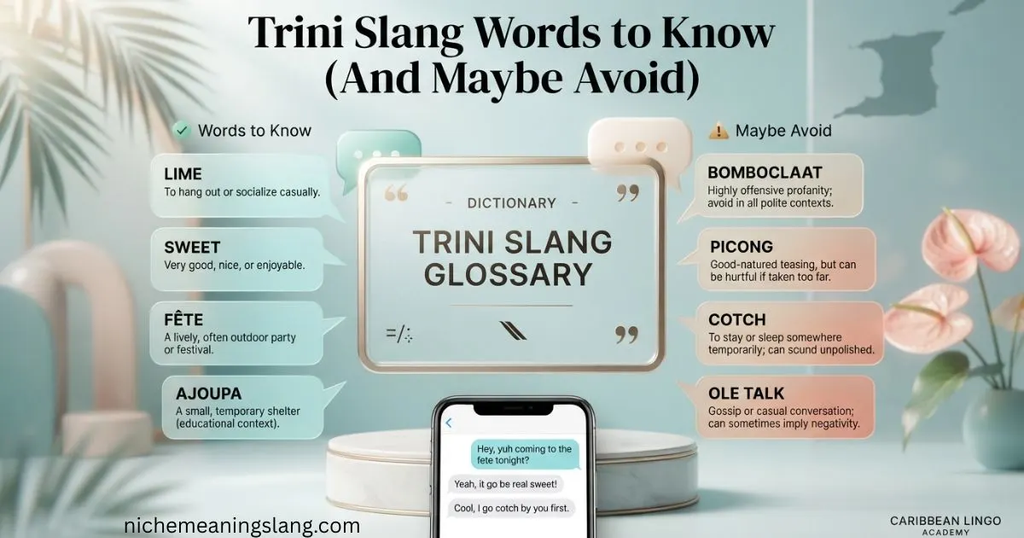
Trini Slang Words to Know (And Maybe Avoid)
Some Trini slang words are perfectly normal among locals but require cultural awareness from visitors. Bacchanal, for example, can refer to drama, scandal, confusion, or an energetic party atmosphere. During Carnival, the word can describe the excitement and chaos associated with celebration.
Visitors should also understand that certain expressions have meanings that are not obvious from standard English. Words associated with dancing, locations, relationships, or local customs may carry cultural implications. Listening to how locals use a term is often safer than assuming a direct dictionary translation gives the complete meaning.
Trini Slang and Carnival Culture
Carnival is one of the most important cultural contexts for understanding Trini slang. Expressions such as “play mas” relate to participating in Carnival masquerade, while “fete” refers to a party or celebration. Soca, steelpan, dancing, costumes, and social gatherings all contribute to the vocabulary surrounding Carnival culture.
The expression “Yuh cyah play mas if yuh fraid powder” essentially communicates that you cannot fully participate in something if you’re afraid of the mess that comes with it. It can also be understood more broadly as encouragement to commit fully to an experience.
Formal Ways to Speak Trini Slang
In formal or business settings, people in Trinidad and Tobago generally use Standard English. The distinctive local vocabulary and pronunciation become more noticeable in informal social situations, where Trinidadian English Creole and local expressions naturally enter conversation.
This means visitors should not assume that every Trini speaker uses slang all the time. The same person can move between formal English and strongly Creole-influenced speech depending on the audience, setting, age, profession, and social situation.
Informal Ways to Speak Trini Slang
Informal Trini slang often uses shortened forms such as ah for “I,” yuh for “you” or “your,” doh for “don’t,” and cyah for “can’t.” These spellings attempt to represent how everyday speech sounds rather than following conventional written English spelling.
You may also see allyuh, a plural form corresponding roughly to “you all.” Expressions such as “allyuh ready?” demonstrate how local grammar and vocabulary work together. These forms are best understood as representations of speech rather than strict spelling rules.
Trini Slang Pronouns and Short Forms
| Trini form | Approximate English |
| Ah | I |
| Yuh | You / your |
| Allyuh | You all |
| Doh | Don’t |
| Cyah / Cyaa | Can’t |
| Deh | There / is there, depending on context |
| Wey | Where / that, depending on context |
| Leh | Let / let’s |
| Di | The |
These forms are common in written representations of Trinidadian speech, but spelling varies. A person writing dialogue may use a different spelling from another writer while intending essentially the same pronunciation.
Tips for Understanding and Using Trini Slang
The easiest way to understand Trini slang is to focus on meaning before pronunciation. Instead of trying to reproduce a Trinidadian accent immediately, learn common vocabulary such as lime, fete, bacchanal, maco, commess, and dotish. Then listen to how native speakers use those words naturally.
Context matters enormously. Maco usually describes someone who is nosy, while commess can refer to drama or confusion. Tabanca refers to emotional heartbreak or longing. These meanings become easier to remember when connected to real situations instead of memorized as isolated vocabulary.
Why Trini Slang Sounds Different
Trinidadian speech developed through a complex history involving English, African languages, French and French Creole, Spanish, and languages brought by Indian indentured laborers. This diverse background helped shape the vocabulary, pronunciation, rhythm, and expressions heard in Trinidad and Tobago today.
There is also no single frozen Trini accent. Speech can vary according to age, region, education, social group, and situation. Tobago has its own speech patterns as well. For that reason, “Trini slang” is best understood as a broad collection of local language practices rather than one rigid dialect.
Examples of Regional Variations in Trini Slang
Regional and social variation is an important part of Trini slang. Two people may use the same expression differently depending on their background, age, location, or social group. Even the pronunciation and spelling of a familiar phrase can vary when it is written online.
The broader Trinidad and Tobago language landscape also includes influences from different cultural communities. This is one reason the vocabulary can feel unusually diverse to outsiders. Words associated with Carnival, food, music, religion, friendship, and everyday social life all contribute to the local lexicon.
Trini Slang in Social Life
One of the clearest examples is liming, which represents much more than simply “hanging out.” It describes a relaxed form of socializing that is deeply associated with everyday Trinidadian life. Likewise, fete connects language with parties, music, dancing, and celebration.
Bacchanal can move between meanings such as drama, confusion, scandal, and energetic fun. These words demonstrate why direct one-word translations cannot always capture the cultural meaning behind Trini expressions.
50+ Trini Slang Words and Their Meanings
| # | Trini slang | Meaning |
| 1 | Allyuh | You all |
| 2 | Ah | I |
| 3 | Yuh | You / your |
| 4 | Cyah | Can’t |
| 5 | Doh | Don’t |
| 6 | Leh | Let / let’s |
| 7 | Wey | Where / contextual form |
| 8 | Ent | Right? / isn’t it? |
| 9 | Lime | Hang out |
| 10 | Liming | Hanging out |
| 11 | Bacchanal | Drama, confusion, wild fun |
| 12 | Maco | Nosy person |
| 13 | Commess | Drama or gossip |
| 14 | Dotish | Foolish or silly |
| 15 | Tabanca | Heartbreak or longing |
| 16 | Fete | Party |
| 17 | Mas | Carnival masquerade |
| 18 | Soca | Trinidadian music genre |
| 19 | Hoss | Close friend |
| 20 | Gyul | Girl |
| 21 | Padna | Friend / partner |
| 22 | Dingolay | Dance joyfully |
| 23 | Ole talk | Casual chatter |
| 24 | Horn | Cheat on a partner |
| 25 | Broughtupsy | Good manners |
| 26 | Kicksing | Fooling around |
| 27 | Cunumunu | Foolish person |
| 28 | Mamaguy | Tease or deceive |
| 29 | Tonnere | Expression of surprise or annoyance |
| 30 | Tout bagai | Everything / all sorts of things |
| 31 | Tringlish | Trinidadian local vernacular |
| 32 | Wha go on? | What’s happening? |
| 33 | Doh study it | Don’t worry about it |
| 34 | Leh we go | Let’s go |
| 35 | Allyuh ready? | Are you all ready? |
| 36 | Ah cyah make it | I can’t make it |
| 37 | We liming | We’re hanging out |
| 38 | What bacchanal is this? | What drama is this? |
| 39 | Back chat | Rude reply |
| 40 | Badjohn | Bully / tough person |
| 41 | Bobolee | Someone easily taken advantage of |
| 42 | Chips | French fries |
| 43 | Parang | Trinidadian Christmas music |
| 44 | Ram goat can’t pee | Expression of disbelief |
| 45 | Never-see-come-see | Unsophisticated person excited by something new |
| 46 | Obzocky | Awkward or unbalanced |
| 47 | Rum talk | Things said while drunk |
| 48 | Whey de arse | Expression of disgust |
| 49 | Tobago love | Troubled or unaffectionate relationship |
| 50 | Washikong | Sneakers |
| 51 | Macoing | Snooping / being nosy |
| 52 | Play mas | Participate in Carnival masquerade |
The meanings above reflect documented Trinidadian vocabulary and phrases, although some words have multiple meanings and spellings. The TriniInXisle dictionary contains a much larger historical collection, while contemporary guides focus on expressions visitors are likely to hear in everyday speech.
Conclusion
Trini slang gives Trinidadian conversation its distinctive energy, humor, rhythm, and cultural character. From lime and fete to bacchanal, maco, dotish, tabanca, allyuh, and doh study it, these words communicate ideas that often go beyond their simple English translations.
The best way to understand Trini slang is to learn the words in context. Trinidadian speech changes according to the speaker, setting, region, and social situation, so there is no single formula for sounding “Trini.” Listen first, understand the culture behind the expressions, and let the language come naturally.
FAQs
What is Trini slang?
Trini slang is the informal vocabulary and expressions associated with Trinidad and Tobago. It forms part of a broader Trinidadian English Creole tradition influenced by English, African languages, French Creole, Spanish, Indian languages, and other cultural influences.
What does “lime” mean in Trini slang?
Lime means to hang out, relax, or spend casual social time with other people. “We liming” essentially means “We’re hanging out.”
What does “bacchanal” mean in Trini slang?
Bacchanal can mean drama, confusion, scandal, gossip, or an energetic atmosphere of fun. Its meaning depends heavily on context.
What does “maco” mean in Trini slang?
A maco is someone who is nosy or interested in other people’s business. Macoing refers to the act of snooping or being overly curious.
What does “dotish” mean in Trini slang?
Dotish generally means foolish, silly, or stupid. It can be used teasingly or as criticism depending on tone.
What does “allyuh” mean?
Allyuh means “you all” or “all of you.” It is a common form in representations of Trinidadian speech.
What does “doh study it” mean?
“Doh study it” generally means “Don’t worry about it,” “don’t dwell on it,” or “don’t let it bother you.”
What does “tabanca” mean?
Tabanca describes emotional heartbreak or deep longing, particularly after a romantic separation.
What does “fete” mean in Trinidad?
A fete is a party or celebration, commonly associated with music, dancing, and socializing. The word is strongly connected with Trinidad and Tobago’s party and Carnival culture.
What does “Tringlish” mean?
Tringlish is a humorous name for the local Trinidadian vernacular, describing Trinidadian English influenced by local Creole vocabulary and speech patterns.
Is Trini slang the same as Jamaican slang?
No. Trinidadian and Jamaican speech both belong to the wider Caribbean linguistic landscape, but they have different histories, vocabulary, pronunciation, and cultural influences. A word that is common in Jamaica may have a different meaning or may not be used in Trinidad.
Is Trini slang a language?
The term Trini slang is commonly used online, but everyday Trinidadian speech is broader than slang alone. Trinidad and Tobago has varieties of English and English Creole with distinctive vocabulary, grammar, pronunciation, and rhythm.
How can I learn Trini slang naturally?
Start with common expressions such as wha go on, lime, doh study it, allyuh, bacchanal, maco, and dotish. Then listen to native speakers rather than trying to imitate an accent immediately. Context and tone are essential to understanding the expressions naturally.
Related Slang Words

Ryan Mitchell is a language enthusiast and writer who explores slang, modern expressions, and everyday language. At nichemeaningslang, he helps readers understand slang meanings, usage, and context in a simple and easy-to-follow way.