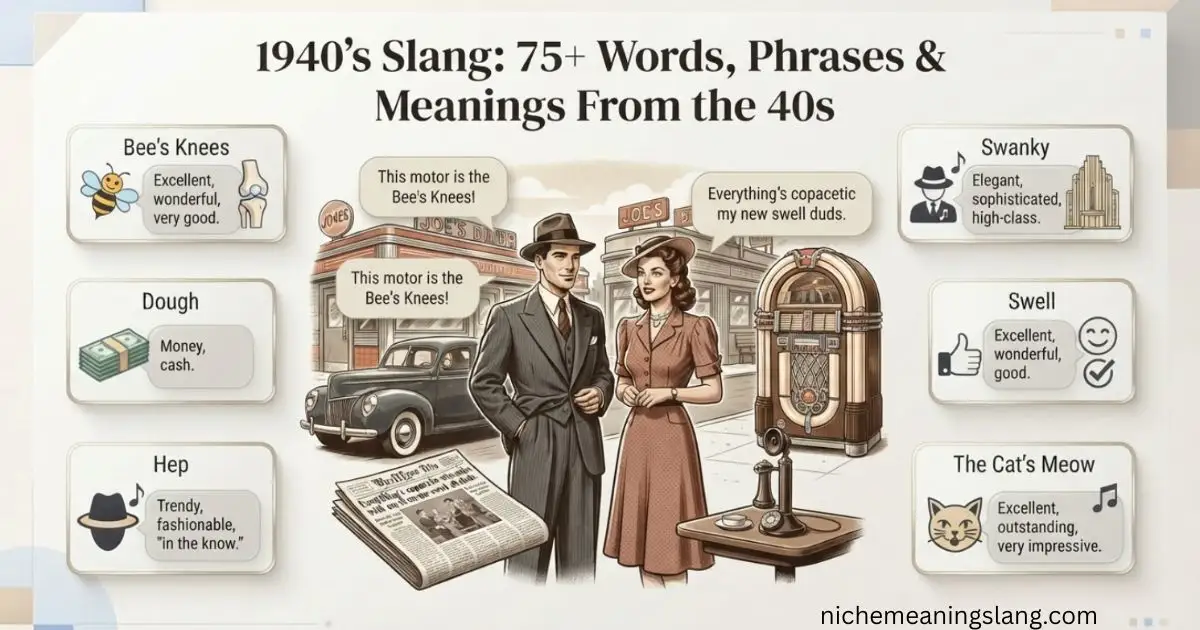
75+1940’s Slang Words, Phrases & Meanings From the 40s
1940’s slang was colorful, playful, blunt, and deeply shaped by World War II, jazz, swing, Hollywood, radio, and changing American life. Expressions such as eager beaver, gobbledygook, cooking with gas, take a powder, moxie, bupkis, and what’s buzzin’, cousin? reveal how Americans communicated in the 1940s.
Researching vintage American language shows why these expressions still feel strangely familiar. Some survived almost unchanged; others shifted meaning, while many disappeared entirely. The useful distinction is historical: a word did not necessarily originate in the 1940s simply because people used it then. This guide separates 1940s usage, popularization, documented origins, wartime vocabulary, jazz culture, and everyday American speech so you can understand the decade without relying on Hollywood stereotypes.
1940’s slang: Examples of 1940s Slang for People
People-focused 1940s slang could be affectionate, complimentary, descriptive, or insulting. Americans used terms such as ace, dreamboat, eager beaver, hipster, rookie, dame, doll, and good egg to describe ability, personality, appearance, relationships, or social identity. Many appeared in everyday dialogue rather than formal writing.
The vocabulary also reflects the era’s social world. Hipster originally connected with jazz culture, while eager beaver became associated with an overly enthusiastic worker or serviceman. Some labels carried gendered or offensive meanings that are outdated today, so understanding historical usage does not mean reproducing it casually in modern conversation.
1. Ace – Meaning Excellent Or Top Notch:
Ace meant excellent, highly capable, or top-notch. The word could describe a skilled person, successful performance, or something impressive. Its semantic relationship with expert, excellence, ability, achievement, and American slang explains why it survived well beyond the 1940s and remains recognizable today.
5. Cat’s Meow – Something That Is Amazing, Great, Or Wonderful:
The cat’s meow described something fabulous, excellent, or unusually appealing. Higher Language connects the expression with earlier popular usage, showing that not every phrase associated with the 1940s originated during World War II. It belongs to the broader vocabulary of compliments, enthusiasm, approval, and vintage American expressions.
9. Good Egg – A Nice Person:
A good egg referred to a genuinely nice or trustworthy person. The expression fits a broader family of character slang, compliments, friendly descriptions, social vocabulary, and everyday American speech. It remains one of the vintage expressions that modern readers can understand immediately even when its period flavor feels unmistakably old-fashioned.
1940’s slang for Good Feelings, Actions or Brags
Some of the most memorable 1940’s slang described success, excitement, courage, dancing, progress, or confidence. Cooking with gas, moxie, killer diller, on the beam, sweet, cut a rug, jitterbug, and hot diggity dog gave speakers colorful alternatives to ordinary words such as great, brave, correct, funny, or dance.
The emotional range is important. This was not simply “old-timey language.” These expressions helped speakers show enthusiasm and personality. A teenager, soldier, jazz fan, or radio listener could use slang to signal familiarity with contemporary music, entertainment, youth culture, dancing, popular speech, and American social life.
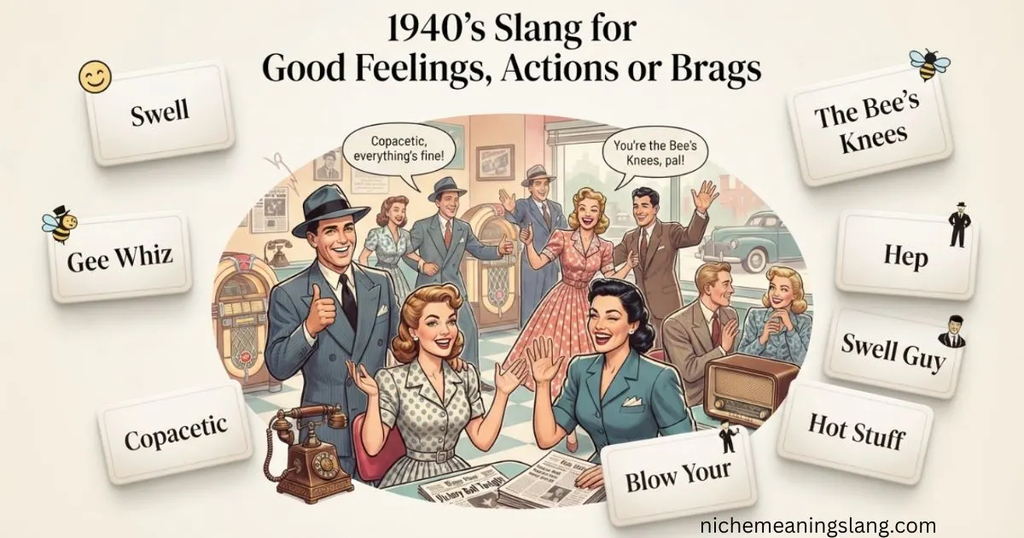
2. Cooking With Gas
Cooking with gas meant doing something successfully or making good progress. Mental Floss traces its popularization through radio and discusses competing explanations for its origin, including vaudeville and advertising. That uncertainty is worth preserving because slang history, etymology, popular culture, advertising, and oral usage rarely follow one perfectly documented path.
5. Eager Beaver
An eager beaver was an extremely enthusiastic or hardworking person. Mental Floss connects its World War II popularity with soldiers eager to please superiors by taking on unpleasant tasks. The expression therefore links wartime slang, military culture, enthusiasm, work ethic, and American English.
17. Whammy
A whammy originally referred to a supernatural force associated with bad luck in 1940s usage. Mental Floss notes that the word was likely built from wham, meaning a solid blow. Later expressions such as “double whammy” developed beyond this earlier sense, illustrating how slang meanings evolve.
1940’s slang: Insults, Put Downs or Negative Reactions
Not all 1940’s slang was cheerful. Americans had colorful ways to describe foolishness, failure, anger, arguments, bad quality, or unwanted behavior. Bupkis, cheesy, crummy, knucklehead, flip your wig, gobbledygook, pass the buck, snap your cap, and pain in the neck appear in historical lists of negative expressions.
These terms also reveal something about conversational style. Many are metaphorical rather than literal, turning physical objects or exaggerated images into social criticism. A phrase such as flip your wig sounds playful today, but its basic meaning losing one’s temper was a recognizable informal expression in the period.
8. Gobbledygook
Gobbledygook means confusing, pompous, or unnecessarily complicated language. Unlike many anonymous slang terms, its origin is unusually well documented: Mental Floss notes that Maury Maverick used it in a 1944 memo while working with the Smaller War Plants Corporation. The term quickly entered broader American vocabulary.
4. Duh
Duh is a surprising example because many people associate it with much later youth culture. Mental Floss cites the Oxford English Dictionary for a 1943 origin in the Merrie Melodies cartoon series. Its earlier use conveyed stupidity or feigned ignorance, demonstrating that modern-sounding slang can have much older roots.
16. Sack Out
Sack out meant going to sleep. It belongs to a family of expressions involving beds, sacks, hay, and nighttime routines. The phrase illustrates how sleep slang, everyday actions, informal vocabulary, American idioms, and physical imagery combined to create memorable expressions during the period.
12. Horse-Feathers – An Expression Of Disbelief:
Horse-feathers was an expression of disbelief or rejection. Its playful construction reflects a common feature of vintage slang: speakers often substituted humorous nonsense for harsher language. In historical context, euphemism, disbelief, exclamations, humor, and conversational style helped such expressions work without requiring literal interpretation.
1940’s slang Terms for Everyday Necessities or Actions
Everyday 1940’s slang covered surprisingly ordinary subjects: money, coffee, eggs, telephones, clothing, sleep, dancing, and leaving. Terms such as ameche, clams, greenbacks, hen fruit, joe, lettuce, peepers, shuteye, specs, stompers, and take a powder transformed routine activities into memorable conversational shorthand.
This category is especially useful for writers recreating 1940s America because these words create atmosphere without forcing every character to sound like a movie gangster. A few carefully chosen expressions can suggest period dialogue, civilian life, wartime America, family conversation, workplace speech, and historical setting.
7. Dressed To The Nines – Looking Your Best, Dressed In The Fanciest Clothes:
Dressed to the nines describes someone dressed extremely well or in their finest clothing. Although the expression predates the 1940s, it appears in period-oriented slang collections because it was part of the recognizable vocabulary of the era. That distinction between origin and period usage matters in historical language research.
11. Soda Jerk – A Person Who Works At A Soda Fountain:
A soda jerk was a worker behind a soda fountain. The term belongs to the social world of American drugstores and lunch counters, where fountain drinks were part of everyday life. It connects food culture, soda fountains, service jobs, youth culture, and vintage American vocabulary.
10. Submarine – To Duck Out Of Sight Quickly:
In the Higher Language collection, submarine is used as a verb meaning to duck out of sight quickly. The metaphor draws on the behavior of a submarine disappearing beneath the surface. It demonstrates how military technology, wartime imagery, movement, concealment, and slang could overlap in American speech.
18. What’s Buzzin’, Cousin?
“What’s buzzin’, cousin?” functioned as a casual way to ask how someone was doing. Mental Floss notes that the expression gained popularity following the 1943 American musical film of the same name. It combines greeting slang, rhyme, entertainment, popular culture, and informal social language.
1940’s slang Related to Alcohol or Drugs
The 1940s also had specialized vocabulary for drinking and drugs. YourDictionary records bender, buzz, fix, sauced, sauce, souse, and swigger, showing how alcohol-related slang formed its own semantic group. These words belong to historical language and should not automatically be treated as uniquely invented during the decade.
Mental Floss similarly documents hitting the sauce, sauce-hound, and sauced up, connecting this vocabulary with drinking culture after Prohibition. Historical slang around alcohol often moved between newspapers, popular entertainment, ordinary conversation, and literary dialogue.
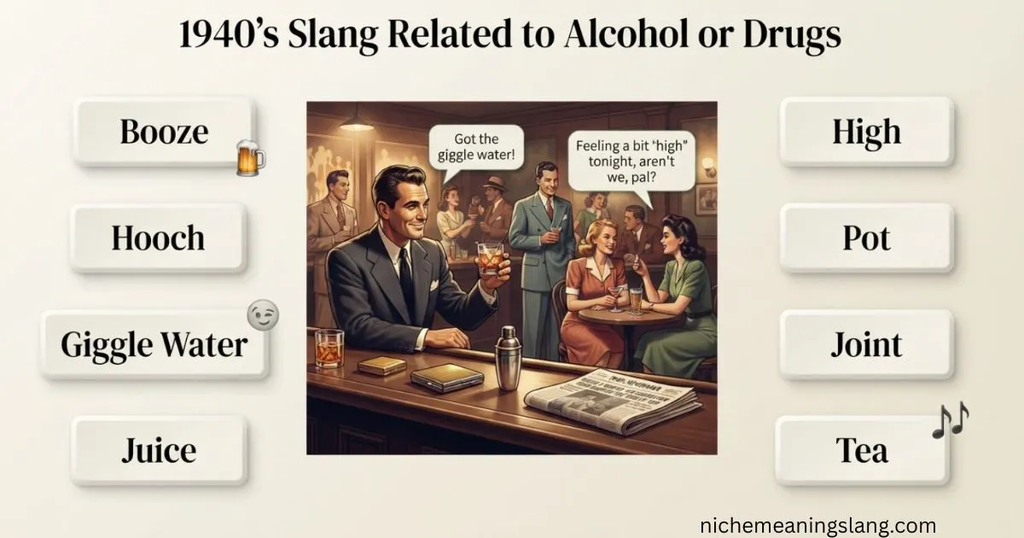
9., 10., and 11. Hitting the Sauce, Sauce-Hound, and Sauced Up
Hitting the sauce meant drinking alcohol, while sauce-hound described a heavy drinker and sauced up described someone who was intoxicated. Mental Floss notes that “sauced” was already being used by 1939, reinforcing the difference between existing expressions and 1940s popularity.
Historical Background of 1940’s slang
The history of 1940’s slang is inseparable from the decade’s upheaval. The United States moved from the lingering effects of the Great Depression into World War II and then toward postwar economic expansion. Military service, jazz, swing, radio, film noir, Hollywood, and changing technology all influenced everyday language.
Language also traveled through communities. Mental Floss notes that hipster in early-1940s usage referred to jazz musicians and fans and connects the term to earlier Black cultural language around hep or hip. Honcho, meanwhile, entered American usage through Japanese hanchō and postwar military experience.
12. Hipster
In the early 1940s, hipster referred especially to jazz musicians and fans rather than today’s familiar image of a trend-conscious urban countercultural consumer. Mental Floss connects it with hep, jazz, Harlem, Black American culture, musicians, and the language of people deeply engaged with contemporary music.
13. Honcho
Honcho became an American informal word for a boss or leader. Mental Floss explains that it was adapted from Japanese hanchō, meaning a leader of a squad, section, or group, and entered American usage through servicemen connected with Japan after World War II.
14. Khaki-Wacky
Khaki-wacky referred to a woman enamored with men in military uniforms. Green’s Dictionary of Slang is cited by Mental Floss for a 1943 occurrence. The rhyming construction captures the playful word formation found throughout period slang, while the meaning reflects the visibility of military uniforms during wartime.
15. Party Pooper
A party pooper was someone who spoiled other people’s enjoyment. Mental Floss dates a known use to 1947 and explains that the term replaced older descriptions such as “wallflower” or “wet blanket” in some contexts. It remains one of the clearest examples of 1940s slang surviving into modern American English.
1940’s slang: Slang By the Decade
Comparing 1940’s slang with later decades reveals how quickly American informal language changes. Some terms survived duh, hipster, gobbledygook, eager beaver, party pooper, and moxie remain recognizable while others became historical curiosities. YourDictionary notes that some words coined or popularized during the 1940s are still used, sometimes with changed meanings.
That survival pattern is the most interesting part of vintage slang. Language does not simply disappear at the end of a decade. Words move through music, movies, military culture, newspapers, families, youth groups, and popular entertainment. Some become standard English; others remain period markers that immediately evoke a particular generation or historical moment.
6. and 7. Gen and Genned Up
Gen meant useful or relevant information, while someone who had been genned up had acquired the information they needed. Mental Floss compares this with modern shorthand such as FYI, showing that the desire to compress information into quick expressions existed long before texting and social media.
3. Cornball
Cornball is a useful example of linguistic evolution. Mental Floss notes that the word originally had a literal food-related meaning before becoming slang for an unsophisticated person in 1949 and then developing a more specific connection with old-fashioned humor. Its history shows how meaning shifts happen gradually.
6. Bogart – To Hog Or Take Something That Isn’t Yours:
Bogart developed as a verb meaning to hog or selfishly hold onto something. Higher Language connects the usage with actor Humphrey Bogart and the stereotypical image of him holding a cigarette for a long time. This is a classic example of a proper name becoming a slang verb.
3. Butter And Egg Man – A Wealthy Person:
A Butter and Egg Man referred to a wealthy person. The expression predates the 1940s, which is another reminder that a historical slang list can contain expressions that were used during the decade without originating in it. Period language research benefits from distinguishing popularity from first attestation.
8. Eagle Eye – Someone Who Pays Close Attention To Detail:
An eagle eye described someone highly observant or attentive to detail. Like several expressions in historical slang lists, its imagery is immediately understandable because it transfers an animal characteristic into human behavior. It belongs to the semantic field of observation, accuracy, attention, and ability.
7. Dressed To The Nines – Looking Your Best, Dressed In The Fanciest Clothes:
The phrase dressed to the nines describes someone wearing especially fine clothing. It is better understood as an established idiom that remained recognizable during the 1940s rather than a phrase necessarily invented in that decade. That distinction improves historical accuracy while preserving its value for period vocabulary.
2. Palooka – Someone Who Is Not Very Good At Something:
Palooka referred to someone ineffectual, clumsy, or not very good at something. Higher Language notes its earlier connection with boxing and describes how the word broadened beyond the ring. This is another example of sports language becoming general American slang.
4. Buzz Wagon – An Ambulance:
Buzz wagon was a humorous slang term for an ambulance. The expression fits the 1940s tendency toward vivid, playful compounds and nicknames for familiar objects. It also belongs to a wider category of vehicle slang, emergency vocabulary, working-class speech, and American colloquial language.
8. Eagle Eye – Someone Who Pays Close Attention To Detail:
Eagle eye described someone who noticed details carefully. Its metaphor is straightforward: an eagle’s exceptional eyesight becomes a shorthand for human observation. The phrase demonstrates how animal imagery, descriptive slang, compliments, workplace language, and ordinary American expressions can overlap in historical vocabulary.
10. Submarine – To Duck Out Of Sight Quickly:
Used as a verb in the cited collection, submarine meant to disappear or duck out of sight quickly. Its metaphor is strongly connected to wartime technology, making it especially useful when studying how World War II changed American vocabulary and gave ordinary speech new military associations.
11. Soda Jerk – A Person Who Works At A Soda Fountain:
A soda jerk was a soda-fountain worker, and the term evokes a very specific American setting: the drugstore counter. It connects food, beverages, youth culture, service work, social gathering places, and period American life, making it useful for historically authentic dialogue.
Conclusion
1940’s slang was far more than a collection of amusing old expressions. It was a linguistic snapshot of wartime America, jazz culture, radio entertainment, changing social habits, military life, and ordinary conversation. Terms such as gobbledygook, eager beaver, cooking with gas, hipster, moxie, and party pooper demonstrate how expressive American English already was.
The most important historical lesson is to avoid treating every “1940s slang” list as a list of words invented between 1940 and 1949. Some expressions were older but popular then; others, such as gobbledygook, have unusually well-documented 1940s origins. That distinction makes a vintage slang guide both more accurate and more useful.
FAQs
What was popular slang in the 1940s?
Popular 1940s expressions included eager beaver, gobbledygook, cooking with gas, take a powder, moxie, hipster, party pooper, sack out, and what’s buzzin’, cousin? Some were newly popularized while others had older origins.
What did people say instead of “cool” in the 1940s?
Depending on context, expressions such as ace, swell, killer diller, on the beam, and the cat’s meow could communicate approval or excellence. Not all were exclusive to the 1940s.
What did “gobbledygook” mean in the 1940s?
It meant confusing, pompous, vague, or overly complicated speech or writing. The term is especially well documented because Maury Maverick used it in a 1944 government-related memo.
What did “eager beaver” mean in the 1940s?
It described an enthusiastic, hardworking person, particularly someone eager to please or take on tasks. Mental Floss connects its World War II popularity with military life.
What did “take a powder” mean?
“Take a powder” meant to leave or depart. YourDictionary includes it among 1940s slang for everyday actions.
What did “dame” mean in 1940s slang?
“Dame” was an informal term for a woman. Historical sources classify it among period slang for people, although its tone and appropriateness differ from contemporary usage.
What did “what’s buzzin’, cousin?” mean?
It was a playful way of asking how someone was doing, roughly comparable to “What’s up?” Mental Floss connects its popularity with a 1943 American musical film.
Did all 1940s slang originate in the 1940s?
No. Some expressions were older but remained popular during the decade. For example, dressed to the nines predates the 1940s, while gobbledygook has a documented 1944 origin.
Is 1940s slang still used today?
Some terms survived into modern American English, including duh, hipster, gobbledygook, eager beaver, party pooper, and moxie, although meanings and connotations can change over time.
What influenced American slang in the 1940s?
Major influences included World War II, military service, jazz, swing, radio, Hollywood, film noir, popular music, and changing American social life.
Related Slang Words

Ryan Mitchell is a language enthusiast and writer who explores slang, modern expressions, and everyday language. At nichemeaningslang, he helps readers understand slang meanings, usage, and context in a simple and easy-to-follow way.