50+Swedish Slang Words & Phrases You’ll Hear in 2026
Swedish slang is the informal language Swedes use in everyday conversation, texting, social media, and relaxed social settings. If textbook Swedish feels easy until someone says tjena, fett bra, or orka, you are not alone. These expressions, along with casual vocabulary, fika culture, youth language, and regional phrases, can completely change how natural Swedish sounds. Having worked with language-focused content, I’ve found that the hardest part is rarely translation it is understanding when a phrase feels natural, who uses it, and what tone it carries.
The good news is that Swedish slang becomes much easier once you learn it through context. This guide covers Swedish expressions, casual greetings, social vocabulary, food and fika terms, compliments, intensifiers, pronunciation, regional differences, and common situations where informal language can backfire. You’ll also see English meanings and practical examples so you can recognize these words when chatting with Swedish speakers rather than memorizing an isolated word list.

What Are the Must-Know Swedish Slang Words?
Swedish slang is informal, constantly changing language used in casual conversations, texting, social media, and youth culture. Common examples include tjena for “hey,” polare for “buddy,” taggad for “excited,” softa for “relax,” and fett as an informal intensifier. Context determines how natural each expression sounds.
One useful distinction is between a word that is simply informal and one that is genuinely slang. Swedish vocabulary also includes regional expressions, English influences, shortened forms, and urban language. LycheeTalk, for example, lists expressions such as tagga, lallare, para, and snubbe, while SwedishPod101 focuses on idiomatic phrases whose meanings cannot always be understood literally.
Swedish Slang: Everyday Hellos and Quick Fillers
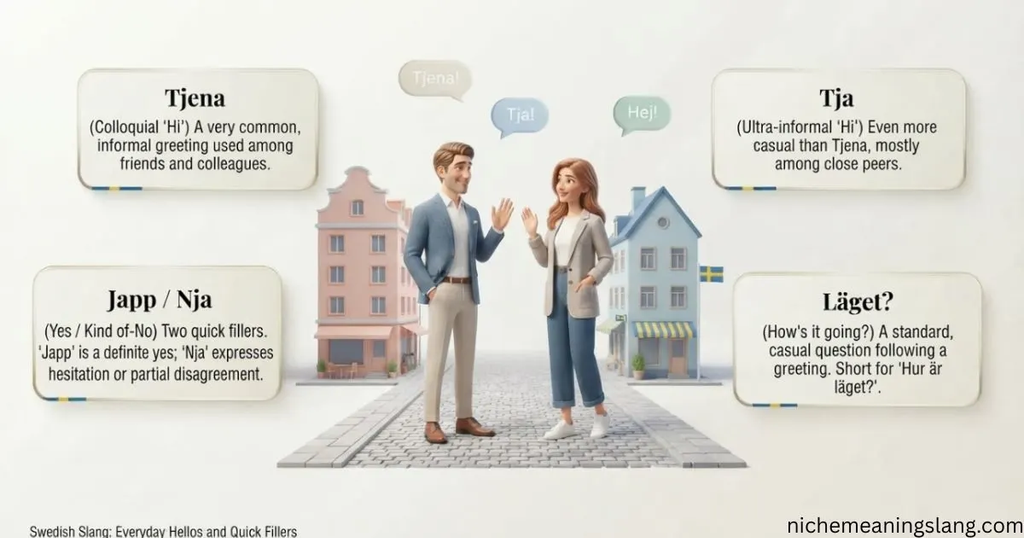
If you are chatting with a Swedish friend, tjena and tja are useful casual greetings. Läget? means roughly “What’s up?” or “How’s it going?” while orka describes having the energy or willingness to do something. Asså, meanwhile, works like “like” or “I mean” in informal speech.
Imagine meeting a friend after work. A formal greeting may sound perfectly correct, but Tjena! Hur är läget? feels much more relaxed. SwedishPod101 similarly teaches expressions such as Sho, vad händer? and Jag bara chillar for casual situations. The lesson emphasizes using these phrases when talking with friends rather than treating them as formal Swedish.
Swedish Slang: Food, Drink, and Fika Culture
Food and socializing have their own corner of Swedish slang. Fika refers to Sweden’s familiar coffee-and-socializing tradition, while käka means “eat.” Preply also lists bira for beer, sockergris for someone with a sweet tooth, and supa for drinking heavily. These words are strongly connected with informal social settings.
Fika is particularly interesting because it is more than a direct vocabulary translation. It describes a social pause involving coffee, food, and conversation, and it can function as both a noun and a verb. That cultural meaning is why translating fika simply as “coffee” loses something important about Swedish everyday life.
Swedish Slang: Social Life and Feelings
Modern Swedish slang appears naturally in friendships, dating, group chats, and casual conversations. Softa means “relax,” mysa means getting cozy, polare means buddy or mate, taggad means excited or hyped, and hänga means to hang out. Jobbigt can describe something annoying, difficult, or troublesome.
Other informal vocabulary can sound even more conversational. LycheeTalk lists snubbe for “guy” or “dude,” syrra for sister, farsa for dad, and para for money. Some expressions have regional or multicultural associations, so learners should avoid assuming that every slang word is equally common throughout Sweden.
Swedish Slang: Intensifiers and Killer Compliments
Swedish speakers can use informal intensifiers to make reactions stronger. Fett can work as a positive intensifier meaning something like “really” or “very,” while galet can convey “crazy” or “insanely.” Other positive expressions include snygg, toppen, skitkul, and kanon.
One especially useful pattern is skit + adjective, which Preply explains as an informal way to intensify an adjective. Thus skitkul can mean “really fun,” while skitbra can mean “really good.” The expression is casual, so register matters; it is better suited to relaxed conversation than formal professional communication.

Swedish Slang in Real Life
Knowing a slang word is only half the job. Pronunciation, region, relationship, and setting can change how an expression is received. Preply specifically notes that Stockholm slang may differ from expressions heard in Gothenburg or Malmö, and it recommends standard Swedish rather than casual slang in professional situations.
Pronunciation also deserves attention because Swedish has distinctive vowels such as å, ä, and ö. Preply provides pronunciation shortcuts for these sounds and explains that vowel and consonant shifts can contribute to the relaxed quality of informal speech. Listening to native speakers is usually more reliable than reading an English approximation alone.
Quick Pronunciation Hacks for å, ä, and ö
For learners, Swedish vowels can make familiar slang look easier on paper than it sounds aloud. Preply describes å with an approximate “aw” comparison, ä with an “eh”-like comparison, and ö as a rounded vowel that has no perfect English equivalent. These are learning aids, not exact replacements.
When Slang Can Backfire
Slang can sound friendly among peers but awkward in a job interview, business meeting, or other formal environment. Regional vocabulary can also confuse someone from another part of Sweden. The safest approach is to recognize the phrase first, listen to how native speakers use it, and then introduce it naturally rather than forcing it into conversation.
Swedish Slang Guide
Here is a practical snapshot of common Swedish slang and informal expressions found across the current competitor set:
| Swedish expression | Approximate English meaning | Typical context |
| Tjena | Hey | Casual greeting |
| Tja | Hi / hey | Casual conversation |
| Läget? | What’s up? | Friends, informal chat |
| Orka | Have the energy | Everyday speech |
| Fika | Coffee/social break | Swedish social culture |
| Käka | Eat | Casual conversation |
| Softa | Relax | Friends, casual speech |
| Mysa | Get cozy | Social/home settings |
| Polare | Buddy/mate | Friends |
| Taggad | Excited/hyped | Events, plans |
| Hänga | Hang out | Friends |
| Jobbigt | Annoying/tough | Everyday reactions |
| Fett | Really/very | Informal intensifier |
| Snygg | Good-looking | Compliments |
| Toppen | Excellent | Positive reaction |
| Kanon | Great/awesome | Casual praise |
| Tagga | Leave/get going | Informal speech |
| Impad | Impressed | Casual reaction |
| Lallare | Fool/clown | Informal/negative |
| Tabbe | Mistake/blunder | Everyday speech |
| Snubbe | Guy/dude | Informal |
| Para | Money | Slang |
| Farsa | Dad | Informal family talk |
| Syrra | Sister | Informal family talk |
These meanings should be treated as context-sensitive rather than as fixed one-to-one translations. For example, tagga can mean leaving or getting going, while other slang expressions can shift meaning according to tone or region.
Conclusion
Swedish slang is much more than a list of funny Swedish words. It reflects friendship, youth culture, regional identity, social habits, pronunciation, texting, and everyday Swedish life. Words such as tjena, polare, taggad, softa, fika, and fett become much easier once you understand the situation in which native speakers use them.
The biggest lesson is context over memorization. A phrase can be perfectly natural among friends and inappropriate in a professional setting, while regional slang may sound unfamiliar outside its home community. Current Swedish-learning resources also show that slang continues to evolve through social media, music, youth culture, and multilingual influence.
FAQs
What Does Fika Mean in Swedish Slang?
Fika refers to Sweden’s coffee-break tradition involving social conversation, usually alongside coffee and something to eat. It can be used as both a noun and verb, making it more culturally specific than simply translating it as “coffee.”
What Are Cute Swedish Words to Impress Friends?
Mysa, kanon, and lagom are examples of Swedish expressions that can communicate coziness, approval, or balance. However, sounding natural matters more than using unusual vocabulary simply to impress someone. Context and pronunciation make the difference.
How Do Swedes Use Skit as an Intensifier?
Skit can appear before an adjective as an informal intensifier meaning something like “really” or “very.” Examples include skitkul for “really fun,” skitbra for “really good,” and skitjobbigt for “really annoying.”
What Does Tjena Mean in Swedish Slang?
Tjena is a casual Swedish greeting meaning roughly “hey” or “hi.” It is associated with informal conversation and is more relaxed than choosing a formal greeting for a professional situation.
What Does Polare Mean in Swedish Slang?
Polare means “buddy,” “mate,” or “friend.” It is informal and is especially useful when describing a friend or someone within a familiar social circle.
Does Swedish Slang Differ by Region?
Yes. Swedish informal vocabulary can vary geographically. Preply specifically notes differences between Stockholm, Gothenburg, and Malmö, while other slang resources also distinguish urban and regional usage. This means a phrase that sounds familiar in one community may be less common somewhere else.
Related Slang Words

Ryan Mitchell is a language enthusiast and writer who explores slang, modern expressions, and everyday language. At nichemeaningslang, he helps readers understand slang meanings, usage, and context in a simple and easy-to-follow way.