
Jobby Scottish Slang Meaning, Uses & Examples Explained
Jobby Scottish slang usually means poop, feces, or a piece of excrement, although documented Scots usage also gives jobbie/jobby other meanings depending on context. If you found the word in a Scottish joke, text, meme, or conversation and felt completely lost, you are not alone. The Dictionary of the Scots Language records jobbie across several Scottish regions and senses.
When researching Scottish vocabulary, I find the tricky part is rarely the dictionary definition; it is understanding tone, context, audience, and regional flavor. Jobby can sound childish, funny, mildly insulting, or simply descriptive. This guide separates those meanings so American readers can recognize the word without accidentally using Scottish slang in the wrong situation.

What Does Jobby Mean in Scottish Slang?
In jobby Scottish slang, the most important meaning is a piece of excrement, poop, poo, or feces. The Dictionary of the Scots Language documents jobbie, also spelled jobie or jobby, with this sense across areas including Edinburgh, Glasgow, Fife, Ayrshire, and other Scottish regions.
The word is informal rather than medical, so its natural setting is casual speech, Scottish humor, family conversation, jokes, or slang-heavy dialogue. Think of it as closer to “poop” or “turd” than the clinical word “feces.” Context matters because jobby can also refer to a small task or be used contemptuously about a person.
Understanding the Word Jobby
For an American reader, the easiest translation is simply “poop” or “a piece of poop.” A sentence such as “There’s a jobby on the pavement” means there is excrement on the sidewalk. The spelling jobbie also occurs in documented Scots sources, so both forms may appear.
Is Jobby a Scottish Word?
Yes, jobby is strongly associated with Scots and Scottish English, although related usage is not necessarily confined to one location. The Dictionary of the Scots Language records regional examples and shows that the word has appeared in Scottish writing and newspapers for decades.
Jobby Scottish Slang: Meaning and Origins
The historical picture is more interesting than a simple “Scottish word for poop” explanation. The Dictionary of the Scots Language derives jobbie under job, documenting multiple senses: a small job or simple task, a lump of excrement, a contemptuous term for a person, and plural jobies meaning nonsense.
That evidence is more reliable than speculative internet etymologies claiming a direct connection to Old Norse jóla. The Scots dictionary supplies dated examples from the twentieth century, including literary and newspaper quotations, showing that jobbie/jobby has been part of recorded Scottish vocabulary rather than a recent internet invention.
Jobby Meaning in Text Messages
The jobby meaning in text messages normally remains the same: poop, a piece of excrement, or something jokingly associated with bodily waste. A Scottish texter might write “The dog did a jobby again” simply to describe what happened without using a formal term such as feces.
Texting adds another layer because slang depends heavily on tone, emojis, friendship, and shared humor. A phrase such as “wee jobby” may sound silly or playful between friends, while calling someone “a jobby” can become an insult. Without surrounding context, the safest interpretation is literal poop.
How Is Jobby Used in Texting?
In casual messages, jobby can appear in jokes, pet stories, complaints, or playful Scottish banter. For example, “Watch where you’re walking—there’s a jobby there” is simply a humorous warning. The meaning comes from the surrounding sentence rather than from texting itself.
Can Jobby Be Used as a Joke?
Yes. Scottish humor, playful language, and toilet humor can make jobby funny precisely because it sounds informal. Online examples often use the word for comic effect, although crowdsourced slang sites may contain exaggerated or unreliable definitions. Context should therefore outweigh isolated internet examples.
Jobby Scottish Slang: How People Use It
People use jobby Scottish slang most naturally in relaxed situations involving friends, family, children, pets, comedy, or casual conversation. It can describe actual excrement, as in “The dog left a jobby,” or appear in humorous banter where the literal meaning is obvious from context.
The documented Scots record also shows broader meanings. Jobbie can mean a small job or simple task, while another recorded sense is a contemptuous term for a person. That means readers should not automatically translate every occurrence as poop without checking the sentence around it.

Jobby in Different Situations
With a dog or pet, jobby can simply refer to poop: “The wee dog left a jobby outside.” With children, families may use the playful term when discussing toilet habits. In a joke, meanwhile, the word can deliberately sound childish, silly, or exaggerated.
The figurative side requires more caution. Calling an object or situation “a jobby” can communicate that it is rubbish, unpleasant, or worthless, depending on local usage. Because Scottish dialects vary by region and speaker, tone can change the emotional meaning considerably.
Talking About a Dog or Pet
Pet-related usage is easy to understand: “The dog left a jobby in the garden” means the dog pooped there. This is a straightforward example of Scottish slang, casual vocabulary, pet conversation, and toilet humor without necessarily insulting anyone.
Talking About a Child
A family might use jobby when talking about a child’s toilet habits because the word sounds less clinical. However, families differ in what they consider appropriate language. The safest interpretation is informal Scottish speech, not a universal term used by every Scottish parent.
Using Jobby for Humor
Humorous use relies on the word’s childish sound and Scottish identity. Someone might deliberately choose jobby instead of “feces” because the informal vocabulary makes an ordinary situation sound funnier. In professional or serious communication, however, that same humor can become inappropriate.
Jobby vs. Similar Words
| Word | Meaning | Register | Scottish association |
| Jobby | Poop/excrement | Informal | Strong |
| Jobbie | Alternate documented form | Informal | Strong |
| Poo | Feces | Informal | Low |
| Poop | Feces | Informal | Low in the U.S. |
| Feces | Bodily waste | Medical/formal | None |
| Stool | Bodily waste | Medical | None |
For an American audience, poop is usually the closest everyday translation. Poo is also understandable, while feces and stool are more formal or medical. The Scottish distinction comes from regional vocabulary and cultural context rather than from a completely different physical meaning.
Jobby vs. Poo
Both words refer to feces, but jobby carries a much stronger Scottish slang identity. “Poo” is broadly understood throughout English-speaking countries, while jobby immediately creates a regional Scots association for listeners familiar with the word.
Jobby vs. Poop
American English speakers will generally understand poop immediately. Jobby communicates essentially the same basic bodily-waste concept but adds Scottish flavor and a more distinctive informal register. In an American conversation, “poop” will normally be clearer.
Jobby vs. Feces
Feces is a formal or medical term; jobby is colloquial. A doctor, scientific article, or medical document would use “feces” or “stool,” whereas a casual Scottish conversation might use jobby. Register not just definition is the key semantic difference.
Is Jobby Rude or Offensive?
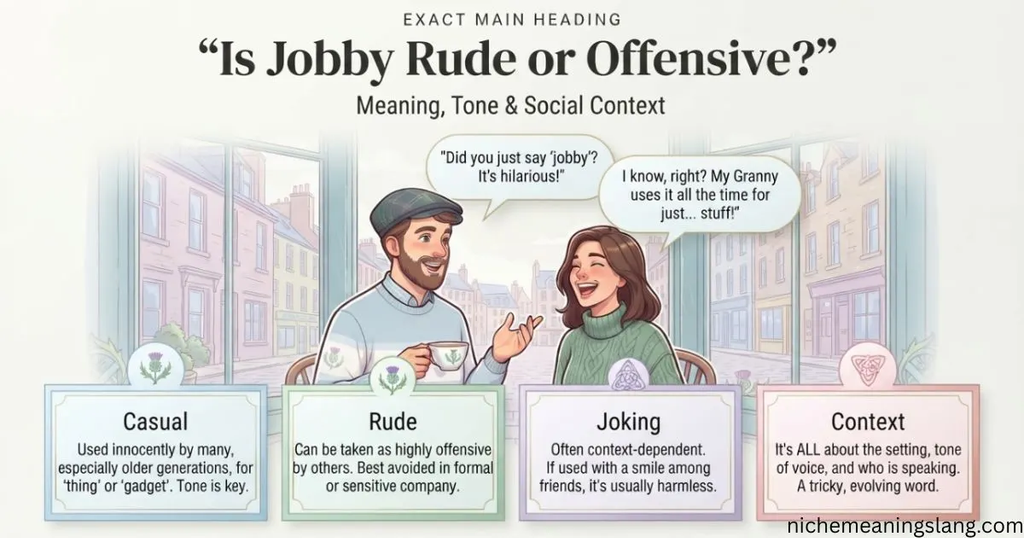
Jobby is informal and can be crude, but it is not automatically a severe swear word. The distinction is important. A word referring to bodily waste may be perfectly ordinary in a joke yet sound inappropriate in a workplace, formal document, classroom presentation, or serious conversation.
The Dictionary of the Scots Language also documents jobby/jobbie as a contemptuous term for a person in some Scottish usage. That means calling someone “a jobby” can move beyond literal toilet vocabulary into insult territory.
Is Jobby a Bad Word?
It is better described as informal Scottish slang than as a universally offensive swear word. Whether it sounds rude depends on the audience, setting, relationship, and intended meaning. Among friends it may be playful; in formal communication, “feces,” “stool,” or “poop” may communicate more appropriately.
Can Children Say Jobby?
Some families may use jobby with children because it sounds playful and less harsh than stronger profanity. That does not mean every Scottish household uses it. Family norms, region, age, and personal preference all influence how acceptable a slang term feels.
Jobby in Social Media and Pop Culture
Social media gives Scottish slang a much larger audience. A word such as jobby can appear in memes, Reddit discussions, comments, comedy clips, and conversations between Scottish speakers and people abroad. American readers may therefore encounter it without ever having visited Scotland.
Online communities also demonstrate why slang definitions need context. Reddit discussions show users explicitly explaining jobby to people unfamiliar with Scottish vocabulary, while dictionary sources provide stronger evidence for its established Scots meanings.
Jobby on Social Media
On social platforms, jobby can work as a meme word, joke, reaction, or literal reference to poop. The humorous spelling and recognizable Scottish flavor make it memorable. However, individual posts can exaggerate meanings, so a dictionary-backed definition is preferable when accuracy matters.
Why Does Jobby Appear in Scottish Content?
Regional vocabulary can signal Scottish identity, humor, place, and cultural familiarity. When a creator uses jobby, the word may do more than describe excrement; it can make the sentence sound distinctly Scottish. That cultural signal helps explain why the term appears in Scottish-focused online content.
How to Use Jobby Correctly
If you are an American learning Scottish slang, the easiest rule is: keep jobby casual and pay attention to context. Use it when you are explaining Scottish vocabulary, joking with people who understand the term, or discussing an example of Scots language—not when you need formal, professional, or medical wording.
Also remember the difference between knowing a slang word and sounding naturally Scottish. Dropping jobby into every sentence will sound forced. Good slang use is usually restrained, context-aware, and connected to the speaker’s actual relationship with the language.
Keep the Context Casual
Use jobby in casual conversation, jokes, Scottish-language examples, and informal messages. Avoid treating it as a polished synonym for “feces.” The word’s strength comes from its informal character, so forcing it into formal prose removes the very context that makes it meaningful.
Consider Your Audience
An American reader may understand jobby from context, but many people will not. If your audience is international, “poop” or “feces” may communicate faster. When teaching Scottish slang, introduce jobby first and immediately give the plain-English equivalent.
Avoid Formal Writing
For a medical report, business email, academic paper, or professional communication, use feces, stool, bowel movement, or another appropriate standard term. Slang is useful for explaining language, but it should not replace precise terminology when precision or professionalism matters.
Conclusion
Jobby Scottish slang is primarily a casual Scottish term for poop, poo, or a piece of excrement, with jobbie appearing as an alternate documented spelling. Its meaning becomes more interesting when you consider tone and context: the word can be literal, humorous, or insulting, while historical Scots sources record additional meanings.
For an American reader, the practical takeaway is simple: understand jobby as Scottish informal vocabulary rather than standard professional English. If you see it in a meme, text, Scottish TV show, or conversation, context will usually reveal the intended meaning. Use it sparingly, understand the audience, and remember that regional slang is most useful when treated as living language rather than a novelty word.
FAQs
Q.1 What Does Jobby Mean in Scottish?
Jobby generally means poop, poo, feces, or a piece of excrement in Scottish slang. The Dictionary of the Scots Language also records related meanings including a small job or task and a contemptuous term for a person.
Q.2 What Is a Wee Jobby?
A wee jobby literally means a small piece of excrement. Wee is a familiar Scottish word meaning small or little, so the phrase combines a Scottish size modifier with jobby.
Q.3 Is Jobby Offensive?
Usually, jobby is mild informal slang, but context matters. It can sound childish or humorous when discussing poop and more insulting when directed at a person. Formal situations are better served by standard vocabulary.
Q.4 Is Jobby Used Outside Scotland?
People outside Scotland can recognize jobby through Scottish media, comedy, books, social media, travel, and conversations with Scottish speakers. Recognition does not mean everyone outside Scotland uses the term naturally.
Q.5 What Is the Difference Between Jobby and Jobbie?
Jobbie is a documented alternate spelling of jobby. The Dictionary of the Scots Language records both forms under its relevant Scots entry, including the excrement sense.
Q.6 Does Jobby Always Mean Poop?
No. The most recognizable slang meaning is poop or excrement, but historical Scots documentation records other senses, including a small job/simple task and a contemptuous term for a person. Context determines which sense is intended.
Related Slang Words

Ryan Mitchell is a language enthusiast and writer who explores slang, modern expressions, and everyday language. At nichemeaningslang, he helps readers understand slang meanings, usage, and context in a simple and easy-to-follow way.