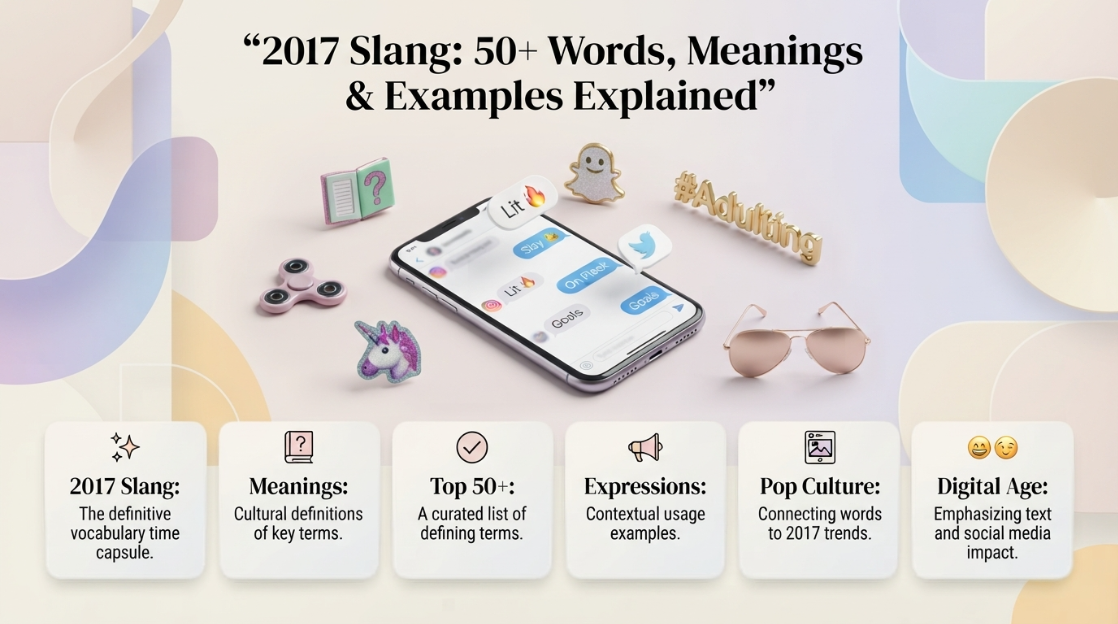
50+2017 Slang Words, Meanings & Examples Explained
2017 slang was a mix of internet humor, social-media shorthand, pop culture, and rapidly changing expressions such as lit, extra, salty, woke, shade, and snatched. If you remember scrolling Twitter, Instagram, or Snapchat and suddenly seeing a word everywhere, you remember how quickly online language moved.
I’ve found that the easiest way to understand this vocabulary is through meaning, tone, context, examples, memes, and digital culture rather than memorizing a dictionary. This guide brings those pieces together so you can recognize 2017 slang, texting expressions, viral phrases, and millennial internet language without feeling completely out of the loop.
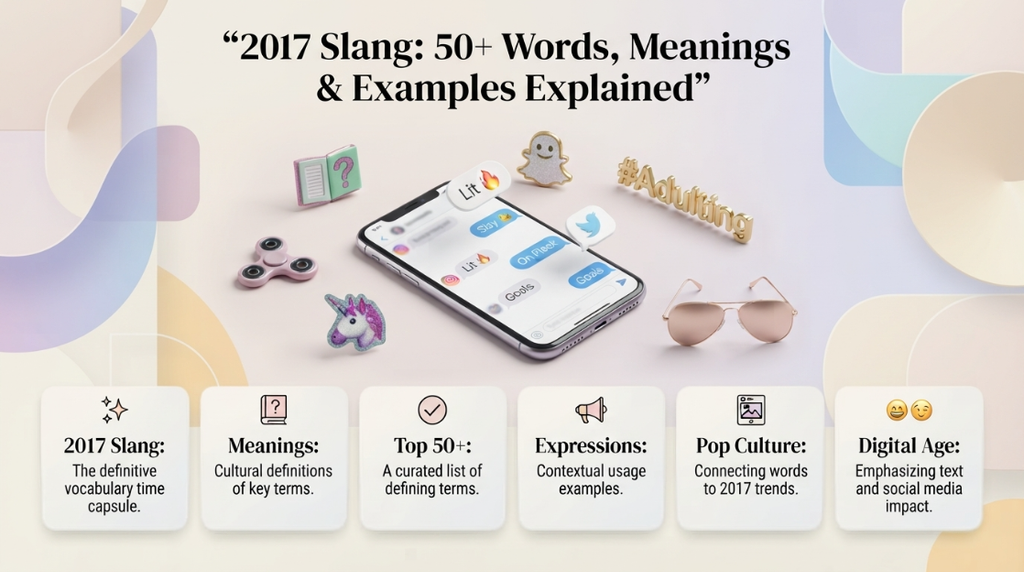
Quick Reference Table: 2017 Slang
| 2017 Slang | Meaning | Typical Tone |
| Lit | Exciting, excellent, or fun | Positive |
| Salty | Annoyed or bitter | Negative/playful |
| Extra | Overly dramatic | Playful |
| Flex | Show off | Casual |
| Fam | Close friend | Friendly |
| Low-key | Quietly or somewhat | Casual |
| High-key | Openly or strongly | Casual |
| Woke | Socially aware | Serious |
| Shade | Subtle insult | Sarcastic |
| GOAT | Greatest of all time | Praise |
| Squad | Close friend group | Friendly |
| Clapback | Sharp response | Bold |
| Receipts | Proof or evidence | Casual |
| Mood | Something relatable | Casual |
| Goals | Something admirable | Positive |
| Basic | Unoriginal or predictable | Critical |
| Ghost | Stop responding/disappear | Casual |
| Bae | Romantic partner | Affectionate |
| Dead | Extremely amused | Humorous |
| Fire | Excellent or impressive | Positive |
| Tea | Gossip or information | Casual |
| Thirsty | Seeking attention | Critical |
| Drag | Criticize harshly | Sarcastic |
| Shook | Shocked or surprised | Emotional |
| Curve | Reject romantic interest | Casual |
| Slay | Do something exceptionally well | Positive |
| Snatched | Attractive or exceptionally styled | Positive |
| Fleek | Perfect or on point | Positive |
| Stan | Extremely devoted fan | Casual |
| Turnt | Highly excited/energetic | Casual |
This quick-reference approach reflects the glossary intent found in the current competitor landscape. SlangLoom, for example, organizes its vocabulary around meaning, tone, usage, and whether expressions are still recognized.
One important historical point: not every expression was invented in 2017. Some had existed earlier but became especially visible or culturally relevant during that year. Grammarly makes this distinction with terms such as photobomb and facepalm, while Google documented the broader explosion of online acronyms and meme-driven language in its 2017 Year in Search.
27 Popular 2017 Slang Terms
The most recognizable 2017 slang vocabulary grew around social media, memes, texting, music, entertainment, and everyday conversation. Words like lit and fire expressed approval, while salty, shade, and extra captured annoyance, sarcasm, or dramatic behavior. The appeal was speed: one short word could communicate an entire attitude.
Some expressions also carried cultural context that matters today. Stan, for example, comes from Eminem’s “Stan” and developed into a verb for being a devoted fan. Similarly, slang such as shade has roots in particular cultural communities before becoming much more mainstream online. Understanding that background makes these expressions more meaningful than simply treating them as trendy vocabulary.
Slang: Lit
Lit described something exciting, impressive, energetic, or highly enjoyable. It could describe a party, concert, night out, or even a particularly entertaining moment online. Example: “That concert was lit.” The expression was common in social-media conversations and remained recognizable well beyond 2017.
Slang: Extra
Extra described behavior that seemed unnecessarily dramatic, excessive, or attention-seeking. Someone arriving at a casual gathering with an elaborate outfit might be called “extra.” The word works because it compresses a longer judgment over-the-top, dramatic, excessive into one short conversational label.
Slang: Low-key
Low-key means quietly, somewhat, subtly, or without making something obvious. “I low-key love that song” communicates a feeling without presenting it dramatically. Its counterpart, high-key, expresses something more openly or strongly. These phrases became especially natural in texting and social-media conversations.
Slang: Woke
Woke was commonly used for someone perceived as socially aware or attentive to social issues. The word’s meaning and cultural associations are broader and more contested than a simple slang definition suggests, so context matters. In 2017, it was firmly embedded in online conversations about awareness and culture.
Slang: Shade
Shade refers to an indirect insult, dismissive comment, or subtle criticism. “Throwing shade” became highly recognizable through pop culture and social media. Grammarly specifically connects its 2017 mainstream visibility with usage surrounding RuPaul’s Drag Race, showing how expressions can move from specific communities into wider internet vocabulary.
Slang: GOAT
GOAT stands for “Greatest Of All Time.” By 2017, it was widely recognizable in sports, entertainment, music, and online fan discussions. Someone might call an athlete, performer, or artist “the GOAT” to express exceptionally high admiration. Google also lists GOAT among acronyms people searched for in 2017.
Slang: Ghost
To ghost someone means to suddenly stop responding or communicating without an explanation. The expression became particularly associated with texting, messaging, and online dating. Grammarly notes that the dating-related usage was already developing before 2017, illustrating how a term can become prominent without actually being invented that year.
Slang: Fire
Fire described something excellent, impressive, exciting, or exceptionally good. A new song could be “fire,” a meal could be “fire,” or someone’s outfit could be “fire.” Like lit, the expression worked as a compact approval signal and became closely associated with internet-era casual speech.
Slang: Shook
Shook meant shocked, surprised, or emotionally stunned. “I’m shook” became a flexible reaction to unexpected news, celebrity moments, plot twists, and viral posts. The expression was part of a broader family of internet reactions that turned emotional responses into short, memorable phrases.
Slang: Slay
Slay meant performing exceptionally well, looking fantastic, or confidently succeeding at something. It could describe an outfit, performance, presentation, or personal achievement. In everyday internet language, “You slayed” became a concise compliment expressing strong approval rather than its older literal meaning.
2017 Slang: The Year of Shade
2017 was especially rich in language surrounding subtweeting, shade, dragging, reading, and indirect criticism. Grammarly described the year as one marked by expressions for passive-aggressive behavior both online and offline. Social media gave people a public stage where a short comment could become a full cultural moment.
The interesting part is that this vocabulary was not simply about being rude. It often communicated humor, social positioning, sarcasm, or playful criticism. The difference between a genuine insult and playful shade depended heavily on tone, relationship, audience, and context, which is why translating slang word-for-word can miss the point.
Throw shade
To throw shade means to make an indirect or subtle insult rather than openly attacking someone. In 2017, the expression was increasingly familiar in mainstream online culture. A comment such as “Interesting choice of outfit” could be interpreted as shade when the surrounding context suggested sarcasm.
Photobomb
A photobomb happens when someone unexpectedly appears in another person’s photograph, usually for comic effect. Grammarly notes that the word predates 2017, with evidence of earlier usage, but highlights how memorable photobomb moments continued to circulate online during the year.
Facepalm
Facepalm describes placing your hand over your face to express embarrassment, disbelief, frustration, or exasperation. The term had been around before 2017, but Grammarly notes that the facepalm emoji helped reinforce its digital presence. It became especially useful because one emoji could replace an entire emotional sentence.
2017 Slang: An Avalanche of Appetizing Appellations
Food-related language also had a surprisingly productive role in 2017 vocabulary. Expressions such as froyo and weak sauce show how ordinary food words can become shortened forms or metaphors. The playful quality of these terms made them particularly suitable for informal internet communication.
This pattern demonstrates an important feature of internet slang: people often create memorable language through metaphor, abbreviation, exaggeration, and wordplay. A phrase does not need to be completely new to feel new; sometimes a familiar word acquires a fresh social meaning and suddenly becomes useful everywhere.
Froyo
Froyo is a shortened form of frozen yogurt. The food itself predates the slangy abbreviation, but the compact form became a familiar casual expression. Grammarly uses it as an example of a food-related term that gained linguistic visibility, showing how everyday vocabulary can evolve through popular culture.
Weak sauce
Weak sauce described something unimpressive, disappointing, or inferior. It works as a humorous metaphor: instead of simply saying “that is disappointing,” someone could dismiss it as “weak sauce.” Grammarly identifies it as a negative counterpart to the older expression awesomesauce.
Word salad
Word salad had a much older specialized history, but its looser everyday meaning became associated with speech or writing that seemed confusing, nonsensical, or incoherent. This is an excellent example of semantic shift: a phrase can move from a technical context into ordinary conversation with a broader meaning.
2017 Slang: Verbing, Continued
One of the most interesting patterns in 2017 slang was verbing—turning a noun or existing word into an action. “Ghost” became “ghosting” and “ghosted,” demonstrating how internet communication continually adapts vocabulary to describe new social behaviors. This flexibility is a major feature of modern informal English.
Digital communication rewards words that are short, adaptable, and easy to turn into different grammatical forms. A person can ghost, get ghosted, or talk about ghosting. That flexibility allows slang to spread quickly because users can immediately fit the word into familiar sentence patterns.
Ghost
Ghost became a particularly useful verb for online relationships: “He ghosted me” means he suddenly stopped communicating. The expression became closely connected with messaging and dating culture, while related terms such as breadcrumbing, cushioning, and benching developed around similar online relationship behaviors.
Generational 2017 Slang Comparison
The slang associated with 2017 sits between older millennial internet language and the faster-moving vocabulary that later became strongly associated with Gen Z. Twitter, Instagram, Snapchat, memes, and viral videos allowed expressions to travel across communities much faster than traditional regional slang.
That does not mean everyone used the same words. Age, online community, location, music preferences, and social circles all influenced vocabulary. A person active on Twitter might encounter different expressions from someone primarily using Snapchat or Instagram. 2017 slang was therefore a network of overlapping vocabularies, not one universal dictionary.
| Group/Context | Common 2017 Language Signals |
| Millennials | Lit, bae, AF, salty, woke |
| Twitter users | Shade, clapback, receipts, subtweet |
| Instagram users | Snatched, fleek, goals, slay |
| Snapchat users | Streaks, lit, squad, mood |
| Meme culture | Shook, dead, fire, extra |
| Fan communities | Stan, GOAT, slay |
Google’s 2017 search data reinforces the importance of this digital environment: users were actively searching for the meanings of acronyms such as WCW, TFW, STG, GOAT, and OFC, while viral memes became major cultural reference points.
How to Use 2017 Slang Naturally Without Sounding Awkward
The easiest way to use 2017 slang naturally is to match the setting, relationship, tone, and audience. Words such as lit, fire, mood, and GOAT can work comfortably in casual conversation, while slang-heavy language can feel inappropriate in formal emails, academic writing, or professional communication.
Context matters more than simply knowing definitions. Saying “That presentation was fire” to a close friend may sound playful; using the same sentence in a formal business report would be unusual. Slang works best when it feels like part of the speaker’s natural vocabulary rather than something deliberately inserted to sound trendy.
Common 2017 Slang Mistakes
A common mistake is treating old internet slang as if every term had one universal meaning. Expressions can shift over time, and some words have different meanings across communities. Woke, shade, stan, salty, and lit, for example, can carry different shades of meaning depending on context and speaker.
Another mistake is assuming that a word became popular in 2017 because it was invented in 2017. That is historically inaccurate. Grammarly specifically notes earlier usage for terms such as photobomb, facepalm, and ghost-related language. A better approach is to say that these expressions were prominent, revived, or culturally relevant in 2017.
Conclusion:
2017 slang captured a fascinating moment when social media, memes, texting, pop culture, and online communities were rapidly reshaping everyday English. Words such as lit, extra, shade, snatched, shook, GOAT, ghost, and slay gave people quick ways to express excitement, criticism, surprise, admiration, and identity.
What makes this vocabulary memorable is not simply the words themselves. It is the culture surrounding them the screenshots, tweets, memes, captions, celebrity moments, and inside jokes that gave ordinary expressions new life. Some 2017 slang has faded, while other terms remain part of today’s casual language. Understanding that evolution makes internet language much easier to decode.
FAQs
What was the most popular 2017 slang?
There was no single universally accepted “most popular” 2017 slang word. Frequently documented expressions included lit, extra, salty, shade, snatched, woke, slay, GOAT, and shook. Different communities used different vocabulary, while the American Dialect Society separately selected “wypipo” as its 2017 slang/informal Word of the Year.
What did “lit” mean in 2017?
In 2017 slang, lit commonly meant exciting, excellent, energetic, or fun. It was particularly common when describing parties, concerts, events, nights out, or entertaining experiences. The exact tone depended on context, but it generally communicated strong positive approval.
What did “extra” mean in 2017?
Extra described someone or something as excessively dramatic, elaborate, or over-the-top. For example, if someone turned a simple birthday dinner into a huge production, a friend might jokingly say, “That is so extra.”
What did “snatched” mean in 2017 slang?
Snatched was used as a compliment for someone who looked exceptionally attractive, stylish, or well put together. The American Dialect Society’s 2017 records define it in the slang/informal category as meaning good-looking or attractive.
What did “shook” or “shooketh” mean?
Shook meant shocked, surprised, or emotionally stunned. Shooketh was a humorous, exaggerated variation. The American Dialect Society described shooketh as a mock-archaic way of expressing shock or excitement and included it among its 2017 slang/informal nominations.
What did GOAT mean in 2017?
GOAT means “Greatest Of All Time.” It was used to praise exceptionally accomplished athletes, musicians, entertainers, creators, and other public figures. Google specifically included GOAT among the acronyms that people searched for during 2017.
Is 2017 slang still used today?
Some expressions remain recognizable and active, while others feel distinctly nostalgic. GOAT, ghost, fire, shade, and slay have continued to appear in modern informal communication, while terms such as bae, fleek, and squad may feel more strongly associated with an earlier internet era.
Why did 2017 slang spread so quickly?
Social media dramatically reduced the time required for new expressions to travel. Twitter posts, Instagram captions, Snapchat conversations, memes, viral videos, celebrities, and online communities could expose millions of people to the same phrase almost simultaneously. Google’s 2017 data illustrates how strongly online language and meme culture shaped searches that year.
Did people really use all these slang words in 2017?
Not everyone used every expression. Slang depends heavily on age, community, platform, region, interests, and social environment. A list of 2017 slang should therefore be understood as a record of expressions that were prominent or recognizable during that period, not a claim that every American used them.
Related Slang Words

Ryan Mitchell is a language enthusiast and writer who explores slang, modern expressions, and everyday language. At nichemeaningslang, he helps readers understand slang meanings, usage, and context in a simple and easy-to-follow way.