Jamaican Slang: 60+ Words, Meanings & Examples
Jamaican slang is full of expressive words and phrases that reflect the island’s language, humor, music, and culture. Expressions such as “wah gwaan,” “irie,” “big up,” and “likkle more” are widely recognized in Jamaican conversations, reggae music, dancehall, and social media. If you have heard these phrases but do not know what they mean, learning their everyday usage can help you understand Jamaican speech more clearly.
Jamaican Patois, also called Patwa or Jamaican Creole, is more than a collection of slang words. It has its own grammar, vocabulary, pronunciation, and cultural history. This guide explores more than 60 Jamaican slang words and expressions, with simple English meanings, example sentences, greetings, and tips for understanding which phrases are appropriate in different situations.
What Is Jamaican Slang?
Jamaican slang refers to informal words and expressions associated with Jamaican communication. Many expressions come from Jamaican Patois, a language that developed through historical contact between English and West African languages, alongside other influences. Jamaican Patois is spoken in everyday life and has a strong presence in music, storytelling, comedy, and popular culture.
Some Jamaican expressions have also spread internationally through reggae, dancehall, migration, and social media. Words such as “wagwan” and “big up” are now recognizable in communities outside Jamaica, although their use and meaning can vary by location.
It is important to distinguish slang from the language itself. Patois is not simply English with different pronunciation. Its words follow their own patterns, and an expression often makes the most sense when understood in context rather than translated word by word.
60+ Jamaican Slang Words and Their Meanings
Here are 60 common or recognizable Jamaican Patois words and expressions. Spellings can vary, particularly when people write spoken language informally.
| Jamaican slang | Meaning | Example |
| 1. Wah gwaan? | What’s going on? / What’s up? | “Wah gwaan, mi fren?” What’s up, my friend? |
| 2. Wagwan | Informal spelling of “wah gwaan” | “Wagwan! Long time no see.” |
| 3. Mi deh yah | I’m here; I’m doing okay | “Mi deh yah, everyting good.” I’m doing okay; everything’s good. |
| 4. Irie | Good, peaceful, or positive | “Everyting irie.” Everything’s good. |
| 5. Big up | Show respect, praise, or congratulate | “Big up yuhself!” Respect to you! |
| 6. Likkle more | See you later | “Mi a go now. Likkle more!” I’m leaving now. See you later! |
| 7. Likkle | Little or small | “Gimme a likkle time.” Give me a little time. |
| 8. Nuff | Plenty or a lot | “Nuff people deh deh.” Lots of people are there. |
| 9. Nyam | Eat or consume food | “Time fi nyam.” It’s time to eat. |
| 10. Bredren | Male friend, brother, or close companion | “A mi bredren dat.” That’s my friend. |
| 11. Sistren | Sister or female friend | “Mi sistren come visit.” My friend came to visit. |
| 12. Gyal | Girl or young woman | “Di gyal dem a dance.” The girls are dancing. |
| 13. Yute | Youth or young person | “Di yute dem a play.” The young people are playing. |
| 14. Pickney | Child or children | “Di pickney dem deh outside.” The children are outside. |
| 15. Yow | Hey; an informal way to get attention | “Yow, come yah!” Hey, come here! |
| 16. Seen | Understood; got it | “Meet me at six, seen?” Meet me at six, understood? |
| 17. Nuh | No, not, or don’t, depending on context | “Mi nuh know.” I don’t know. |
| 18. Mi | I or me | “Mi ready.” I’m ready. |
| 19. Yuh | You or your, depending on context | “Weh yuh deh?” Where are you? |
| 20. Dem | They or them; can also mark a plural noun | “Di pickney dem.” The children. |
| 21. Deh yah | Here or present in common expressions | “Mi deh yah.” I’m here. |
| 22. Fi | For, to, or a marker of purpose, depending on context | “Dis a fi yuh.” This is for you. |
| 23. Soon come | I’ll be back or arrive later | “Mi soon come.” I’ll be back later. |
| 24. Tek time | Take your time; don’t rush | “Tek time, nuh rush.” Take your time; don’t rush. |
| 25. Nuh problem | No problem | “Tank yuh!” “Nuh problem.” Thank you! No problem. |
| 26. Bless up | A positive greeting, wish, or farewell | “Bless up, mi fren.” Take care, my friend. |
| 27. Gwaan | Go on, continue, or proceed | “Gwaan wid di work.” Continue with the work. |
| 28. Gwaan easy | Take it easy or take care | “Gwaan easy, mi fren.” Take care, my friend. |
| 29. Mash up | Break, damage, ruin, or overwhelm | “Di phone mash up.” The phone is broken. |
| 30. Cotch | Relax, sit, or hang out in some usage | “Wi a cotch yah.” We’re relaxing here. |
| 31. Badmind | Jealous or resentful toward someone | “Nuh badmind nobody.” Don’t be jealous of anyone. |
| 32. Facety | Cheeky, rude, or disrespectfully bold | “Nuh get facety.” Don’t be cheeky. |
| 33. Rude bwoy | A tough or rebellious male figure; context matters | “Di rude bwoy deh a dance.” The tough guy is dancing. |
| 34. Gyalis | A man known for attracting or pursuing multiple women | “Him have a gyalis reputation.” He has a reputation as a womanizer. |
| 35. Likkle bit | A little or a small amount | “Wait likkle bit.” Wait a little. |
| 36. Nuh badda | Don’t bother or don’t trouble yourself | “Nuh badda wid dat.” Don’t bother with that. |
| 37. Pree | Look at, observe, or pay attention to | “Pree di new car.” Check out the new car. |
| 38. Link up | Meet or get together | “Wi ago link up later.” We’re going to meet later. |
| 39. Buss a move | Make a move or start dancing | “Di music start and everybody buss a move.” The music started and everyone began dancing. |
| 40. Forward | Come forward or replay a song in music contexts | “Di crowd shout, ‘Forward!’” The crowd called for the song to be played again. |
| 41. Shell it | Perform impressively or bring strong energy | “Di dancer shell it.” The dancer did an amazing job. |
| 42. Vex | Angry or annoyed | “Mi vex bout dat.” I’m angry about that. |
| 43. Hype | Excitement, publicity, or showing off | “Too much hype over one song.” Too much buzz over one song. |
| 44. Boasy | Proud, boastful, or showing off | “Him a act boasy.” He’s showing off. |
| 45. Tun up | Increase the energy or make a celebration lively | “Di party tun up.” The party got lively. |
| 46. Nice up | Make something more enjoyable or lively | “Nice up di place!” Make the place more lively! |
| 47. Chune | Tune or song, especially in music-related usage | “Dat a mi favourite chune.” That’s my favorite song. |
| 48. Dub | A music mix or version associated with Jamaican music traditions | “Di selector play a dub.” The selector played a dub version. |
| 49. Ital | Natural or pure; associated with Rastafari dietary and lifestyle practices | “Him prefer ital food.” He prefers Ital food. |
| 50. Yard | Home, yard, or home territory, depending on context | “Mi a go a yard.” I’m going home. |
| 51. Out a road | Out and about or away from home | “Him out a road.” He’s out and about. |
| 52. Tek weh | Take away or remove | “Tek weh di plate.” Take away the plate. |
| 53. Gimme | Give me; an informal spoken form | “Gimme a likkle water.” Give me a little water. |
| 54. Brawta | Something extra, such as a bonus or additional treat | “Mi get a brawta wid mi purchase.” I got something extra with my purchase. |
| 55. Bomboclaat / Bumboclaat | A strong expletive expressing intense emotion | “Bomboclaat!” A strong exclamation; the force depends on context. |
| 56. Raatid | An emphatic expression of surprise or frustration | “Raatid! Yuh reach already?” Wow! You’ve arrived already? |
| 57. A so it go | That’s how it goes | “Sometimes yuh win, sometimes yuh lose. A so it go.” Sometimes you win, sometimes you lose. |
| 58. A lie | That’s a lie or that’s not true | “A lie yuh a tell!” You’re telling a lie! |
| 59. Gwaan wid yuhself | Go ahead or carry on, depending on context | The tone determines whether it sounds supportive or dismissive. |
| 60. Yah man | Yes, man; an affirmative expression associated with Jamaican speech | “Yah man, mi understand.” Yes, I understand. |
These examples are simplified learning aids, not a claim that every Jamaican speaker uses the same spelling or phrasing. Regional differences, age, tone, and situation can affect how a word is understood.
Jamaican Slang Greetings and Everyday Phrases
Greetings are a useful starting point for anyone learning Jamaican slang. They help you recognize common expressions and understand the flow of everyday conversations.
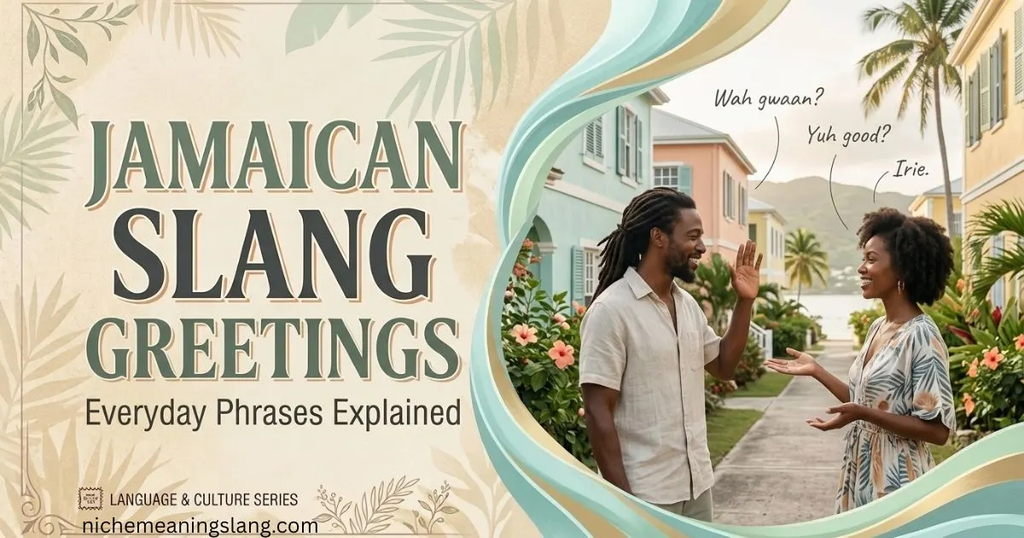
“Wah Gwaan?” What’s Up?
“Wah gwaan?” is one of the best-known Jamaican greetings. It can mean “What’s going on?”, “What’s up?”, or “How are things?” depending on the situation.
Example:
- Person A: “Wah gwaan?”
- Person B: “Mi deh yah.”
The response can communicate that the person is present or doing okay. The phrase is informal and is most natural in casual interactions.
“Big Up” Respect or Praise
“Big up” is used to show appreciation, give recognition, or congratulate someone. It is also familiar in Jamaican music culture.
Example: “Big up everybody who help wid di event.”
Meaning: Respect to everyone who helped with the event.
“Likkle More” See You Later
“Likkle more” is a casual farewell. It is a friendly way to say that you expect to see someone later.
Example: “Mi haffi go now. Likkle more!”
Meaning: I have to leave now. See you later!
“Soon Come” I’ll Be Back Later
“Soon come” can mean that someone will return or arrive later. It does not always mean immediately, so the situation and speaker matter.
Example: “Mi soon come; mi just a run one errand.”
Meaning: I’ll be back later; I’m just running an errand.
“Bless Up” A Positive Greeting or Farewell
“Bless up” is an expression of goodwill, respect, or a positive wish. It can be used when greeting someone or saying goodbye.
Example: “Bless up, mi fren. Tek care.”
Meaning: Take care, my friend.
Jamaican Slang for Friends and Relationships
Jamaican expressions can communicate affection, familiarity, admiration, and sometimes criticism. The relationship between the speakers is important when deciding whether a word sounds friendly or disrespectful.
- Bredren: A male friend, brother, or close companion.
- Sistren: A sister or female friend.
- Gyal: Girl or young woman.
- Yute: A young person.
- Pickney: A child or children.
- Gyalis: A man known for pursuing or attracting multiple women.
- Badmind: A person or attitude associated with jealousy.
- Rude bwoy: A term with different meanings across Jamaican social history and music culture.
For example, “A mi bredren dat” can mean “That’s my friend.” Calling someone “badmind,” on the other hand, can accuse them of jealousy and may create conflict.
Do not assume that every word is suitable for every relationship. Some expressions sound affectionate between close friends but overly familiar or offensive when used with strangers.
Jamaican Slang for Feelings and Reactions
Jamaican expressions can communicate happiness, anger, excitement, surprise, or disappointment. Tone is especially important because the same phrase may be playful in one situation and confrontational in another.
| Expression | Meaning | Example |
| Irie | Good, peaceful, or positive | “Everyting irie.” — Everything is good. |
| Vex | Angry or annoyed | “Mi vex bout di delay.” — I’m annoyed about the delay. |
| Badmind | Jealous or resentful | “Nuh be badmind.” — Don’t be jealous. |
| Boasy | Boastful or showing off | “Him sound boasy.” — He sounds boastful. |
| Hype | Excitement or exaggerated attention | “Di event have nuff hype.” — The event has a lot of buzz. |
| Raatid | An emphatic reaction | “Raatid! Dat big!” — Wow! That’s big! |
| Mash up | Broken, ruined, or overwhelmed | “Rain mash up di plan.” — Rain ruined the plan. |
| Shell it | Perform impressively | “Di singer shell it.” — The singer did an amazing job. |
Learning these expressions in context is more useful than memorizing a single English equivalent for each one.
Popular Jamaican Expressions in Music and Social Media
Jamaican music has helped many expressions travel far beyond the island. Reggae and dancehall use language creatively to convey rhythm, attitude, storytelling, humor, and cultural identity.
“Chune”
“Chune” is a spelling associated with “tune” or “song,” particularly in Jamaican music-related contexts.
Example: “Dat a mi favourite chune.”
Meaning: That’s my favorite song.
“Forward”
In Jamaican sound-system culture, “forward” can be a call for a song to be replayed. The expression is linked to the crowd’s response to music and a performer or selector’s ability to excite listeners.
Example: The crowd shouts “Forward!” when they want to hear a track again.
“Shell It”
“Shell it” can describe an impressive performance or someone bringing powerful energy to a musical event.
Example: “Di performer shell it last night.”
Meaning: The performer did an amazing job last night.
“Tun Up”
“Tun up” describes an increase in energy, excitement, or liveliness, particularly at a party or event.
Example: “Di dance tun up when di DJ play di tune.”
Meaning: The party got lively when the DJ played the song.
These expressions can also appear online, but internet usage may differ from how a phrase is used in a particular Jamaican community.
Jamaican Slang Words to Use With Caution
Not every expression in a slang glossary is suitable for casual use. Some words are vulgar, insulting, or closely tied to specific cultural contexts.
Bomboclaat or Bumboclaat
This is a strong Jamaican expletive that may express anger, shock, or other intense emotions. It is not a neutral greeting, and using it casually can offend people.
Badmind
Calling someone “badmind” suggests they are jealous, envious, or resentful of another person’s success. It may sound accusatory when directed at someone.
Rude Bwoy
“Rude bwoy” has cultural and historical associations beyond a simple insult. Its meaning can change depending on whether it appears in everyday conversation, music, or a historical discussion.
Facety
“Facety” can describe someone who is cheeky, rude, or disrespectfully bold. It may be teasing among friends but critical in other situations.
A useful rule: Learn an expression’s meaning, tone, and context before using it. A phrase heard in a song may not be appropriate in a professional setting or when speaking with someone you do not know well.
How to Learn Jamaican Slang
If you want to understand Jamaican conversations, start with everyday expressions and listen for how speakers use them naturally.
- Learn greetings first. Begin with “Wah gwaan?”, “Mi deh yah,” and “Likkle more.”
- Listen to Jamaican speakers. Interviews, cultural programs, and music can help you recognize pronunciation and rhythm.
- Use reliable dictionaries. Compare definitions and example sentences rather than relying on one social media post.
- Learn the language structure. Jamaican Patois has its own grammatical patterns, so changing the spelling of English words alone will not make a sentence authentic.
- Pay attention to context. The speaker, setting, relationship, and tone can all change how an expression is understood.
- Use strong language carefully. Understand vulgar or insulting terms before repeating them.
Jamaican speech is not identical across every region or community. Individual speakers may use different spellings, pronunciations, and expressions, so learning should involve listening as well as reading.
Conclusion
Jamaican slang offers a window into the island’s expressive language and culture. Words such as “wah gwaan,” “irie,” “big up,” “nyam,” and “likkle more” are useful starting points for understanding everyday expressions, while music-related phrases such as “forward” and “shell it” reveal another side of Jamaican communication.
Remember that Jamaican Patois is more than slang: it is a living language with its own structure, history, and cultural significance. Learn each expression through examples, listen to Jamaican speakers, and pay attention to context before using unfamiliar phrases. With that approach, you can understand Jamaican slang more confidently and appreciate the culture behind the words.
FAQs
1. What are some common Jamaican slang words?
Common and widely recognized expressions include “wah gwaan,” “irie,” “big up,” “mi deh yah,” “likkle more,” “nuff,” “nyam,” and “bredren.” Meanings and usage depend on context.
2. What does “wah gwaan” mean in Jamaican slang?
“Wah gwaan?” is an informal greeting meaning “What’s going on?”, “What’s up?”, or “How are things?” It is commonly associated with casual Jamaican conversation.
3. What does “irie” mean in Jamaican slang?
“Irie” expresses a positive feeling, such as being good, peaceful, or content. It is strongly associated with Jamaican culture and is often used to describe a good mood or situation.
4. What does “big up” mean in Jamaica?
“Big up” means to show respect, give praise, or recognize someone’s contribution. For example, “Big up to everyone who helped” expresses appreciation.
5. How do you say hello in Jamaican slang?
“Wah gwaan?” is a well-known informal greeting similar to “What’s up?” A common response is “Mi deh yah,” which can mean “I’m here” or “I’m doing okay.”
6. What does “likkle more” mean?
“Likkle more” is a casual way to say “See you later.” It is often used when saying goodbye to a friend or acquaintance.
7. What does “nyam” mean in Jamaican slang?
“Nyam” means to eat or consume food. It is a useful everyday word to recognize in Jamaican conversations.
8. Is Jamaican Patois the same as Jamaican slang?
No. Jamaican Patois, also called Patwa or Jamaican Creole, is a language with its own grammar and vocabulary. Slang refers to informal expressions associated with it, but the language includes much more than slang.
9. What does “bomboclaat” mean?
“Bomboclaat,” also spelled “bumboclaat,” is a strong Jamaican expletive used to express intense emotion. It can be offensive, so it should be understood before being repeated.
10. Why is Jamaican slang popular around the world?
Jamaican expressions have reached international audiences through reggae, dancehall, migration, entertainment, and social media. Some words have become familiar outside Jamaica, although usage may differ from place to place.
Related Slang Words

Ryan Mitchell is a language enthusiast and writer who explores slang, modern expressions, and everyday language. At nichemeaningslang, he helps readers understand slang meanings, usage, and context in a simple and easy-to-follow way.
2 Comments