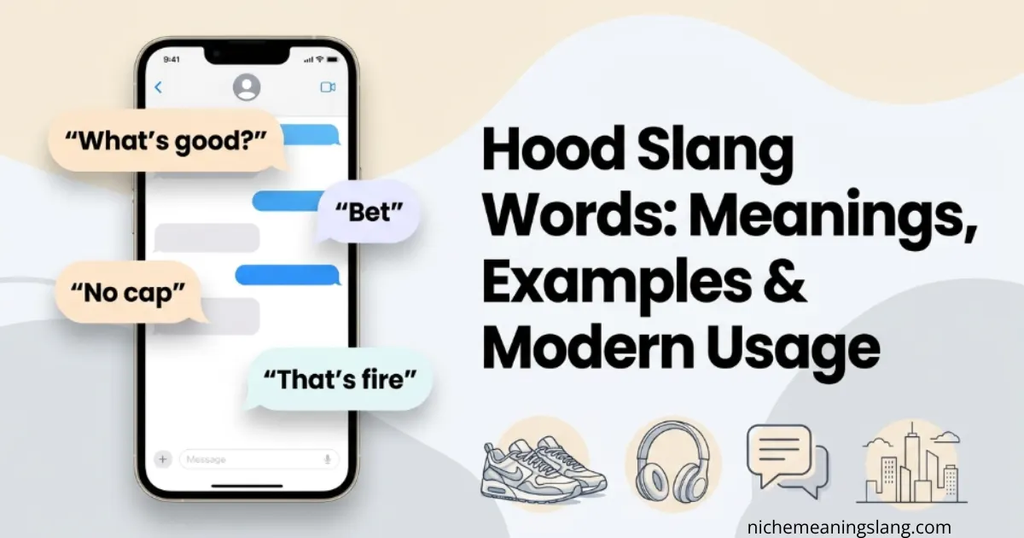
Hood Slang Words Meanings, Examples & Modern Usage
Hood slang words are informal expressions associated with urban communities, street culture, African American English, hip-hop, and evolving online communication. They can express honesty, friendship, approval, style, emotion, humor, or attitude, but their meanings often depend heavily on context, region, and community.
If you’ve ever seen someone write “no cap,” “that’s bussin,” “bet,” or “he’s an OG” and wondered what they actually meant, you’re not alone. I’ve spent years studying how everyday American expressions move between conversations, music, entertainment, and social platforms. This guide separates established slang from fast-moving internet language so you can understand the meaning without forcing the vocabulary.
What Hood Slang Words Really Mean
Hood slang words generally refers to informal vocabulary and expressions associated with urban communities and street culture. Common examples include cap, no cap, homie, fam, crib, lit, dope, bet, and bussin. Their meanings are not always literal, and context can completely change how a phrase is understood.
It’s also important not to treat “hood slang” as a formal linguistic category. Some expressions overlap with African American English, regional American English, hip-hop language, youth slang, and internet culture. AAVE itself is a systematic variety of English with its own grammatical and phonological patterns, not simply a collection of slang words.
The Cultural Roots Behind Hood Slang Words
Many expressions associated with hood slang developed through communities, local speech patterns, music, and cultural interaction. Hip-hop became especially influential in spreading vocabulary beyond particular neighborhoods, while migration and communication between communities helped expressions travel across American cities and eventually into mainstream culture.
That history matters because a word can carry more than a dictionary definition. Respect, identity, humor, belonging, confidence, struggle, and creativity can all shape how an expression feels. Linguistic research also emphasizes variation within African American language rather than treating it as one completely uniform speech style.
25 Hood Slang Words Explained
| Hood slang word | Common meaning | Example |
| Cap | A lie or exaggeration | “That’s cap.” |
| No cap | Honestly / for real | “No cap, that’s good.” |
| Bet | Okay / agreed | “Meet at eight?” “Bet.” |
| Homie | Close friend | “What’s up, homie?” |
| Fam | Close friend or family-like person | “Good looking out, fam.” |
| OG | Respected or experienced person | “He’s an OG.” |
| Lit | Exciting or energetic | “The party was lit.” |
| Dope | Excellent or cool | “That jacket is dope.” |
| Wack | Bad or disappointing | “That movie was wack.” |
| Bussin | Extremely good, especially food | “These wings are bussin.” |
| Lowkey | Quietly or somewhat | “I lowkey like it.” |
| Highkey | Openly or strongly | “I highkey want one.” |
| Drip | Stylish clothing or appearance | “His drip is clean.” |
| Flex | Show off | “He’s flexing again.” |
| Deadass | Seriously / genuinely | “I’m deadass serious.” |
| Finesse | Skillfully maneuver or obtain something | “She finessed the deal.” |
| Slay | Perform exceptionally well | “She slayed that look.” |
| Goat | Greatest of all time | “He’s the GOAT.” |
| Glow up | Major positive transformation | “She had a glow up.” |
| Slaps | Very good, especially music | “This song slaps.” |
| Sus | Suspicious | “That story sounds sus.” |
| On God | Strong affirmation | “On God, I’m telling you.” |
| Pull up | Arrive or come over | “Pull up later.” |
| Clout | Influence or social attention | “He’s chasing clout.” |
| Shade | Indirect insult or criticism | “That was definitely shade.” |
The current ranking pages emphasize that these terms differ in age, context, popularity, and cultural background. Some are longstanding slang, while others became especially visible through social media.
No Cap / Cap
Cap means a lie, false claim, or exaggeration, while no cap signals sincerity. For example, “That story is cap” challenges someone’s statement, whereas “No cap, that was the best burger I’ve had” emphasizes that the speaker genuinely means what they said.
Lowkey / Highkey
Lowkey suggests something understated, private, or somewhat hidden, while highkey means openly, strongly, or obviously. You might hear “I lowkey like that song” versus “I highkey love that song.” Both expressions depend heavily on conversational tone and context.
Bussin
Bussin is commonly used to describe food that tastes exceptionally good. “This pizza is bussin” is an enthusiastic compliment. The term became especially visible through online food content and TikTok, although its history predates its broader internet popularity.
Slaps
When something slaps, it is very enjoyable or impressive, particularly music. “This track slaps” means the speaker strongly approves of it. Although the expression can be used more broadly, its association with music is particularly common in contemporary informal American speech.
Fam / Gang
Fam can refer to family or close friends, while gang may be used casually as a term of address for one’s close group. In informal conversation, neither necessarily means a literal family relationship or criminal organization; the intended meaning depends on the speaker and context.
Bet
Bet is a compact way to express agreement, confirmation, or acknowledgment. If someone says, “Meet me at seven?” replying “Bet” generally means “okay” or “agreed.” It is now widely recognized beyond any single community and appears frequently in casual speech and online messages.
Deadass
Deadass means seriously or genuinely. Someone saying “I’m deadass serious” is emphasizing that they are not joking. The term has strong associations with New York usage but is now recognized more broadly through American popular culture and online communication.
Drip
Drip refers to someone’s stylish clothing, accessories, or overall fashion. Saying “Your drip is clean” is a compliment about appearance. The word became especially prominent through youth culture, music, social media, and fashion conversations.
Glow Up
A glow up describes a noticeable positive transformation, often involving appearance, confidence, lifestyle, or success. The phrase is frequently used online when someone compares an earlier version of themselves with their current look or circumstances.
The Evolution of Hood Slang Words: From Streets to Everywhere
Hood slang words do not remain fixed. A phrase can develop within a particular community, spread through music, appear in memes, reach TikTok or Instagram, and eventually become familiar to people who never used it in its original setting. Social platforms dramatically accelerate this movement.
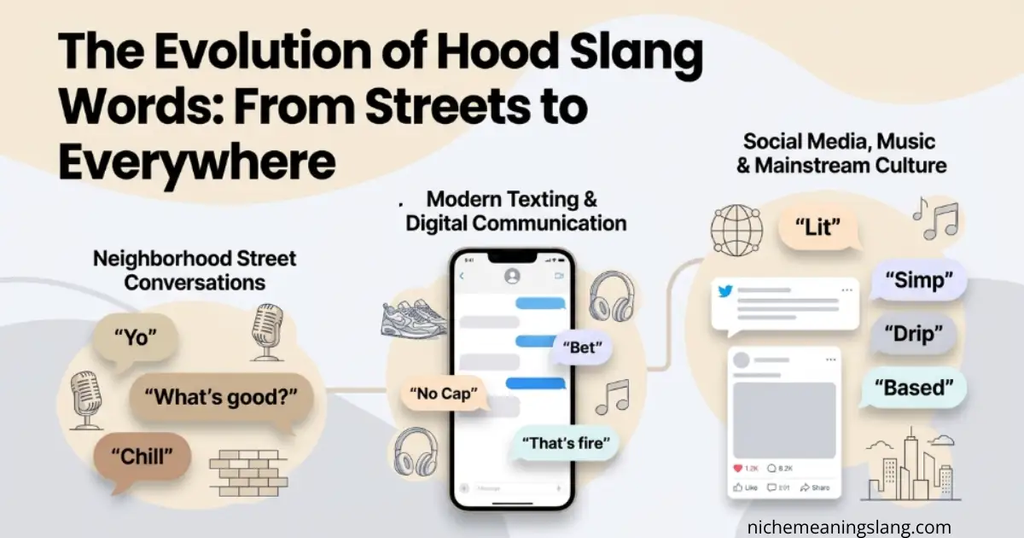
This evolution explains why slang can feel confusing. A word that was popular several years ago may sound dated today, while a relatively new expression can suddenly appear everywhere. SlangLoom similarly emphasizes that expressions move differently across generations, online spaces, and everyday conversation.
Hood Slang Words in Music, Movies and Social Media
Music and entertainment have played an enormous role in spreading urban expressions. Hip-hop, movies, television, YouTube, TikTok, Instagram, memes, and online communities can carry a phrase far beyond the place where listeners first encountered it.
Social media also changes the speed of language evolution. A phrase can become recognizable nationwide after appearing repeatedly in captions, comments, short videos, songs, or memes. But popularity online does not automatically mean a word is universally used offline, so context remains essential.
How to Use Hood Slang Words Naturally Without Sounding Awkward
The easiest way to use hood slang words naturally is to understand the situation before copying the expression. Listen to how speakers use a term, notice whether it is serious or playful, and pay attention to pronunciation and context.
A group chat and a job interview require very different language. Words such as bet, cap, bussin, or drip may sound perfectly natural among friends but inappropriate in formal communication. The goal is not to insert slang into every sentence; it is to understand when informal language genuinely fits.
Common Mistakes People Make With Hood Slang Words
One common mistake is assuming every term labeled “hood slang” belongs to one community or has one fixed meaning. Language varies by region, age, social group, and context. A phrase familiar in one city may sound unusual or mean something different somewhere else.
Another mistake is using outdated slang or forcing expressions you’ve only seen online. SlangLoom specifically warns against overuse, formal settings, and outdated vocabulary, while Slang Insights emphasizes listening first and understanding cultural context before repeating terms.
Why Hood Slang Words Actually Matter
Hood slang words matter because informal language can reveal how communities create identity, humor, solidarity, and efficient ways of expressing emotion. Treating these expressions as meaningless “bad English” misses the linguistic creativity behind them. Scholarly work on African American English has documented systematic patterns in vocabulary, grammar, phonology, and social variation.
There’s also a broader lesson: American English is constantly changing. Expressions move between communities, generations, regions, music, entertainment, and digital spaces. Understanding that movement makes it easier to interpret conversations without assuming that one dictionary definition captures every use.
Generational Hood Slang Words Comparison
| Generation/context | Common language influences |
| Older generations | Regional expressions, established American slang |
| Millennials | Early internet, hip-hop, pop culture |
| Gen Z | TikTok, memes, gaming, social media |
| Current online culture | Rapidly changing viral expressions |
These categories are broad rather than absolute. People regularly borrow expressions from other generations, and online culture has made those boundaries much less rigid. SlangLoom notes that different generations adapt expressions according to their cultural and technological environments.
Frequently Asked Questions About Hood Slang Words
What does hood slang mean?
Hood slang generally refers to informal words and expressions associated with urban communities and street culture. The label can overlap with African American English, regional slang, hip-hop vocabulary, youth language, and internet slang, so it should not be treated as one standardized dialect.
Why is hood slang popular?
Its popularity has been amplified by music, hip-hop, movies, television, social media, memes, and everyday conversations. Digital platforms allow expressions to travel between communities much faster than they could before widespread internet communication.
Is hood slang the same everywhere?
No. Meaning and popularity can vary by city, region, generation, community, and social setting. A phrase that feels completely normal in one group may sound unfamiliar somewhere else. Context is one of the most important parts of understanding slang.
What does “no cap” mean?
No cap means someone is being honest or telling the truth. It is often added to emphasize sincerity, as in “No cap, that was the best concert I’ve seen.”
Can anyone use hood slang words?
People can learn slang, but understanding its cultural and social context matters. Some expressions have specific histories or associations, and using them without understanding those nuances can come across as forced or disrespectful.
How fast does hood slang change?
It can change extremely quickly. Social media, music, memes, and youth culture can push a word into mainstream visibility, while older expressions may gradually disappear or become intentionally humorous.
Should hood slang words be used in professional communication?
Usually, standard professional language is safer. Slang can be appropriate in informal workplace conversations depending on the environment, but academic papers, official documents, resumes, and formal business communication generally call for clearer standard English.
Is hood slang proper English?
“Proper English” is too simplistic a way to describe the issue. Informal slang and dialect varieties serve different purposes from formal Standard American English. AAVE, for example, is recognized by linguists as a systematic, rule-governed variety of English.
Is hood slang only used by certain communities?
Many expressions originate within particular communities, but popular slang can spread widely through music, entertainment, migration, and social media. That does not erase the history of where a particular expression originated.
Conclusion
Hood Slang Words and Modern American Language
Hood slang words are more than a collection of trendy expressions. They reflect how American language evolves through communities, culture, music, regional speech, entertainment, and social media. Words such as cap, no cap, bet, homie, bussin, drip, OG, and lowkey can communicate ideas quickly, but their meaning always depends on context.
The most important lesson is to understand the language rather than simply imitate it. Learn where expressions come from, recognize regional and generational differences, and use informal vocabulary naturally. When you approach hood slang with context and respect, you gain more than definitions you gain a clearer understanding of how modern American English continues to change.
FAQs
For PAA/AEO, I would prioritize these exact query patterns because they are directly represented in the current competitor FAQ structures:
- What does hood slang mean?
- Why is hood slang so popular?
- Is hood slang the same everywhere?
- What does no cap mean?
- Can anyone use hood slang?
- Where did hood slang come from?
- Why does hood slang change so fast?
- Is hood slang proper English?
- Should slang be used in professional communication?
These questions are supported by the FAQ structures appearing across the analyzed pages.
Related Slang Words

Ryan Mitchell is a language enthusiast and writer who explores slang, modern expressions, and everyday language. At nichemeaningslang, he helps readers understand slang meanings, usage, and context in a simple and easy-to-follow way.