The Hood Slang Meaning, Words, Examples, and Cultural Context
The hood slang generally refers to informal language connected with urban neighborhoods, local communities, street culture, and expressions that have developed within particular social and cultural environments. In everyday American English, “the hood” itself usually means a neighborhood or home area, while hood slang describes the vocabulary used around those communities. The meaning can shift with region, speaker, tone, and situation.
If you have ever heard someone say “that’s my hood,” “no cap,” “my homie,” or “we’re back in the hood,” the confusing part is rarely the individual word it is the context behind it. After looking closely at how these expressions work in conversations, music, texting, and social media, one thing becomes clear: understanding the culture and situation matters more than memorizing a giant slang list.
What Hood Slang Actually Is (And Where It Comes From)
Hood slang is informal language associated with urban neighborhoods and communities. It can include words about friendship, honesty, style, respect, money, loyalty, work, and everyday experiences. Terms may develop locally before spreading through hip-hop, sports, movies, television, and social media.
The phrase itself is broad rather than a formal linguistic category. Some expressions have roots in African American Vernacular English, while others come from regional communities or wider American slang. That is why two cities can use similar words differently, and why an expression that sounds natural in one conversation may feel unfamiliar somewhere else.
What Does Hood Mean in Text?
In texting, “hood” most commonly refers to a neighborhood, especially someone’s own neighborhood or an urban community. A message such as “I’m going back to the hood” usually describes returning to a familiar area rather than making a statement about crime or danger.
Context can add another layer. “My hood” may express belonging, hometown identity, nostalgia, or pride. “That looks hood” can instead describe a street-style aesthetic or something associated with urban culture. The speaker’s intention and relationship to the word are important.
The Cultural Roots Behind Hood Slang
The history of hood slang is closely connected with communities developing distinctive ways of expressing identity, humor, relationships, struggle, confidence, and belonging. Some vocabulary existed locally for years before becoming recognizable outside the communities where it was naturally spoken.
Music has played a major role in that movement. Hip-hop and rap gave regional expressions enormous audiences, while television, movies, YouTube, and social platforms accelerated the process. A phrase can now move from a neighborhood conversation to a song, then to TikTok or Instagram, within a remarkably short time.
The Core Words You Need to Know
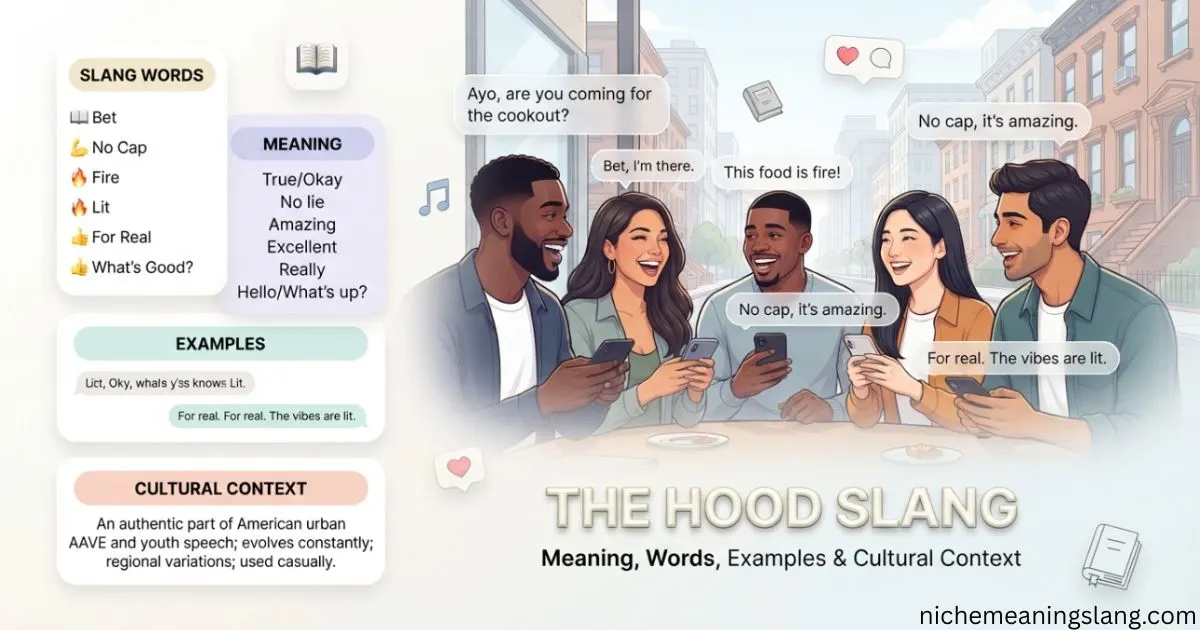
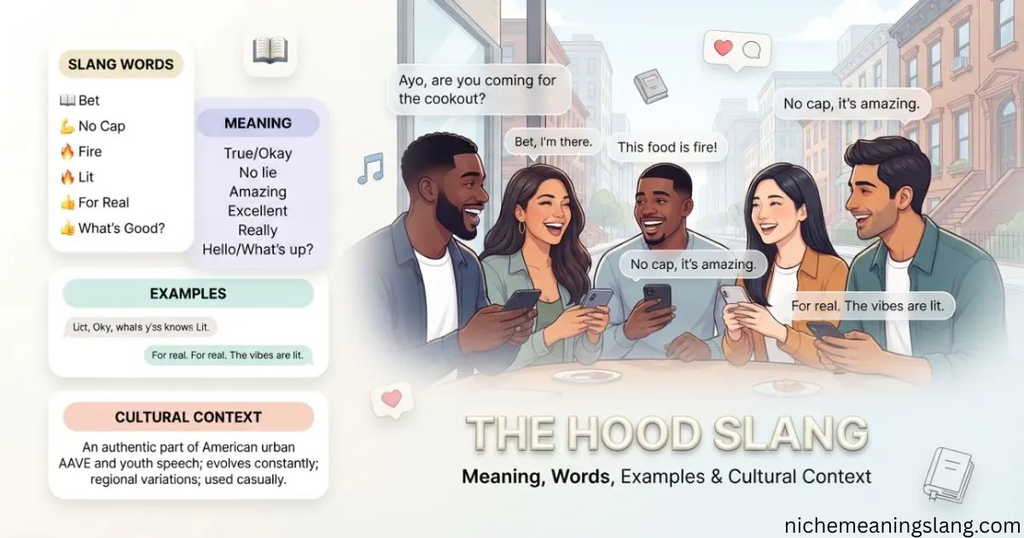
Hood slang includes a wide range of expressions, and their meanings are often straightforward once you see them in context. Words such as homie, fam, cap, bet, drip, flex, OG, lit, and no cap can communicate friendship, agreement, honesty, style, respect, excitement, or social status.
| Hood slang | Common meaning | Example |
| Homie | Close friend | “That’s my homie.” |
| Fam | Close friend or trusted group | “What’s good, fam?” |
| Cap | Lie or false statement | “That’s cap.” |
| No cap | Seriously / honestly | “That movie was good, no cap.” |
| Bet | Okay / agreed | “Meet at eight?” “Bet.” |
| Drip | Stylish clothing | “Your drip is clean.” |
| Flex | Show off | “He’s just flexing.” |
| OG | Respected or experienced person | “She’s an OG around here.” |
No Cap / Cap
“Cap” is commonly used to mean a lie or something untrue, while “no cap” emphasizes honesty. You might see “Stop capping” when someone is accused of exaggerating. These expressions are now common far beyond their original cultural settings, especially in texting, memes, music discussions, and social media.
Lowkey / Highkey
“Lowkey” can signal something understated, private, or not openly emphasized, while “highkey” generally pushes the feeling in the opposite direction. For example, “I lowkey love this song” suggests a quieter admission, whereas “I highkey love this song” makes the enthusiasm much more explicit.
Fam / Gang
“Fam” and “gang” can refer to close friends or a trusted social circle rather than literal relatives or an actual gang. In a casual message such as “What’s up, fam?” the word works as a friendly form of address. Tone determines whether it sounds affectionate, playful, or simply familiar.
Bet
“Bet” commonly communicates agreement, confirmation, or acceptance. If someone texts, “I’ll pick you up at seven,” replying “Bet” can mean “okay” or “sounds good.” Its popularity comes partly from its efficiency: one short word can acknowledge a plan without requiring a full sentence.
Drip
“Drip” refers to stylish clothing, accessories, or overall fashion presentation. A comment such as “Your drip is crazy” is generally a compliment about someone’s look. Like many slang expressions, the word is informal, so its natural home is casual conversation, social media, music, and fashion discussions.
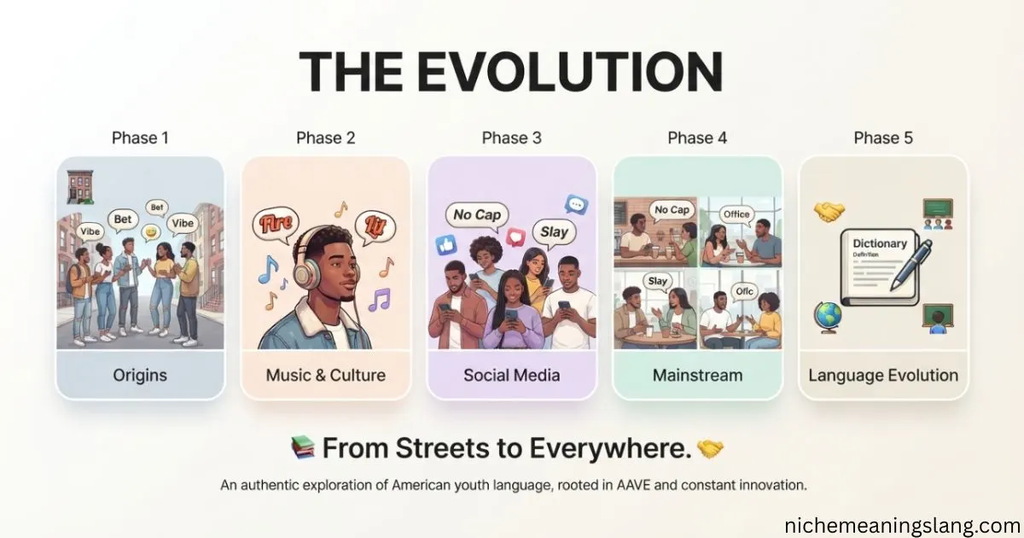
The Evolution: From Streets to Everywhere
The path from local slang to mainstream vocabulary is rarely a straight line. A phrase can circulate within a community, appear in music, become recognizable through movies, and then explode through social platforms. TikTok, Instagram, YouTube, and X have made that process dramatically faster.
That spread can also change meaning. When people encounter a word outside its original environment, they may use it differently, shorten it, or turn it into a meme. A definition found online may therefore miss the emotional or cultural meaning that a speaker intends in real life.
Examples of Hood in Conversation
“The hood” is usually easiest to understand when you look at the entire sentence. Someone talking about “my hood” may be discussing home, childhood, family, or community. Someone describing an outfit as “hood” may instead be talking about a particular street-inspired style.
| Context | Example | Likely meaning |
| Friendly | “I’m going back to the hood.” | Returning to the neighborhood |
| Identity | “I’ll always rep my hood.” | Connection to home/community |
| Descriptive | “That place has hood vibes.” | Urban or street-style atmosphere |
| Storytelling | “The hood raised me.” | Childhood and lived experience |
| Playful | “You’re acting hood today.” | Teasing about behavior or style |
Friendly / Casual
In a friendly conversation, “hood” often simply identifies someone’s neighborhood or home area. “I’m heading back to the hood” can sound as ordinary as saying someone is going back home, particularly when the speaker already uses the expression naturally.
Proud / Identity-Based
“Proud of my hood” or “I’ll never forget my hood” can express connection to a place and the people who shaped someone’s life. Here, the phrase carries emotional meaning rather than simply describing geography. It can represent memories, loyalty, family, and community identity.
Descriptive
When someone says something has “hood vibes,” the expression becomes descriptive rather than geographic. Depending on context, it might refer to music, clothing, food, decoration, language, or an atmosphere associated with urban culture. The phrase can be complimentary, neutral, teasing, or stereotypical depending on delivery.
Funny / Playful
Friends sometimes use “hood” humorously to describe behavior that feels exaggerated, dramatic, resourceful, or street-inspired. Because humor depends heavily on relationships, the same sentence can sound playful between friends but insulting when directed at someone unfamiliar with the speaker.
Storytelling
“The hood raised me” is more than a location statement. It can summarize someone’s childhood, relationships, challenges, lessons, and sense of identity. In music and personal storytelling, “the hood” can function as shorthand for an environment that influenced who someone became.
When to Use and When Not To Use Hood
Using “hood” naturally depends on context and personal connection. It is common in casual conversation, social media, music discussions, and informal storytelling. If someone is describing their own neighborhood, the word may carry a strong sense of familiarity, pride, humor, or nostalgia.
The situation changes in professional or academic communication. “Neighborhood,” “community,” or a specific place name may be clearer and more neutral. The biggest mistake is treating “hood” as a costume or performance rather than understanding how the person speaking actually uses it.
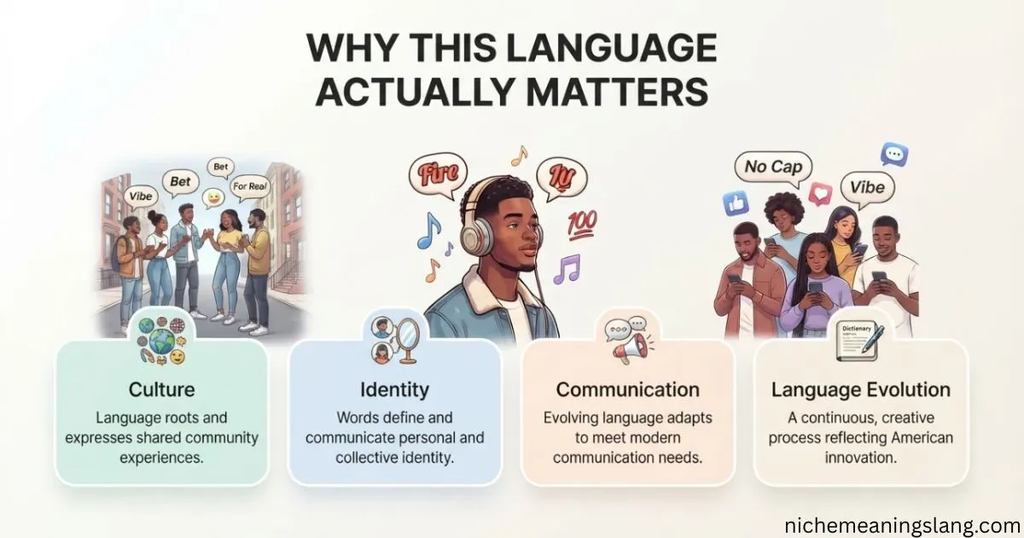
Why This Language Actually Matters
Slang is not merely a collection of shortcuts. It can show how communities create new expressions for ideas that matter to them friendship, loyalty, honesty, confidence, respect, struggle, success, humor, and belonging. Once those expressions spread, they can influence the vocabulary of people who never lived in the communities where the words developed.
That is why the hood slang is worth understanding through context rather than stereotypes. A word can have a dictionary definition, a cultural history, a regional meaning, and a completely different emotional effect in conversation. Learning those layers makes it easier to understand music, movies, social media, and everyday American speech without forcing slang where it does not belong.
Conclusion
The hood slang is best understood as a broad collection of informal expressions connected with neighborhoods, urban communities, cultural identity, music, social relationships, and everyday communication. Meanwhile, “the hood” itself generally means a neighborhood or home area, with its exact tone depending on the speaker and context.
From “my hood” and “homie” to “no cap,” “bet,” and “drip,” these expressions show how American slang can move between local communities, hip-hop, movies, texting, and social media. The most important lesson is simple: learn the meaning, understand the context, and respect the culture behind the language rather than treating slang as a costume.
FAQs
What does “the hood” mean in slang?
“The hood” is slang for a neighborhood, particularly an urban neighborhood or the area where someone lives or grew up. Depending on context, it can communicate home, identity, community, or local roots.
What is hood slang?
Hood slang is a broad term for informal words and expressions associated with urban communities and street culture. It overlaps with AAVE, regional slang, hip-hop vocabulary, and modern internet language, but it is not one fixed dictionary category.
Is “hood” short for neighborhood?
Yes. Major dictionaries identify hood/’hood as a slang shortening of neighborhood. Dictionary.com dates the American slang sense to 1965–70, while Oxford describes it as a shortening of neighborhood.
Does “the hood” always mean a dangerous area?
No. The slang word primarily identifies a neighborhood. Some contexts associate it with poverty, crime, or difficult conditions, while other uses emphasize community, home, identity, pride, or upbringing. The surrounding sentence and speaker’s intention matter.
Is hood slang the same everywhere?
No. Slang can vary between cities, neighborhoods, generations, and communities. Current competitor research specifically emphasizes regional differences and changing meanings.
Is “hood” rude?
Not automatically. It can be completely ordinary when someone refers to their own neighborhood or cultural background. It can become insensitive when used to stereotype, mock, or make assumptions about communities or people.
Can hood slang be used professionally?
Most hood slang is informal. In professional emails, academic writing, interviews, and formal presentations, standard wording is generally clearer. Competitor research similarly distinguishes casual slang from formal communication.
What are some common hood slang words?
Examples appearing repeatedly across current competitor research include homie, fam, cap, no cap, bet, lit, drip, flex, OG, lowkey, highkey, and bussin. Meanings can vary according to region and context.
What is the difference between hood, block, streets, and turf?
They overlap but are not identical. Hood usually refers to a broader neighborhood or community; block can refer to a specific street or local area; streets can evoke urban life or experience; and turf usually means a particular territory or area.
Is hood slang proper English?
Hood slang is informal language rather than a formal register of standard written English. That does not make it meaningless or linguistically unsophisticated; slang can have systematic patterns, cultural history, and communicative functions.
Related Slang Words

Ryan Mitchell is a language enthusiast and writer who explores slang, modern expressions, and everyday language. At nichemeaningslang, he helps readers understand slang meanings, usage, and context in a simple and easy-to-follow way.