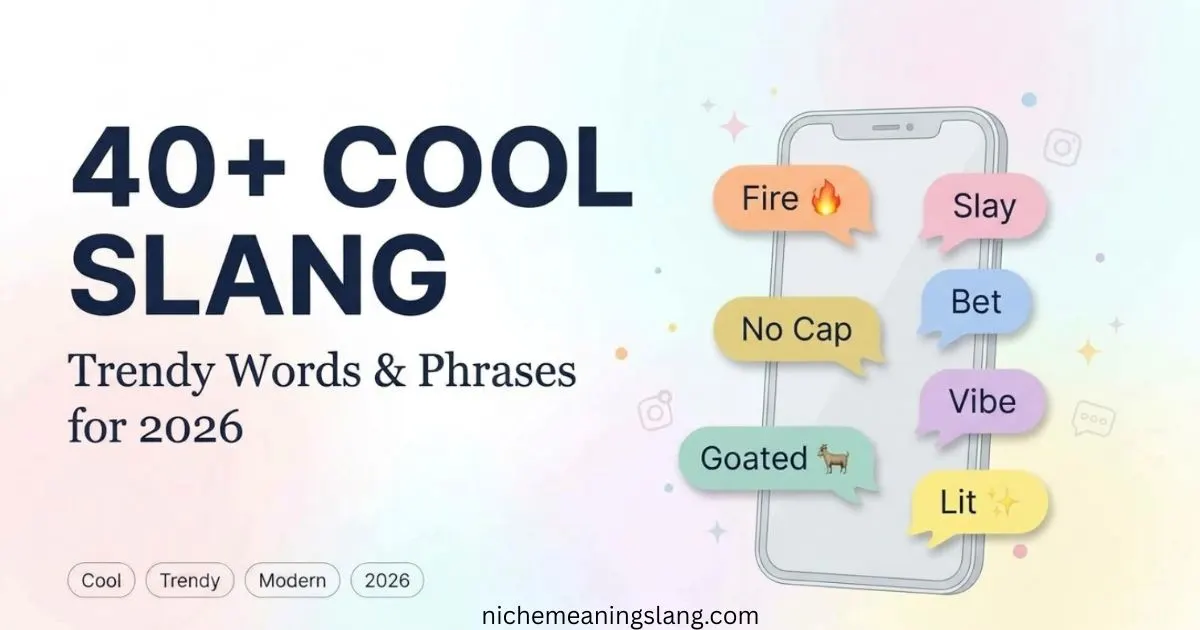
40+Cool Slang Trendy Words & Phrases for 2026
Cool slang includes words like fire, drip, gas, valid, goated, aura, slaps, bussin’, and iconic, but the right choice depends on what you are describing. In American English, people rarely use slang as a simple dictionary replacement for “cool.” The word changes with fashion, music, food, personality, achievement, age, and online culture.
If you have ever typed “that’s cool” and wondered what people actually say now, you are not alone. After comparing current slang patterns across American English, social media, texting, and generational vocabulary, one thing stands out: context matters more than chasing the newest viral word. This guide shows what each expression really communicates and when it sounds natural.
What Counts as a Slang Word for Cool
A slang word for cool is an informal expression showing approval, style, excitement, quality, or admiration. Fire can praise a song or outfit, drip focuses on fashion, slaps usually describes music, and bussin’ is strongly associated with excellent food. Each term carries its own flavor.
That distinction is important because modern slang has become highly specific. Instead of one universal compliment, speakers choose language according to the category. A stylish sneaker can be clean, a great player can be goated, and someone with effortless presence can have aura. The basic meaning is positive, but the semantic context changes.
How the Meaning of Cool Has Shifted
The traditional meaning of cool covers calmness, style, approval, and social appeal. Modern slang divides those ideas into narrower expressions such as drip for fashion, aura for presence, fire for broad approval, and valid for agreement. This makes casual vocabulary more expressive and context-specific.
Why Gen Z Rarely Says Cool Anymore
Gen Z still understands “cool,” but social-media language gives speakers more precise alternatives. Fire, gas, valid, drip, and aura can communicate different shades of approval. Slang also changes when expressions become mainstream, creating a constant cycle of new vocabulary, irony, repetition, and reinvention.
20+ Slang Words for Cool You Can Actually Use
Some of the most useful current terms include fire, drip, gas, valid, slaps, bussin’, goated, hits different, aura, steez, sheesh, chill, fly, legit, tuff, wicked, rad, iconic, clean, W, and no cap. They are not perfect synonyms, but they cover most casual situations.
| Slang | Meaning | Best Context |
| Fire | Excellent or impressive | General, music, fashion |
| Drip | Stylish appearance | Clothes, sneakers |
| Gas | Excellent or exciting | Music, food, performance |
| Valid | Worthy or approved | Choices, opinions |
| Slaps | Very good | Music |
| Bussin’ | Extremely good | Food |
| Goated | Among the best | Skills, sports, gaming |
| Hits different | Unusually satisfying | Experiences, music |
| Aura | Cool presence | People, personality |
| Steez | Effortless style | Fashion, attitude |
| Sheesh | Strong admiration | Reactions |
| Chill | Relaxed and cool | People, vibes |
| Fly | Stylish | People, fashion |
| Legit | Genuinely good | General |
| Tuff | Impressive | Objects, outfits, actions |
| Wicked | Very good | Regional/general |
| Rad | Excellent | Casual, nostalgic |
| Iconic | Memorable | People, moments, fashion |
| Clean | Sharp or polished | Fashion, design |
| W | A win | Achievements |
| No cap | Seriously/honestly | Emphasis |
The key is not memorizing every word. Learn the strongest category associations. If you remember only a few, fire is highly versatile, drip is fashion-specific, slaps is music-focused, bussin’ fits food, and goated highlights exceptional ability.
Best Slang Words for a Cool Person
When you describe a person rather than an object, the vocabulary becomes more personal. Goated suggests exceptional skill, fly suggests style, aura suggests presence, iconic suggests memorable impact, and chill describes a relaxed personality. These words praise different qualities instead of simply saying someone is cool.
For example, “He’s got aura” focuses on presence, while “She’s fly” emphasizes style. “That player is goated” signals elite ability. “He’s chill” is softer and more relaxed. Choosing the right compliment makes the sentence feel natural because the slang matches the quality being praised.
Slang for Someone With Great Style
For someone with strong fashion sense, fly, drip, clean, fire, and tuff are useful choices. “Your fit has serious drip” focuses on the outfit, while “those shoes are fire” highlights a specific item. Clean adds a polished, coordinated feeling rather than pure excitement.
Slang for Someone With Good Energy
Chill and aura are especially useful for personality. Chill suggests relaxed, easygoing energy, while aura suggests a distinctive presence or confidence. Someone can have “good aura” without being loud or flashy, making the expression different from high-energy praise such as fire, lit, or insane.
Slang for Someone Who Is Impressive
Goated and iconic are stronger choices when someone stands out. Goated connects the person with exceptional skill or status, while iconic emphasizes memorability. For example, “That chef is goated” praises ability, whereas “That entrance was iconic” focuses on the lasting impression of a particular moment.
Cool Slang for Clothes and Outfits
Fashion has its own slang ecosystem. Drip is strongly associated with an impressive outfit, while clean describes something sharp and well put together. Fire, fly, and tuff can praise standout clothing, sneakers, accessories, or a complete look.
Imagine a friend arriving in a perfectly coordinated outfit. “That fit is fire” gives broad enthusiastic approval. “You’ve got drip” specifically praises style. “Those sneakers are clean” focuses on their polished appearance. These subtle differences make the compliment sound more intentional and less like a random slang substitution.
Slang Words for a Cool Song or Music
Music usually favors specialized expressions such as slaps, banger, hits different, and fire. A song that “slaps” sounds powerful and replayable, while a “banger” often suggests an energetic track. “Hits different” is more emotional, describing how a song feels especially powerful in a particular moment.
For example, “This song slaps” is a straightforward music compliment. “This track is fire” is broader and can work outside music too. “This song hits different at night” describes the emotional experience rather than simply saying the production is excellent.
Slaps
Slaps is one of the clearest music-specific compliments. It means a track hits strongly, sounds great, or creates an enjoyable reaction. “This song slaps” is natural in a group chat, comment section, or conversation about playlists, albums, concerts, beats, or new releases.
Banger
A banger is a highly enjoyable or energetic song, often something that immediately stands out in a playlist or party setting. Unlike “fire,” which can describe almost anything impressive, “banger” has a strong music association. “That new track is a banger” sounds more specific than “that track is cool.”
Hits Different
Hits different describes an experience that feels unusually good, emotional, powerful, or satisfying. It is less about technical quality and more about personal impact. A song can “hit different” because of a memory, setting, mood, relationship, season, or moment—not simply because it is objectively better.
Fire
Fire is broader than music-specific terms. You can call a song, beat, album, outfit, restaurant, idea, or performance fire. That flexibility is why it remains one of the strongest modern casual compliments when the speaker wants enthusiasm without needing a highly specialized expression.
Gen Z Slang for Cool Right Now
Current Gen Z vocabulary frequently uses fire, gas, drip, valid, aura, goated, and tuff, although no slang list should be treated as universal. Social platforms accelerate vocabulary changes, and different communities can adopt, remix, exaggerate, or abandon terms at different speeds.
One useful rule is to observe rather than force. If people around you naturally say “fire,” “valid,” or “goated,” those expressions will feel easier to use. Slang becomes awkward when someone learns a word from a list and immediately inserts it into every sentence without understanding its tone.
What Gen Z Actually Means by Cool
For many younger speakers, “cool” is not one exact quality. A song can slap, an outfit can have drip, a person can have aura, and an achievement can earn a W. The vocabulary changes according to what makes the thing appealing, impressive, stylish, successful, or memorable.
Gen Alpha Words That Can Mean Cool
Some younger internet communities use expressions such as aura, sigma, W, mogging, and let him cook in positive or exaggerated contexts. These terms are particularly dependent on memes, irony, gaming culture, and short-form content, so their meanings can shift quickly.
That is why Gen Alpha vocabulary should not automatically be treated as a direct replacement for “cool.” Aura can describe presence, W celebrates a win, and “let him cook” can encourage someone who appears to be doing something well. The surrounding conversation determines the intended meaning.
Slang for Cool in Texting and Social Media
Texting favors short expressions because a single word can communicate an entire emotional reaction. Fire, valid, W, no cap, goated, iconic, and sheesh work especially well in comments, group chats, captions, and replies because the content around them supplies additional context.
Social media also creates rapid vocabulary cycles. TikTok, Instagram, X, Discord, and other communities can turn niche expressions into mainstream language quickly. The result is a constantly changing vocabulary where understanding tone is often more important than memorizing a fixed dictionary definition.
Short Ways to Say That’s Cool
For a quick reply, try “fire,” “valid,” “W,” “goated,” “clean,” or “no cap.” “Fire” expresses enthusiasm, “valid” communicates approval, and “W” celebrates a positive outcome. The shortest expressions work best when the recipient already understands the surrounding context.
Cool Slang for Comments and Captions
Comments often favor expressive reactions such as “sheesh,” “goated,” “iconic,” “fire,” and “that’s a W.” Captions can use phrases such as “straight heat,” “whole vibe,” or “no cap.” Because social media is visual, the image or video usually helps establish the meaning.
Cool Slang Words by Situation
| Situation | Best Choices | Example |
| Outfit | drip, fire, clean | “That fit is fire.” |
| Sneakers | clean, fire, tuff | “Those kicks are clean.” |
| Song | slaps, banger, fire | “This song slaps.” |
| Food | bussin’, fire | “These wings are bussin’.” |
| Person | aura, fly, goated | “He’s got aura.” |
| Achievement | W, goated | “Huge W.” |
| Idea | valid, legit | “That idea is valid.” |
| Experience | hits different, iconic | “That trip hit different.” |
Situation is the easiest way to avoid misuse. The same person who says “that burger is bussin’” might say “that song slaps” five minutes later. Both communicate strong approval, but their semantic environments are different.
12 Slang Phrases That Mean That’s Cool
Useful phrases include “That’s fire,” “That goes hard,” “It hits different,” “It’s giving [quality],” “No cap, that’s fire,” “That’s so clean,” “Straight heat,” “You ate that,” “That’s a whole vibe,” “Say less,” “That’s valid,” and “Big W.”
These longer expressions can be more natural than forcing a single trendy word into every conversation. They also communicate different kinds of approval: goes hard suggests intensity, whole vibe describes atmosphere, you ate that praises execution, and Big W celebrates success.
Old-School Slang for Cool That Still Holds Up
Older American slang includes rad, groovy, fly, wicked, chill, far out, and boss. Some now sound nostalgic or deliberately retro, while others remain surprisingly usable. Dictionary.com’s historical record shows that the vocabulary of cool has changed repeatedly across decades.
This history is useful because today’s slang will eventually become yesterday’s slang too. Terms once associated with particular music, fashion, youth, or regional communities can either disappear, become mainstream, or return ironically years later.
Slang for Cool by Generation
| Generation / Era | Common Associations |
| 1960s–70s | groovy, far out, fab |
| 1980s | rad, tubular, fresh |
| 1990s–2000s | dope, sick, fly, phat |
| Millennials | sick, dope, legit, epic |
| Gen Z | fire, drip, gas, valid, goated |
| Younger internet slang | aura, W, sigma, tuff |
Generational labels are useful patterns, not strict rules. People borrow vocabulary across age groups, regions, communities, and platforms. Dictionary.com documents older examples such as groovy, far out, radical, fresh, wicked, sick, dope, lit, and fire, showing how the vocabulary of approval continually evolves.
How to Use Cool Slang Without Sounding Forced
The easiest way to sound natural is to match the word to the situation and audience. Drip belongs naturally around fashion, slaps around music, bussin’ around food, and goated around exceptional performance. When the category fits, slang feels conversational instead of manufactured.
Also consider who you are speaking to. A phrase that works perfectly in a group chat may sound strange in a business email. Current slang research repeatedly points toward the same practical lesson: understanding usage is more valuable than memorizing definitions.
Slang Words for Cool You Should Use Carefully
Some expressions depend heavily on region, age, culture, or online community. Wicked, for example, has strong regional associations, while newer expressions can shift meaning quickly. Other words may be ironic rather than sincere. That does not make them wrong; it simply means context carries more weight.
Avoid overloading a sentence with trendy vocabulary. “That fit is fire” feels natural. “That fit is fire, goated, bussin’, aura, W, no cap” sounds like someone copied a slang glossary. One well-chosen expression usually communicates more than six forced ones.
Conclusion
The cool slang landscape is not a fixed list. Current American usage ranges from broad compliments such as fire and legit to highly contextual expressions such as drip, slaps, bussin’, goated, aura, and W. Historical terms such as rad, groovy, fly, and wicked also show that slang repeatedly reinvents itself
FAQs
What is the best slang word for cool?
Fire is one of the most versatile choices because it can describe music, fashion, food, ideas, experiences, and other impressive things. However, drip is better for style, slaps for music, bussin’ for food, and goated for exceptional ability.
What is Gen Z slang for cool?
Current examples include fire, drip, gas, valid, aura, goated, and tuff. Their meanings are not identical: drip relates strongly to fashion, aura to presence, and goated to exceptional performance or status.
What do Americans say instead of cool?
Depending on context, Americans may say fire, dope, sick, legit, lit, awesome, rad, or fresh. Younger online communities may also use gas, drip, valid, goated, and aura.
What is a good slang word for a cool person?
Goated, fly, aura, iconic, and chill are useful depending on the quality you mean. Goated praises ability, fly praises style, aura suggests presence, iconic emphasizes memorability, and chill describes relaxed energy.
What slang means very cool or extremely impressive?
Fire, goated, straight heat, iconic, sick, and unreal can communicate strong approval. The best option depends on whether you are describing an object, person, performance, song, outfit, or experience.
What does drip mean in slang?
Drip means stylish clothing, fashion sense, or an impressive overall look. “That outfit has drip” focuses on someone’s fashion rather than simply saying the person is generally cool.
Is lit still used as slang?
Yes, lit is still recognizable and used in casual American English, especially for excitement, parties, events, or energetic situations. However, current slang has expanded into more specific expressions such as fire, gas, valid, and goated.
Related Slang Words

Ryan Mitchell is a language enthusiast and writer who explores slang, modern expressions, and everyday language. At nichemeaningslang, he helps readers understand slang meanings, usage, and context in a simple and easy-to-follow way.