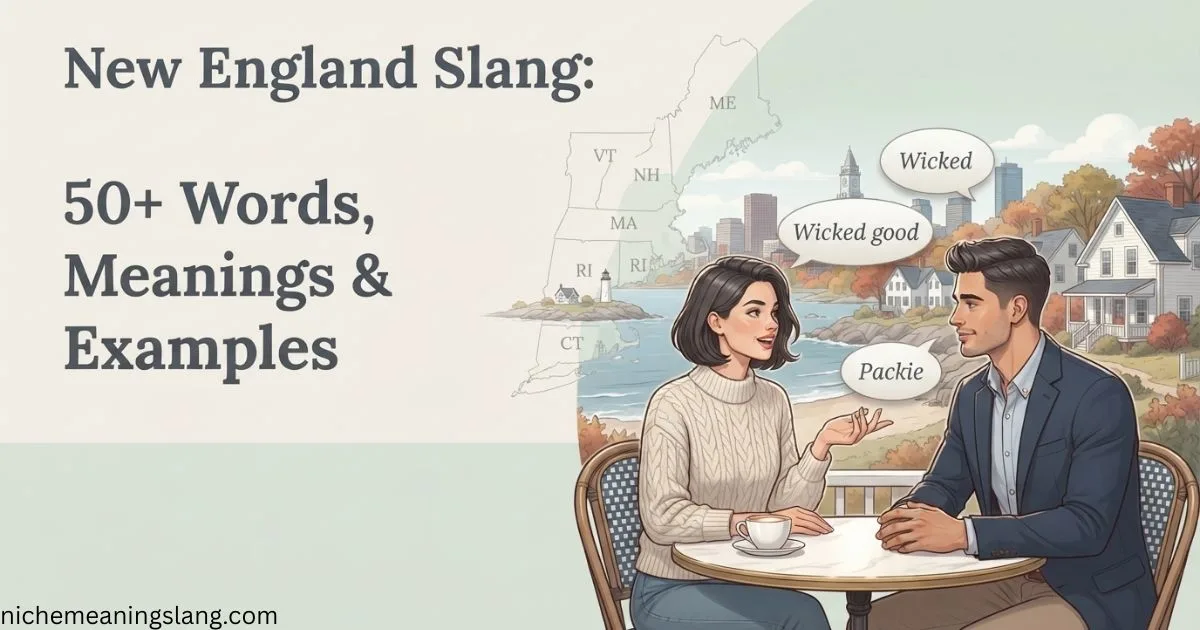
50+New England Slang Words, Meanings & Examples
New England slang includes distinctive regional words and expressions such as wicked, bubbler, ayuh, and bang a uey, which locals use in everyday conversation across Massachusetts, Maine, Vermont, New Hampshire, Rhode Island, and Connecticut. These phrases reflect the region’s history, culture, accents, and local traditions. Whether you are visiting Boston, exploring coastal Maine, talking with New England friends, or watching a movie set in the Northeast, learning these expressions can help you understand what people mean. This guide covers more than 50 New England slang words and phrases, their meanings, and examples of how to use them naturally.
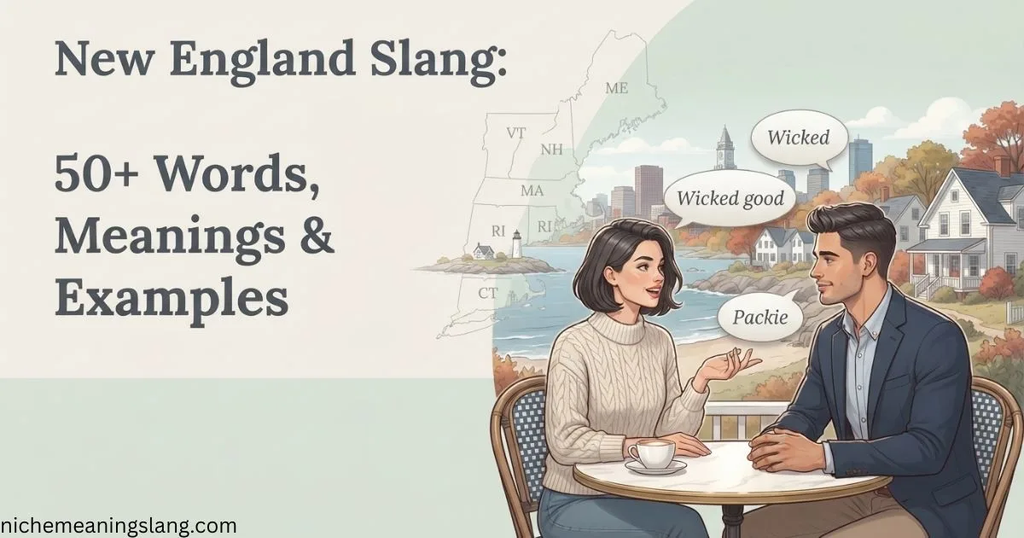
New England Slang Words
New England slang varies from state to state, so not every expression is equally common throughout the region. Some words are strongly associated with Boston and Massachusetts, while others are more familiar in rural Maine or northern New England. Here are popular examples to help you recognize the local vocabulary.
| Slang word | Meaning | Example |
| Wicked | Very or extremely | That game was wicked fun. |
| Wicked good | Extremely good | This clam chowder is wicked good. |
| Bubbler | Drinking fountain | Where is the nearest bubbler? |
| Packie | Liquor store; short for package store | Stop at the packie on your way home. |
| Rotary | Traffic circle or roundabout | Take the second exit at the rotary. |
| Grinder | Submarine sandwich | I ordered an Italian grinder for lunch. |
| Frappe | Ice-cream-based milkshake, especially in Massachusetts | Can I get a chocolate frappe? |
| Tonic | Older regional term for soda | My grandfather called it tonic. |
| Ayuh | Yes or yup, particularly associated with Maine | “Are you coming?” “Ayuh!” |
| The T | Boston’s public transit system | I take the T to work. |
| Bang a uey | Make a U-turn | You missed the street—bang a uey. |
| Down East | Coastal Maine, especially areas farther northeast | They rented a cabin Down East. |
| Door yard | Yard or space immediately outside a house, especially in Maine usage | The kids were playing in the door yard. |
| Flatlander | Someone from a less mountainous area, especially in Vermont usage | The mountain road surprised the flatlander. |
| Leaf peeper | Someone who travels to see autumn foliage | The roads are packed with leaf peepers. |
| P-town | Informal name for Provincetown, Massachusetts | We are spending the weekend in P-town. |
| Cape | Often means Cape Cod in local conversation | We are heading to the Cape on Friday. |
| Kid | Casual way to address someone | Hey, kid, how have you been? |
| Masshole | Teasing or insulting term for a Massachusetts resident, often a stereotypically aggressive driver | That driver is acting like a Masshole. |
| Mint | Excellent or impressive in some local usage | Your new bike looks mint. |
| Beat | Tired, worn out, or unattractive, depending on context | I am beat after that long shift. |
| Dummy | Foolish person; often a mild insult | Don’t be a dummy—bring a jacket. |
| Uey | Short for U-turn | Make a uey at the next street. |
| Nor’easter | A powerful storm affecting the northeastern coast | A nor’easter is heading our way. |
| Chowder | A thick soup, particularly associated with New England seafood traditions | We ordered bowls of clam chowder. |
| Lobstah | Playful representation of the regional pronunciation of lobster | We had lobstah rolls by the water. |
| Pissa | A regional expression associated with something excellent, often in the phrase “wicked pissa” | That concert was wicked pissa. |
| Wicked cold | Extremely cold | It is wicked cold this morning. |
| Wicked smart | Extremely intelligent | She is wicked smart. |
| Wicked busy | Extremely busy | The restaurant is wicked busy tonight. |
| Wicked far | Very far away | Their house is wicked far from here. |
| Wicked easy | Very easy | That recipe is wicked easy. |
| Wicked hard | Extremely difficult | The final exam was wicked hard. |
| Wicked nice | Very nice | Your neighbors are wicked nice. |
| Wicked late | Very late | We got home wicked late. |
| Wicked tired | Extremely tired | I am wicked tired after work. |
| Wicked fast | Very fast | That car moves wicked fast. |
| Wicked funny | Extremely funny | That comedian is wicked funny. |
| Wicked expensive | Very expensive | Parking downtown is wicked expensive. |
| Wicked windy | Extremely windy | It is wicked windy near the coast. |
| Wicked close | Very close | The two teams were wicked close in score. |
| Wicked busy | Very busy | The store gets wicked busy before the holidays. |
| Wicked excited | Extremely excited | We are wicked excited about the trip. |
| Wicked small | Very small | That apartment is wicked small. |
| Wicked strong | Very strong | The coffee is wicked strong. |
| Wicked early | Very early | We left wicked early to beat traffic. |
| Wicked quiet | Very quiet | The beach was wicked quiet this morning. |
| Wicked helpful | Extremely helpful | The local guide was wicked helpful. |
| Wicked clear | Very clear | The sky is wicked clear tonight. |
| Wicked popular | Extremely popular | That bakery is wicked popular around here. |
| Wicked lucky | Extremely lucky | You were wicked lucky to find a parking spot. |
Some expressions in this list are variations built around the same regional intensifier rather than separate slang words. They show how flexible “wicked” can be in casual speech. Regional expressions and their frequency can differ by age, town, and individual speaker.
New England Slang Phrases
New England slang is not limited to individual words. Everyday expressions often refer to driving, weather, local geography, food, or casual conversation. Some phrases are especially associated with Maine, while others are commonly linked with the Boston area.
1. “Wicked Pissa”
Meaning: Extremely good, excellent, or impressive.
This expression is associated particularly with Boston-area speech. “Wicked” intensifies the compliment, while “pissa” is a regional form used in the expression.
Example: “That was a wicked pissa concert!”
2. “Bang a Uey”
Meaning: Make a U-turn.
This informal driving expression is particularly associated with Massachusetts and Boston-area speech. It is useful when giving directions or explaining that a driver needs to turn around.
Example: “We passed the entrance, so bang a uey at the next intersection.”
3. “Down East”
Meaning: A term associated with coastal Maine, particularly areas farther northeast.
The expression has maritime associations and remains part of Maine’s regional vocabulary. Its exact geographical reference can depend on the speaker and context.
Example: “We are taking a road trip Down East this summer.”
4. “Ayuh”
Meaning: Yes, yup, or an affirmative response.
“Ayuh” is strongly associated with Maine speech and is recognizable from popular depictions of rural Maine characters. It is more of a regional expression than a universal greeting.
Example: “You finished the work?” “Ayuh, all done.”
5. “So Don’t I”
Meaning: An unusual regional expression that can communicate agreement in some local speech patterns.
The meaning depends on context and can confuse people who are unfamiliar with the expression. It is best understood through an actual conversation rather than treated as a phrase used by everyone in New England.
Example: If a local uses the expression to agree with a statement, listen to the surrounding conversation to understand the intended meaning.
6. “Down Cellar”
Meaning: Down to the basement or cellar.
This phrase occurs in some New England speech, particularly in older or local household expressions.
Example: “The extra blankets are down cellar.”
7. “The Cape”
Meaning: Cape Cod, Massachusetts, in many local conversations.
People who live in or frequently visit the region may use “the Cape” without explaining the full name.
Example: “We are going to the Cape for a few days.”
8. “Leaf Peepers”
Meaning: Visitors who travel to admire autumn leaves.
New England is well known for its colorful fall foliage, and this phrase is often used for tourists who visit during peak leaf-changing season.
Example: “The small towns are full of leaf peepers in October.”
9. “Take the T”
Meaning: Use Boston’s public transportation system.
The phrase is a practical part of everyday Boston conversation rather than an exclusive slang word.
Example: “Let’s take the T instead of driving downtown.”
10. “Wicked Cold”
Meaning: Extremely cold.
“Wicked” works as an intensifier, making this a natural way to describe winter temperatures or chilly weather.
Example: “It was wicked cold waiting for the bus this morning.”
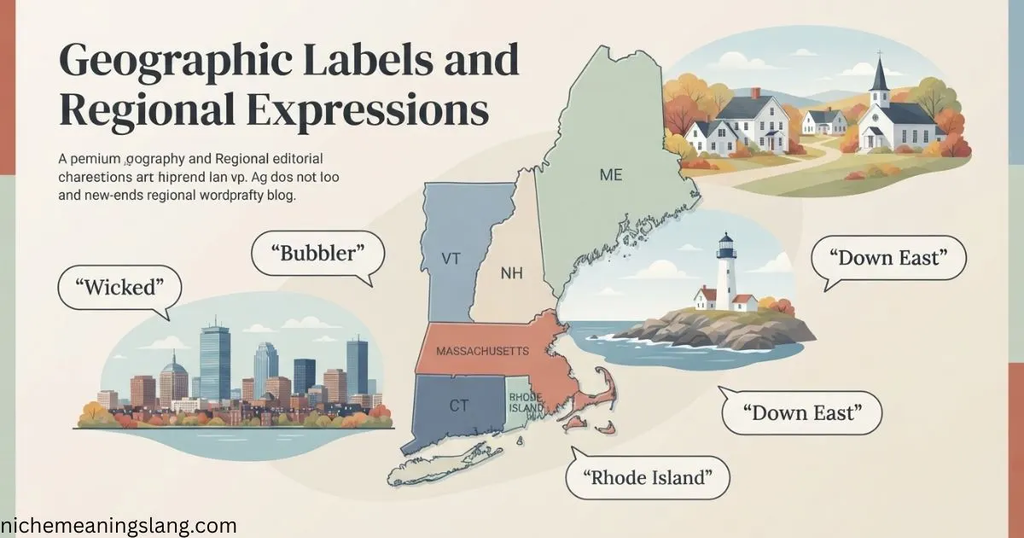
Geographic Labels and Regional Expressions
New England contains six states, and their local speech is not identical. Boston vocabulary may sound different from rural Maine expressions, while Vermont and New Hampshire have their own rural and mountain-area traditions. Knowing where an expression is used can help you avoid assuming that every local says the same thing.
Massachusetts and Boston Slang
Massachusetts is particularly associated with “wicked,” “packie,” “rotary,” “grinder,” and “the T.” The Boston accent is also famous for its tendency to drop the “r” sound in certain words, although pronunciation varies significantly between speakers.
Example: “It’s wicked cold, so let’s take the T instead of walking.”
Maine Slang
Maine is known for expressions such as “ayuh,” “Down East,” and “door yard.” Coastal traditions, fishing communities, rural life, and local pronunciation all contribute to the state’s distinctive vocabulary.
Example: “Ayuh, we’ll meet you in the door yard before heading Down East.”
Vermont Slang
Vermont speech includes some regional terms associated with rural life, mountain communities, tourism, and changing seasons. “Flatlander” can refer to someone from a less mountainous area, while “leaf peeper” describes a visitor who comes to see autumn foliage.
Example: “The roads are full of leaf peepers when the fall colors arrive.”
New Hampshire Slang
New Hampshire shares many expressions with neighboring Massachusetts, Maine, and Vermont. Local usage can change between southern towns, mountain communities, and rural areas.
Example: “We need to take a uey because we missed the road.”
Rhode Island Slang
Rhode Island has its own local vocabulary and distinctive pronunciation patterns. “Bubbler,” meaning a drinking fountain, is particularly associated with Rhode Island and some neighboring areas.
Example: “Let’s stop by the bubbler before we head outside.”
Connecticut Slang
Connecticut shares vocabulary with the broader New England region, but local speech can differ between coastal communities, the Hartford area, and towns closer to New York.
Example: “We grabbed a grinder before heading home.”
These examples illustrate regional associations, not strict state borders. People move, slang spreads through media, and some expressions are understood far beyond their original communities.
Everyday Examples of New England Slang
The easiest way to learn New England slang is to see how people use it in realistic situations. These examples combine common expressions with ordinary American English.
| Situation | Example sentence | Meaning |
| Complimenting food | “This chowder is wicked good.” | The chowder is extremely good. |
| Giving directions | “Bang a uey at the lights.” | Make a U-turn at the traffic lights. |
| Asking for water | “Is there a bubbler nearby?” | Is there a drinking fountain nearby? |
| Buying a drink | “I’ll stop at the packie.” | I’ll stop at the liquor store. |
| Talking about weather | “It’s wicked cold today.” | It is extremely cold today. |
| Discussing travel | “We’re heading Down East.” | We’re traveling toward coastal Maine. |
| Taking public transit | “I’ll meet you after I get off the T.” | I’ll meet you after using Boston’s transit system. |
| Talking about autumn | “The leaf peepers are here already.” | Visitors have arrived to see fall foliage. |
| Ordering lunch | “I’ll have an Italian grinder.” | I’ll have a submarine sandwich. |
| Agreeing casually | “Ayuh, sounds good.” | Yes, that sounds good. |
You do not need to memorize every expression at once. Start with words you are likely to hear in ordinary conversations, especially “wicked,” “bubbler,” “grinder,” and “the T.” Add more localized phrases as you learn about specific towns and communities.
How to Use New England Slang Naturally
Pay attention to location. If you are talking with someone from Boston, “wicked” or “the T” may be familiar. Someone from coastal Maine may use expressions that are less common in Boston.
Listen to pronunciation. Regional accents can change how familiar English words sound. The well-known Boston tendency to drop certain “r” sounds is one example, but not everyone in Massachusetts speaks with the same accent.
Match the situation. Words such as “wicked” fit casual conversation, while terms like “packie” are informal regional vocabulary. Use standard language in professional settings unless the context is relaxed.
Avoid forcing an accent. Learning local vocabulary is a good way to understand people and connect with a place. Copying an accent excessively can sound unnatural, so focus on meaning and respectful communication.
Remember that usage changes. Some expressions are common today, while others are older, humorous, or especially associated with particular towns and generations.
Conclusion
New England slang gives American English a distinctive regional character, from Boston’s famous “wicked” to Maine’s “ayuh,” Rhode Island’s “bubbler,” and the familiar phrase “bang a uey.” These words and expressions reflect the region’s local traditions, geography, accents, and everyday routines. However, New England is not linguistically uniform: vocabulary can differ between states, towns, and generations. Start with the most recognizable expressions, learn their meanings in context, and pay attention to how local people actually use them. Whether you are visiting the Northeast or simply curious about American regional English, understanding New England slang can make conversations easier and more enjoyable.
FAQs
1. What are some common New England slang words?
Common examples include “wicked,” “bubbler,” “packie,” “rotary,” “grinder,” “frappe,” “ayuh,” and “the T.” Their popularity varies by state and community.
2. What does “wicked” mean in New England slang?
“Wicked” often means “very” or “extremely.” For example, “wicked cold” means extremely cold, and “wicked good” means very good. It is particularly associated with Massachusetts and the Boston area.
3. What does “bubbler” mean in New England?
A “bubbler” is a drinking fountain or water fountain. The word is strongly associated with Rhode Island and is also used in parts of Massachusetts.
4. How do people in Maine say yes?
“Ayuh” is a recognizable Maine expression that means “yes” or “yup.” It is particularly associated with rural Maine speech, although not every resident uses it regularly.
5. What does “packie” mean in Boston?
“Packie” is an informal term for a liquor store, derived from “package store.” It is commonly associated with Massachusetts and neighboring parts of New England.
6. What does “bang a uey” mean?
“Bang a uey” means to make a U-turn. It is a familiar expression in Massachusetts and Boston-area conversation.
7. What is a grinder in New England?
A “grinder” is a submarine-style sandwich, typically made with a long roll and fillings such as meat, cheese, vegetables, or dressing. The word is associated with parts of New England and other northeastern areas.
8. What is a frappe in Massachusetts?
A “frappe” is an ice-cream-based milkshake. In parts of Massachusetts, this differs from a traditional “milkshake,” which may be made with milk and flavoring without ice cream.
9. Do all six New England states use the same slang?
No. Massachusetts, Maine, Vermont, New Hampshire, Rhode Island, and Connecticut share some vocabulary, but local expressions and pronunciation vary by area, community, and generation.
10. What does “the Cape” mean in New England?
In many local conversations, “the Cape” refers to Cape Cod, Massachusetts. The intended meaning usually depends on the speaker’s location and the surrounding conversation.
11. What does “leaf peeper” mean?
A “leaf peeper” is someone who travels to see colorful autumn foliage. The term is particularly relevant in New England, where fall colors attract many visitors.
12. What does “Masshole” mean?
“Masshole” is a teasing or insulting term for someone from Massachusetts, often used to describe a stereotypically aggressive driver. It can be humorous among friends but offensive in other contexts.
13. What is the Boston accent known for?
The Boston accent is widely associated with dropping the “r” sound in certain words, as in the familiar phrase “pahk the cah.” Actual pronunciation varies, and not all Boston residents speak the same way.
14. Is New England slang still used today?
Yes. Many expressions, including “wicked,” “grinder,” and “bubbler,” remain recognizable. Some are used frequently in certain communities, while others are more traditional, humorous, or localized.
15. What is the best way to learn New England slang?
Start with common words, read examples in context, listen to local speakers, and learn which expressions belong to particular areas. Using a few familiar terms naturally is better than forcing an entire regional accent.
Related Slang Words

Ryan Mitchell is a language enthusiast and writer who explores slang, modern expressions, and everyday language. At nichemeaningslang, he helps readers understand slang meanings, usage, and context in a simple and easy-to-follow way.