K Meaning in Chat What Does “K” Really Mean in Text?
If you receive a message that simply says “K,” it usually means “okay,” but the tone can change depending on the conversation, relationship, punctuation, and context. In everyday texting, this tiny abbreviation can signal agreement, acknowledgment, understanding, or a desire to keep things brief.
After researching modern texting language and the way people actually use short replies, one thing becomes clear: the biggest problem is rarely the definition itself. The real confusion comes from tone, digital communication, social media habits, quick replies, emotional conversations, and relationship dynamics. This guide breaks down those clues so you can understand a “K” without immediately assuming someone is angry.
What Does K Mean in Text & Chat?
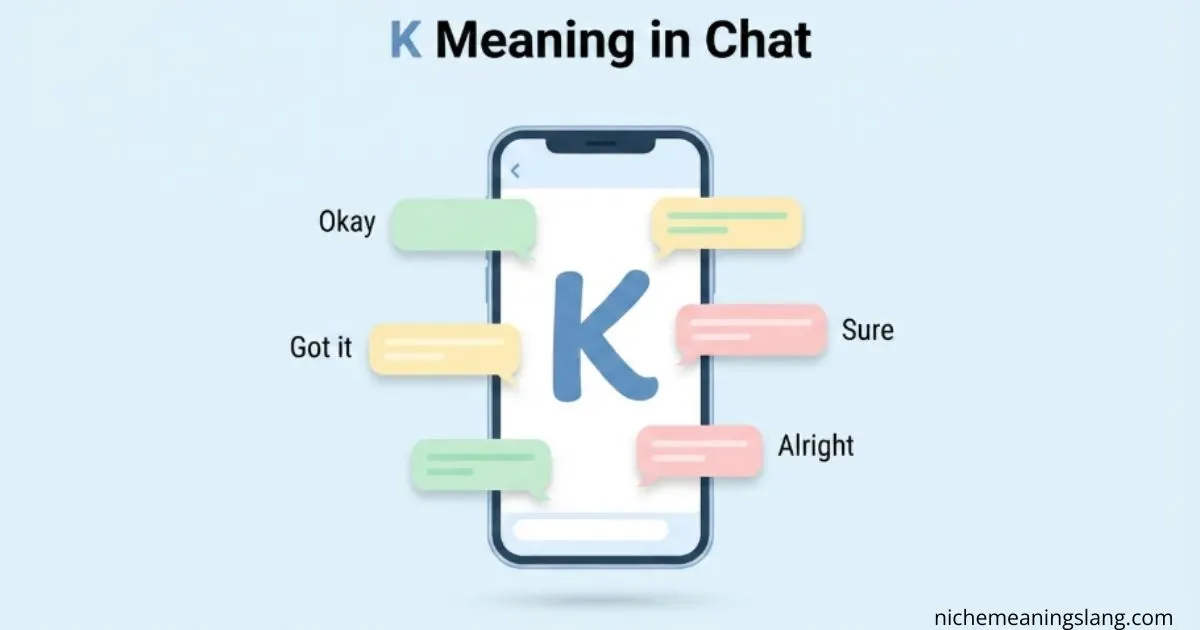
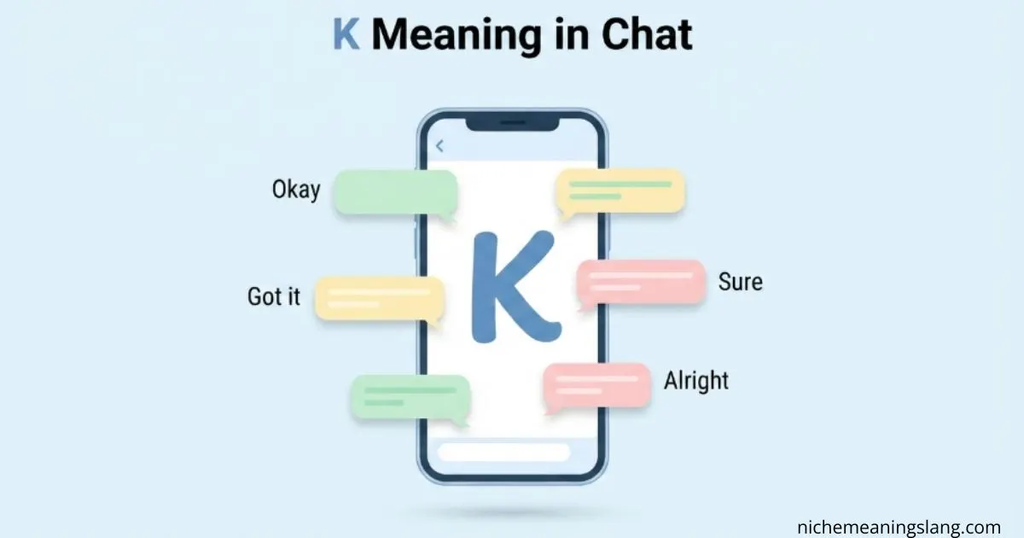
In text and chat, K usually means “okay,” “alright,” “got it,” or “I understand.” It is a shortened response used for quick acknowledgment, agreement, confirmation, or simply keeping a conversation moving. In casual messaging, the sender may not attach any negative emotion to it at all.
However, context matters more than the single letter. A friend saying “K” after “I’ll see you at 7” is probably just confirming the plan. But after an emotional message, “K” may feel cold, distant, dismissive, or uninterested. The surrounding conversation gives the better answer.
Quick meanings of “K”
The most common interpretations are okay, got it, understood, sure, and message received. It can also function as a conversation closer. The important distinction is that “K” does not automatically communicate anger; its emotional meaning develops from timing, previous messages, punctuation, and the sender’s normal texting style.
Full Form, Stands For & Short Meaning of K
“K” does not have a special multi-word full form in ordinary texting. It is generally a shortened form of “OK” or “okay.” The progression is essentially OK → okay → K, reflecting the broader habit of shortening familiar expressions for faster digital communication.
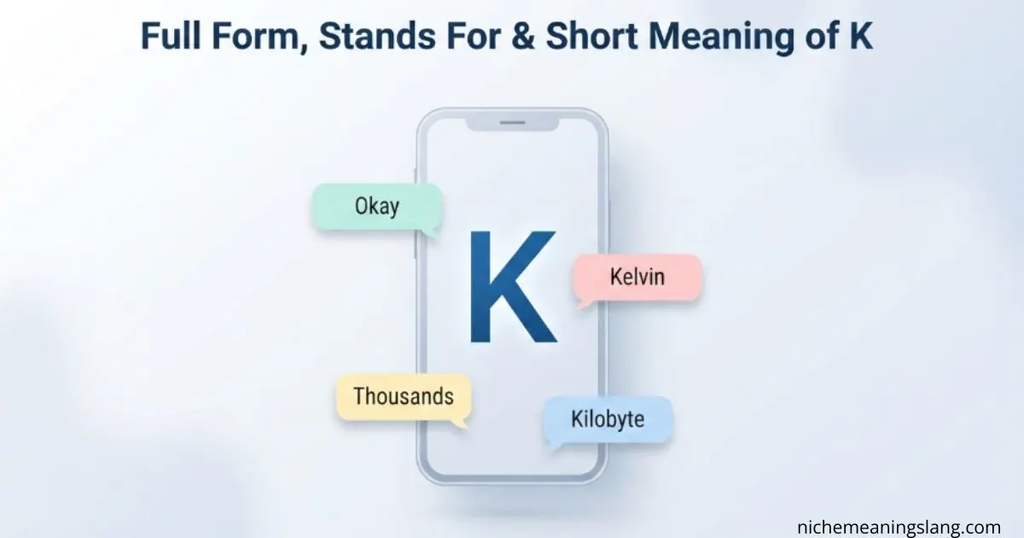
This makes K different from acronyms such as “LOL” or “BRB.” Instead of representing several words, it is primarily a shortened spelling and conversational acknowledgment. In practical terms, “K” can communicate “okay,” “fine,” “understood,” or “message received,” depending on the circumstances.
| Text | Common meaning | Typical feeling |
| K | Okay | Very brief |
| OK | Okay | Neutral |
| Okay | Agreement | Warmer |
| KK | Okay / got it | Casual, friendlier |
| Sure | Agreement | Positive |
| Got it | Understood | Clear |
| Sounds good | Agreement | Warm |
These distinctions are not absolute rules. People have different texting personalities, and one person’s ordinary “K” can sound completely different from another person’s. Competitor research repeatedly emphasizes that tone and context should be considered before assigning emotion to a short reply.
Meaning of K in Different Contexts
In a friendly conversation, “K” often means nothing more complicated than “okay” or “sounds good.” A person might use it because they are driving, working, distracted, or simply accustomed to short replies. A quick acknowledgment can be efficient without carrying any hidden emotional message.
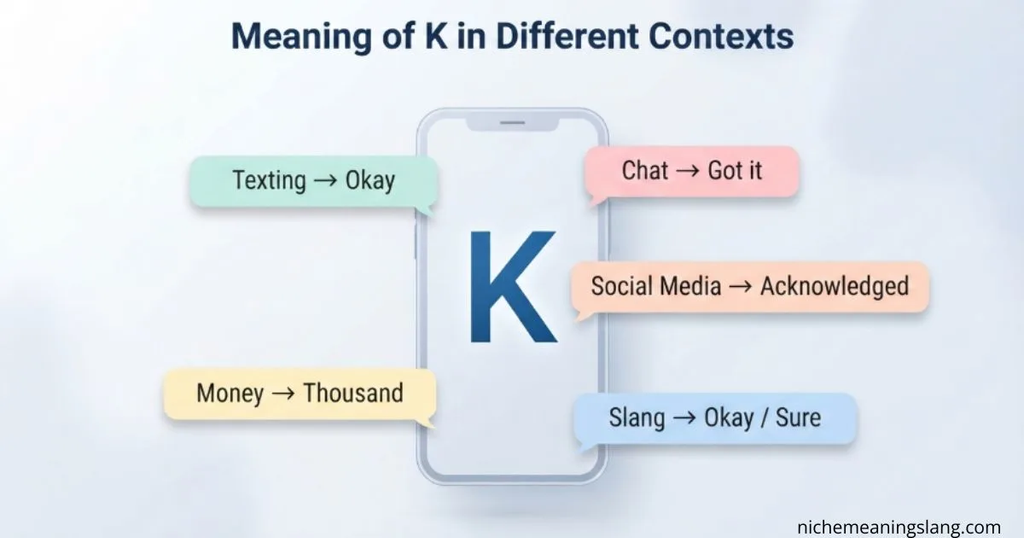
Relationships make the interpretation more sensitive. After an apology, disagreement, romantic message, or serious discussion, a lone “K” may feel emotionally distant. In workplace or gaming chats, however, the same letter can simply mean received, understood, ready, or confirmed.
Friendly Chat
Imagine a friend texts, “Movie at 8?” and you answer, “K 👍.” The message clearly functions as agreement and confirmation. The emoji softens the short response, making it feel more relaxed. This is why identical words can produce different impressions when the surrounding emotional signals change.
Family Messages
In family texting, K can simply acknowledge an instruction: “Don’t forget the groceries.” → “K.” Here, the sender may be communicating understood, will do, or okay rather than trying to end the relationship or express frustration. Familiarity between people can make short replies feel completely ordinary.
Relationship Conversations
Romantic conversations are where “K” can become surprisingly complicated. If someone sends a heartfelt message and receives only “K,” the short response may feel dismissive or emotionally distant. Still, it does not prove that the person is angry; previous messages, habits, timing, and relationship dynamics provide better evidence.
K Meaning Across Different Platforms
Across WhatsApp, Instagram, Snapchat, TikTok, Facebook Messenger, and other messaging platforms, K generally retains its basic meaning of okay or acknowledgment. What changes is the social environment. Some platforms encourage extremely short replies, while comments and DMs can make minimal responses feel more noticeable.
For example, a K in a fast Snapchat conversation may feel perfectly normal, while a K in an emotional Instagram DM may feel abrupt. Platform culture can influence expectations, but it still does not override the most important factor: the actual conversation between the two people.
| Platform | Common interpretation of K |
| Okay, understood, acknowledgment | |
| Okay, sure, or sometimes dry | |
| Snapchat | Okay, got it, quick response |
| TikTok | Okay, agreement, sometimes dismissive |
| Facebook Messenger | Okay, understood |
| Discord | Okay, ready, continue |
The safest approach is to avoid treating platforms as fixed dictionaries. The same person may use K casually on WhatsApp and more seriously on Instagram. Their personal texting habits often tell you more than the app itself.
On WhatsApp, K is commonly used as a quick acknowledgment. Someone might send it after receiving a plan, update, reminder, or request. In an ordinary personal chat, there is usually no reason to interpret the letter as hostile unless the preceding conversation already contains tension.
Instagram DMs can make K feel more ambiguous because conversations may involve flirting, friendships, reactions, and casual social interaction. “K” might simply mean okay, but after a personal or emotional message, its brevity can make the response feel less engaged.
Snapchat
Snapchat encourages fast, casual communication, so K can simply mean “got it” or “okay.” If someone normally communicates with one-word replies, there may be little emotional meaning behind it. Compare the reply with that person’s usual behavior rather than judging one message in isolation.
TikTok
On TikTok, K may appear in comments as a short acknowledgment, agreement, joke, or dismissive reaction. Comment sections also have stronger meme and sarcasm cultures, so the surrounding video and discussion can matter when interpreting the intent.
How to Respond to K
If someone sends you K, your response should match the situation rather than automatically treating it as a problem. If the conversation was casual, you can simply continue normally. “Cool,” “Sounds good,” or another natural response usually works when the message clearly means acknowledgment.
If K arrives after an emotional message and feels unusually cold, avoid immediately escalating the situation. A calm question such as “Everything okay?” gives the other person an opportunity to explain. If the conversation has naturally ended, no response may be necessary at all.
If K Means Okay
When the surrounding conversation is friendly, there is usually nothing to decode. You can answer naturally or move forward with the plan. A short “K” after “See you at 7” is normally just confirmation, especially when the sender regularly communicates in brief messages.
If K Seems Cold
Look at what came immediately before it. If you sent a long emotional explanation and received only “K,” the response may feel distant. Rather than assuming anger, ask a simple question and allow the person to clarify their tone.
If the Conversation Is Finished
Sometimes K is simply a natural stopping point. If the previous message did not require a response, you do not need to manufacture another message. Ending a chat with a brief acknowledgment can be completely normal, especially during busy everyday communication.
Is K Rude or Passive Aggressive?
K is not automatically rude or passive-aggressive. It can be completely neutral when used between people who already communicate in short messages. The problem is that text removes facial expressions, vocal tone, and body language, leaving readers to interpret emotion from very little information.
A K is more likely to feel rude when it follows an emotional statement, disagreement, apology, serious question, or unusually long message. Punctuation can also influence perception: “K.” may feel more final than “K,” while “K 😊” obviously adds a warmer signal.
The most reliable clue is behavioral change. If someone normally writes full sentences and suddenly starts replying with repeated Ks, the change may indicate reduced engagement, frustration, distraction, or simply being busy. One isolated message is weak evidence; a consistent pattern tells you much more.
Difference Between K and Similar Texting Responses
“K,” “OK,” “Okay,” “KK,” “Sure,” and “Got it” can all communicate acknowledgment, but their perceived tone is not identical. Competitor comparisons consistently position K as the shortest and most clipped option, while “Okay” and “Sounds good” tend to feel more complete or warm.
| Response | Meaning | Common tone |
| K | Okay | Very brief |
| OK | Okay | Neutral |
| Okay | Agreement | Warm |
| KK | Okay / got it | Friendly |
| Sure | Agreement | Positive |
| Got it | Understood | Clear/professional |
| Sounds good | Agreement | Warm |
This does not mean K is always colder. Personal habits matter. Someone who has typed K for years may use it without emotional intention, while another person may deliberately choose it when they want to keep a conversation short.
Real Chat Examples Using K
Real-world examples make the difference easier to understand because the same letter can communicate very different impressions. Compare “I’ll be there at 7.” → “K” with “I’m really hurt by what happened.” → “K.” The letters are identical, but the conversational context is completely different.
| Situation | Message | Reply | Likely meaning |
| Plans | “Meet at 7?” | “K” | Agreement |
| Friend | “I’m outside.” | “K 👍” | Acknowledgment |
| Work | “Send the report.” | “K” | Received |
| Casual | “I’m leaving now.” | “K” | Understood |
| Emotional | “I feel ignored.” | “K” | May feel dismissive |
| Argument | “Can we talk?” | “K.” | Could feel cold |
| Gaming | “Hold position.” | “K” | Understood/ready |
The lesson is simple: do not interpret the letter separately from the conversation. Look at what was said before it, how quickly the response arrived, whether punctuation was used, and whether the sender normally writes this way.
WhatsApp chat
Person A: “I’ll be late.”
Person B: “K.”
Here, K is probably just acknowledgment. There is no obvious emotional conflict, so the simplest interpretation“okay, got it”makes the most sense.
Instagram DM
Person A: “Check my new post when you get a chance.”
Person B: “K 👍”
The emoji makes the response feel more relaxed. The message is short, but there is little evidence that the sender is annoyed or uninterested.
Emotional chat
Person A: “I’m sorry. I really didn’t mean to hurt you.”
Person B: “K.”
This can feel cold because the emotional weight of the first message is much greater than the one-letter reply. Even here, though, K does not prove anger; the person could be processing their feelings or simply not know what to say.
Popularity and Trends Over Time
K remains part of modern digital communication because short replies are efficient. Texting evolved around speed, limited keyboards, and the desire to communicate quickly, and abbreviated forms became part of online language. Today, K continues to appear across messaging apps and social platforms.
What has changed is how people perceive the tone. Many users now recognize that a single K can sound more abrupt than “Okay,” “Sure,” or “Sounds good.” Social media discussions and memes have also reinforced the idea that a lone K can feel intimidating or passive-aggressive, even when the sender meant nothing negative.
The safest interpretation is therefore not “K means anger” or “K means everything is fine.” Instead, think of K as a context-sensitive acknowledgment. Its dictionary-like meaning is usually “okay,” while its emotional meaning depends on the relationship, conversation, timing, punctuation, and personal texting style.
Conclusion
The K meaning in chat is usually simple: “okay,” “alright,” “got it,” or “I understand.” But the emotional tone is not fixed. Depending on the conversation, relationship, punctuation, and timing, K can feel neutral, casual, cold, dismissive, or even passive-aggressive.
The biggest mistake is assuming that one letter tells you exactly how someone feels. If a friend normally sends short replies, “K” may mean absolutely nothing beyond acknowledgment. If someone suddenly sends “K.” after an emotional conversation, it may deserve a little more attention.
So, when you see K in a chat, start with the simplest interpretation okay and then look at the context. That approach will help you understand digital conversations without turning one tiny letter into a much bigger problem.
FAQs
What does K mean in chat?
K usually means “okay” or “alright.” It can acknowledge a message, confirm information, express agreement, or indicate that the sender has understood what was said.
Is K rude in texting?
Not necessarily. K can be completely normal in casual conversations. However, after an emotional message, disagreement, or serious discussion, a single K may feel cold or dismissive.
Does K mean someone is mad?
No. K does not automatically mean someone is angry. The surrounding conversation and the sender’s usual texting style are much better indicators of emotion than the single letter itself.
What does K mean from a girl?
Usually, K simply means okay or acknowledgment. Depending on the conversation, it can also indicate that she is busy, distracted, uninterested, or ready to end the conversation. Context matters.
What does K mean from a guy?
It usually means okay, understood, or message received. A guy may also use K because he is busy or naturally prefers short replies. A single K does not prove he is upset.
What is the difference between K and KK?
Both can mean “okay,” but KK often feels more casual or friendly, while a single K can feel shorter or more abrupt. The sender’s normal texting style still matters.
What does K mean on Snapchat?
On Snapchat, K generally means okay, got it, or acknowledgment. Because Snapchat conversations are often fast and casual, a short reply may not carry any negative meaning.
Why do people only reply with K?
People may reply with K because it is quick, convenient, and easy to type. They may also be busy, acknowledging information, or signaling that they have nothing more to add.
Is “K.” different from “K”?
It can feel different. A period can make the message appear more final, serious, or irritated, although punctuation habits vary between individuals. Context should always be considered before assuming an emotional meaning.
Related Slang Words

Ryan Mitchell is a language enthusiast and writer who explores slang, modern expressions, and everyday language. At nichemeaningslang, he helps readers understand slang meanings, usage, and context in a simple and easy-to-follow way.