Cop Slang Meaning Definition, Origin, Uses & Examples
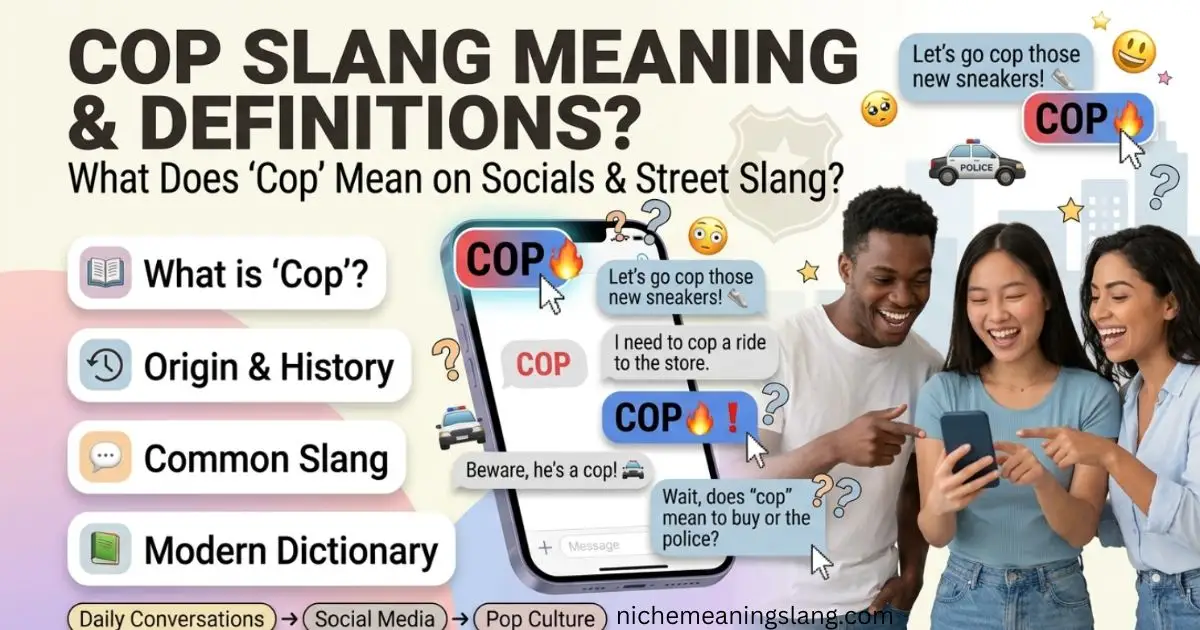
Cop slang most commonly means a police officer, but “cop” can also mean to get, buy, obtain, catch, or admit something depending on context. If you have heard someone say “there’s a cop outside” and later “I’m gonna cop those sneakers,” the difference can feel confusing. After studying slang usage and word origins, I’ve found that the surrounding sentence not one fixed definition is usually the fastest clue. Police slang, informal English, street slang, law enforcement, and modern texting all shape how the word works.
The useful part is that cop slang becomes surprisingly easy once you recognize its patterns. In American conversation, a cop usually points to a police officer, while to cop something often means get, buy, acquire, or grab it. Expressions such as cop out, cop to something, and cop a plea add separate meanings. This guide connects those everyday phrases with their historical origin, modern streetwear and sneaker usage, legal language, contextual clues, and respectful alternatives so you can understand the word without guessing.
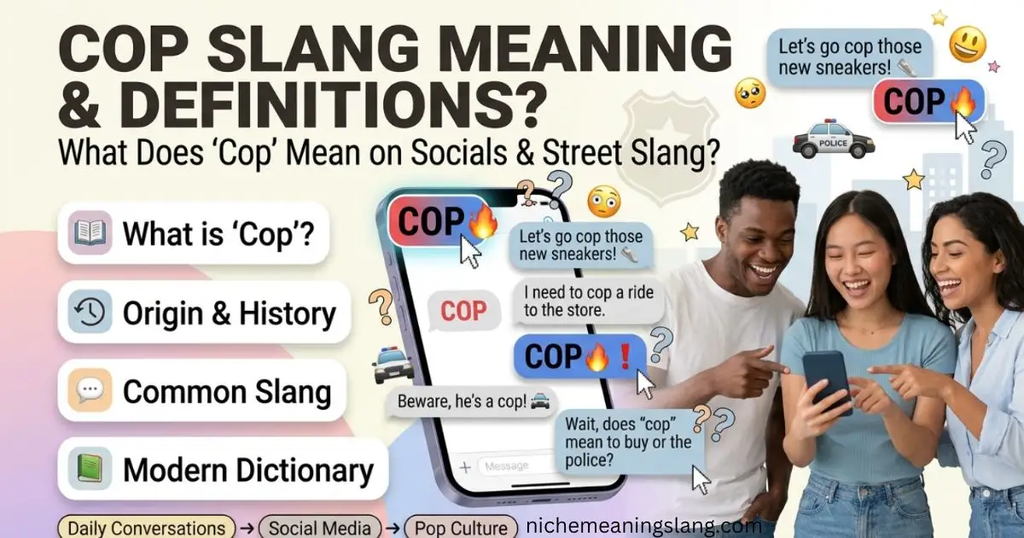
“Cop” Meaning, Origin and Usage
“Cop” works as both an informal noun and verb. As a noun, it commonly refers to a police officer. As a slang verb, it can mean get, buy, obtain, catch, or acquire something. That flexibility explains why context matters so much in everyday English and online conversation.
The historical meanings are connected rather than random. Older uses of cop involve the idea of seizing, catching, or taking, which helps explain both the police-related copper/cop sense and later slang about obtaining things. Modern speakers have simply extended an old semantic idea into new cultural settings.
What Does “Cop” Mean?
When cop is a noun, its most familiar American meaning is an informal word for a police officer: “A cop pulled him over.” Dictionaries classify this usage as informal, while police officer or officer is generally more appropriate in formal or professional communication.
As a verb, however, cop often means get, obtain, grab, or buy. Someone saying “I need to cop those shoes” is normally talking about acquiring the shoes, not law enforcement. Sneakers, clothing, games, tickets, merchandise, and other desirable items commonly create this context.
Origin of “Cop”
The strongest etymological evidence does not support the popular “Constable on Patrol” acronym story. Etymonline records cop meaning “seize/catch/capture” from 1704, copper for a policeman from 1846, and shortened cop for policeman from 1859.
That history provides a logical semantic bridge. A copper was associated with someone who cops that is, catches or seizes and cop later became the shortened police term. World Wide Words likewise rejects “Constable on Patrol” and copper-badge explanations as unreliable origin stories.
Common Meanings of “Cop”
The four useful meanings to remember are police officer, get/buy, receive/experience, and catch/capture. American users are especially likely to encounter the first two: “a cop stopped me” refers to law enforcement, while “I copped a hoodie” means someone got or bought it.
Other varieties of English may use cop for receiving something, particularly something unpleasant, while older or less common uses retain the sense of catching. Modern slang can therefore look unrelated until you recognize the recurring semantic idea of taking, getting, receiving, or seizing something.
| Cop slang usage | Meaning | Example |
| a cop | police officer | “A cop was directing traffic.” |
| cop something | get/buy | “I’m going to cop those shoes.” |
| copped something | obtained/bought | “She copped concert tickets.” |
| cop to something | admit | “He copped to the mistake.” |
| cop out | avoid/back out | “Don’t cop out now.” |
| cop a plea | accept a plea arrangement | “He decided to cop a plea.” |
Common Phrases with “Cop”
Cop out means backing away from an obligation or taking an easy escape. Cop to something means admitting or confessing something. Cop a plea is a legal expression connected with admitting guilt under a plea arrangement. These phrases cannot be interpreted simply as “police officer.”
The same pattern appears in expressions such as cop an attitude. Dictionary.com documents multiple verb constructions built around grabbing, obtaining, confessing, or assuming something. For readers trying to understand cop slang, memorizing the complete phrase is usually more useful than memorizing the word alone.
A police officer
As a noun, cop is a widely understood informal term for a police officer in the United States. You may hear “call the cops,” “a New York cop,” “cop car,” or “traffic cop” in everyday speech, television, movies, journalism, and casual conversation.
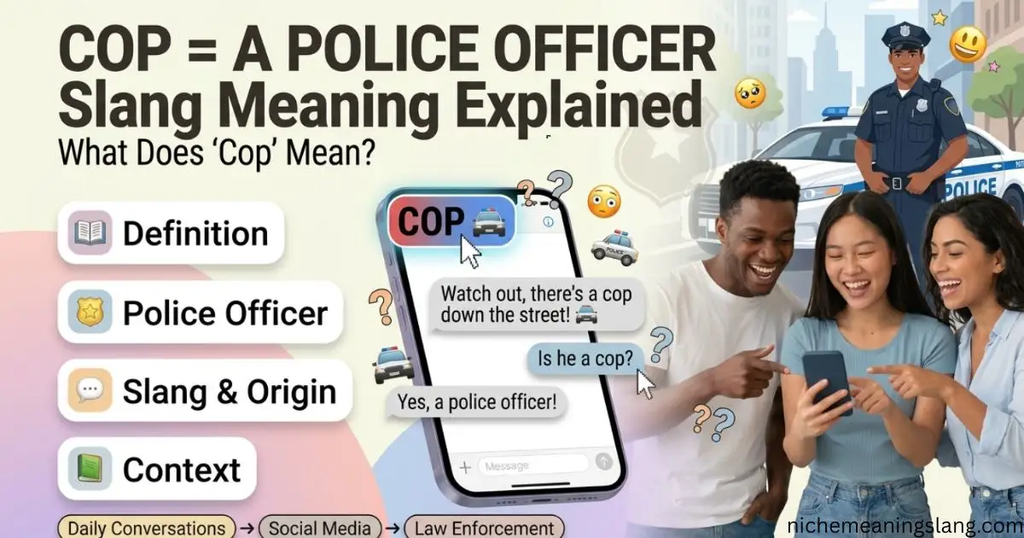
Although the term began as slang, it has become extremely familiar. Oxford labels it informal, and Wiktionary notes that it has moved into general use, including journalism and police-related contexts. Still, police officer remains the clearer, more neutral choice for formal or respectful writing.
Who uses cop?
People across age groups use cop casually, and the term appears in entertainment, news, conversation, and law-enforcement discussions. Dictionary.com notes that police officers themselves may also use the convenient gender-neutral term, although tone can still affect how respectful or dismissive it sounds.
Context therefore matters more than assuming the word is automatically insulting. “A cop helped us after the crash” sounds neutral, while hostile wording surrounding cop can obviously change the tone. In professional reports, academic work, and formal correspondence, police officer usually avoids that ambiguity.
Related Terms to “Cop”
Cop slang sits inside a larger network of American police terminology. Related terms include officer, police officer, law enforcement officer, Five-O, fuzz, po-po, narc, cop car, and squad car. These words overlap semantically, but their tone, era, and exact reference can differ.
For example, officer sounds neutral, Five-O and po-po are clearly slangy, narc has a more specialized association, and pig is derogatory. Knowing those differences is useful because replacing one police term with another can unexpectedly change the emotional tone of a sentence.
Synonyms for “Cop”
When cop means a police officer, useful alternatives include police officer, officer, law enforcement officer, and sometimes constable, depending on jurisdiction. When the verb means acquire something, better equivalents include get, buy, grab, pick up, obtain, acquire, or secure.
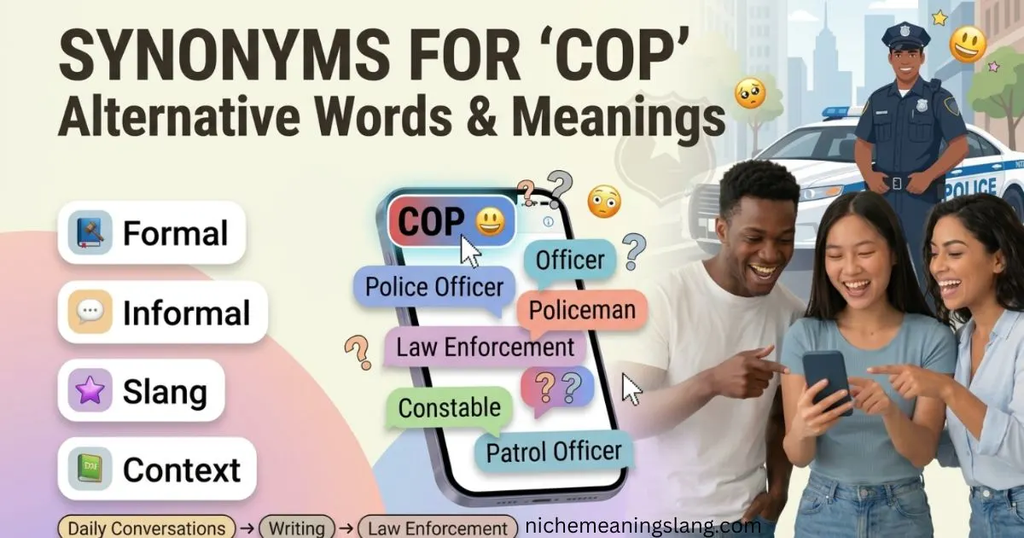
Choosing the synonym depends on register. “I copped the sneakers” sounds casual and streetwise; “I purchased the sneakers” sounds formal. Likewise, “the cops arrived” is conversational, while “police officers arrived” better suits an official report. Meaning and tone should always be considered together.
Examples of “Cop”
Real examples are the fastest way to understand cop slang because grammatical position immediately narrows the meaning. In “A cop is outside,” cop is a noun referring to an officer. In “I copped the jacket,” it is a verb meaning obtained or bought.
Phrases create another layer. “He copped to it” means he admitted something, whereas “she copped out” means she backed away or avoided responsibility. Instead of treating cop as one definition, read the surrounding verb pattern, object, situation, and conversational tone.
Example 1: Talking About a Police Officer
Maya: “Why is traffic stopped?”
Jordan: “There’s a cop directing cars at the intersection.”
Here, cop clearly means police officer. The references to traffic and directing cars establish a law-enforcement context, so meanings such as buy, get, or obtain would make no grammatical sense.
Example 2: Talking About Buying Something
Chris: “Those sneakers drop Friday.”
Dylan: “Yeah, I’m trying to cop them.”
Here, cop means buy, get, or secure the sneakers. This usage is common in informal conversations involving desirable products, fashion, footwear, merchandise, tickets, and releases where getting the item may feel competitive or time-sensitive.
Example 3: Using “Cop Out”
Ava: “You promised you’d come with us.”
Noah: “I might stay home.”
Ava: “Don’t cop out now.”
Cop out means back out, avoid responsibility, or take an easy escape. It functions as its own established expression, so translating cop as police officer or purchase would completely miss the speaker’s meaning.
Example 4: Using “Cop To”
Sam: “Did he admit he broke it?”
Alex: “Yeah, he finally copped to it.”
Here, copped to means admitted or confessed to something. The construction is especially useful for recognizing context: when cop is followed by to and an action, accusation, mistake, or wrongdoing, admission is a likely interpretation.
Conclusion
Cop slang most commonly refers to a police officer, but that is only part of the word’s story. As a verb, cop can mean get, buy, obtain, catch, or acquire, while expressions such as cop out, cop to something, and cop a plea have their own established meanings.
Historically, the police sense is best connected to older cop meanings involving seizing or catching, with copper recorded for a policeman before shortened cop. The popular “Constable on Patrol” explanation is a folk etymology, not the accepted historical origin.
For modern readers, one rule solves most confusion: read the entire sentence. “A cop” usually means an officer; “cop those shoes” means get or buy them; “cop out” means back away; and “cop to it” means admit it.
FAQs
The live search interface did not expose a verified Google People Also Ask module that I can quote as such, so I won’t falsely label questions as current Google PAA. These are PAA-style questions supported by the current ranking-page/search-intent patterns.
What does cop mean in slang?
Cop commonly means a police officer. As a slang verb, it can also mean to get, buy, grab, or obtain something, such as “I’m going to cop those sneakers.”
Why are police called cops?
The strongest etymological explanation connects cop with an older verb meaning seize, catch, or capture. Copper was recorded for a policeman in the 1840s and shortened cop appears by 1859.
Does cop mean buy?
Yes. In modern informal English, to cop something can mean to buy, get, acquire, or secure it. “Did you cop the new shoes?” essentially asks whether someone got or bought them.
What does “cop it” mean?
In British informal usage, cop it can mean receiving punishment, trouble, or another unpleasant consequence. Oxford also records a stronger context in which it can mean being killed.
What does “cop out” mean?
Cop out means to back away, avoid responsibility, give up, or choose an easy excuse. A cop-out can also be a noun describing an excuse or evasive action.
What does “cop to” mean?
Cop to something means to admit or confess it, particularly when the subject involves wrongdoing, responsibility, or something embarrassing.
What does “cop a plea” mean?
In American legal usage, cop a plea refers to admitting guilt as part of a plea arrangement, typically involving a lesser charge or negotiated outcome.
Is “cop” a derogatory word?
Not necessarily. It is primarily informal, and it is now widely used. However, police officer or officer is generally more neutral and suitable when respectful or formal language matters.
Is cop short for “Constable on Patrol”?
No reliable etymological evidence supports that acronym. Linguistic sources instead trace the police meaning through cop/copper and older senses involving seizing or catching.
What does “cop” mean in sneaker slang?
In sneaker, fashion, and streetwear conversations, cop means to buy, acquire, or secure an item. “Cop or drop?” therefore asks whether something is worth getting rather than referring to police.
Related Slang Words

Ryan Mitchell is a language enthusiast and writer who explores slang, modern expressions, and everyday language. At nichemeaningslang, he helps readers understand slang meanings, usage, and context in a simple and easy-to-follow way.