19 Mexican Slang for Homie Words You’ll Actually Hear
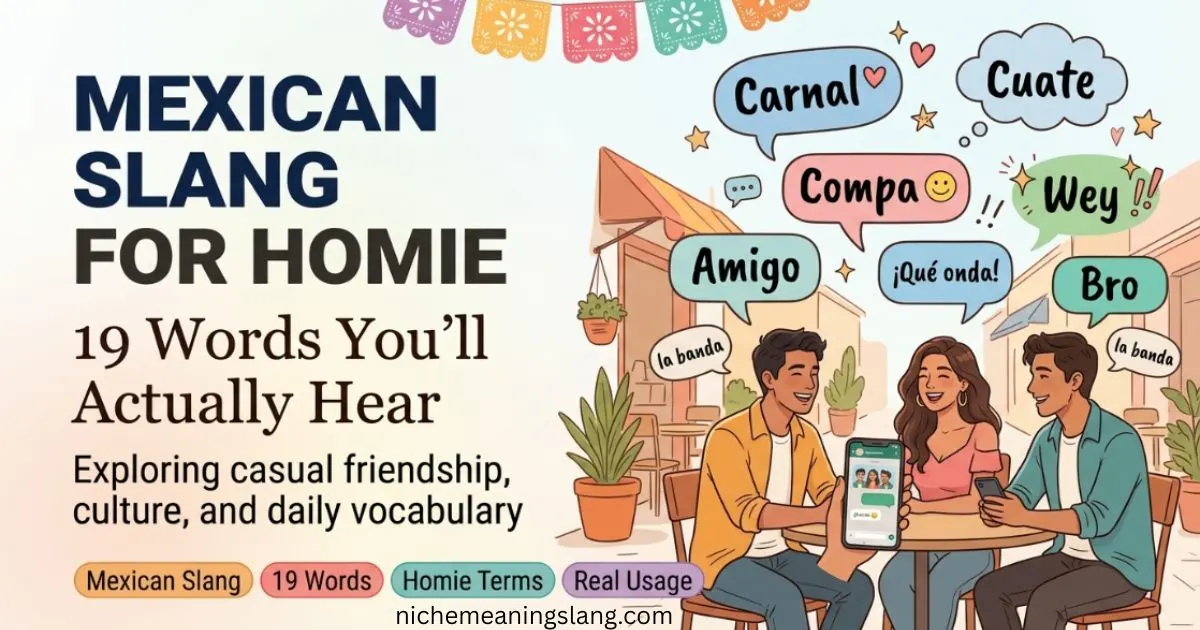
If you’re looking for Mexican slang for homie, the closest everyday choices are usually carnal, compa, cuate, and güey, but they do not all carry the same feeling. Mexican Spanish uses friend slang, buddy terms, brother expressions, and casual forms of address differently depending on tone, region, age, and familiarity.
In researching this topic, the biggest mistake is treating every Mexican slang word as a perfect translation of “homie.” A good expression should fit the relationship. Carnal suggests brother-like loyalty, compa feels friendly and familiar, while güey is more flexible but can become insulting. This guide helps you choose naturally.
Word of Caution
Mexican slang is highly dependent on context, tone, regional usage, and familiarity. A word that sounds affectionate between longtime friends can feel disrespectful from a stranger. Güey is a good example: dictionaries record both friendly “dude/man” meanings and an insulting “idiot” sense.
The Psychology & Culture Behind “Homie” Slang
Calling someone carnal or compa can communicate more than friendship; it can signal trust, familiarity, and social closeness. Competitor research also highlights music, memes, messaging, migration, and Mexican-American communities as forces that continually reshape slang and its spelling or tone.
Amigacho/a
Amigacho is a playful form built around amigo, meaning something like “buddy” or “pal.” It belongs more to the informal side of Mexican Spanish than standard vocabulary. Because it is less universally recognizable than compa or güey, it is better understood through context rather than treated as the default word for homie.
Cabron
Cabrón requires caution. Among close friends it can be teasing or affectionate, but it can also mean something considerably harsher. That makes it very different from a neutral amigo. If you do not already understand the relationship and tone between speakers, choosing compa or carnal is safer.
Carnal
Carnal is one of the strongest answers to Mexican slang for homie because Mexican dictionaries explicitly record its popular meanings as both “brother” and “friend.” The word evokes blood or family connection, so it often feels warmer and more loyal than simply calling someone amigo.
For example, “¿Qué onda, carnal?” can naturally convey “What’s up, bro?” while “Ese es mi carnal” suggests someone who is more than an ordinary acquaintance. It is especially useful when the relationship feels like chosen family rather than casual friendship.
Compa
Compa is another excellent everyday equivalent. ASALE identifies it as an abbreviation of compañero or compadre and records it in Mexico as a term for an intimate friend, acquaintance, or affectionate address. That makes compa broad, friendly, and highly useful in casual conversation.
Think of compa as the flexible middle ground. It can work when carnal feels too emotionally strong but amigo feels too ordinary. You might hear “¿Qué onda, compa?” as a relaxed “What’s up, buddy?” without necessarily implying lifelong brotherhood.
Cuate
Cuate can mean buddy, pal, or friend and is especially associated with Mexican usage. It can sound friendly without carrying the stronger family-like implication of carnal. That makes it useful when you want a distinctly Mexican informal expression without reaching for harsher street slang.
A simple example is “Mi cuate viene mañana”, meaning “My buddy is coming tomorrow.” The word can also have the literal sense of a twin, so context matters. Its friendship meaning is colloquial, while the exact flavor can vary among speakers and regions.
Güey
Güey, also written wey or we in informal writing, is probably the most recognizable Mexican equivalent of “dude.” It can function as an informal address between friends, but it can also mean “guy” or “idiot,” so tone is critical.
You might hear “¿Qué onda, güey?” as “What’s up, dude?” among friends. But saying güey to a stranger, superior, or someone in a tense situation can sound disrespectful. It is common, flexible slang not a universally safe synonym for “homie.”
Mano
Mano is a shortened form of hermano, literally “brother.” In friendly speech, it can therefore work much like “bro” or “my man.” Its emotional meaning generally comes from closeness rather than from the word itself being inherently street slang.
For example, “Gracias, mano” means something close to “Thanks, bro.” It has a warmer feeling than a purely neutral amigo, but it is not necessarily as strong as carnal. The related manito can add an affectionate or diminutive flavor.
Vato
Vato generally means guy or dude in Mexican usage. It can have a rougher, street-flavored feel depending on the speaker and setting, so it should not automatically be translated as “best friend.” SpanishDictionary identifies it as a Mexican colloquial term meaning “dude” or “guy.”
For example, “Ese vato sabe” is closer to “That dude knows his stuff” than “That is my homie.” The distinction matters: vato can identify a person without necessarily expressing deep friendship.
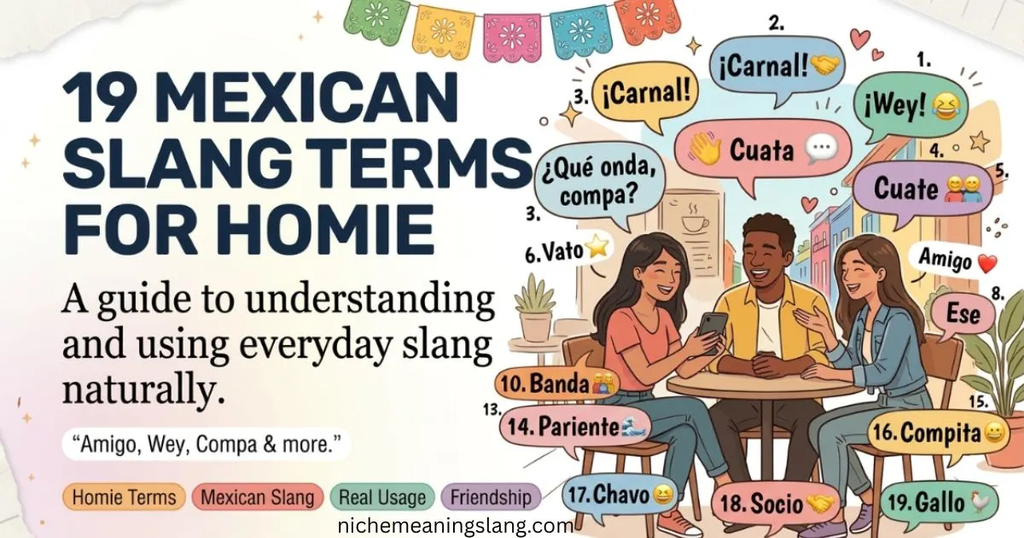
19 Mexican Slang Terms for Homie
The broader competitor list includes expressions ranging from güey and carnal to banda, broder, hermano, compita, manito, and socio. But these terms are not equally Mexican, equally informal, or equally close to “homie.” The most accurate approach is to treat them as related expressions rather than interchangeable translations.
| Term | Closest English idea | Tone | Best interpretation |
| Carnal | Bro / homie | Close | Brother-like friend |
| Compa | Buddy / pal | Friendly | Trusted companion |
| Güey | Dude / bro | Very casual | Flexible address |
| Cuate | Buddy / pal | Friendly | Friend |
| Vato | Dude / guy | Edgier | Person/guy |
| Mano | Bro | Warm | Short for hermano |
| Compita | Buddy | Warm | Affectionate compa |
| Manito | Little bro | Warm | Affectionate friend |
| Hermano | Brother | Emotional | Brother-like closeness |
| Banda | Crew | Social | Friend group |
| Broder | Bro | Modern | English-influenced |
| Amigo | Friend | Neutral | Safest general option |
| Pana | Pal | Casual | Common in mixed communities |
| Camarada | Comrade | Respectful | Loyal companion |
| Primo | Cousin/bro | Playful | Joking closeness |
| Loco | Crazy/man | Playful | Friendly teasing |
| Jefe | Boss | Respectful/playful | Friendly honorific |
| Padrino | Godfather | Respectful | Mentor-like friend |
| Socio | Partner | Casual | Trusted associate |
The table above reflects competitor coverage, but not every entry should be treated as an equally “Mexican” synonym for homie. For example, pana has broader Latin American/Caribbean associations, while broder is clearly influenced by English.
Banda
Banda means a crew or group of friends rather than one individual homie. It is therefore better for sentences such as “Voy con la banda” roughly “I’m going with the crew.” It describes collective friendship and social identity, making it useful for group-oriented contexts rather than one-to-one address.
Broder
Broder is an English-influenced Spanish form of “brother.” It fits casual, youthful, bilingual, or internet-heavy communication more naturally than formal Spanish. If someone texts “¿Qué onda, broder?”, the meaning is immediately understandable as something like “What’s up, bro?”
Amigo
Amigo is not technically slang, and that distinction matters. It is the standard Spanish word for “friend,” but it can still function casually in everyday conversation. If you are unsure about regional slang or the relationship, amigo is much safer than experimenting with an edgy expression.
Hermano
Hermano literally means “brother,” but close friends can use it emotionally to communicate strong solidarity. It is broader and more standard than carnal, while still carrying a sense of closeness. Mexican Spanish also recognizes hermano in literal family relationships, so context determines whether the relationship is biological or social.
Compita
Compita gives compa a warmer, diminutive flavor. It can sound affectionate or friendly rather than aggressive. Think of it as a softer “buddy” in the right context. It works best when the speakers already have an easy relationship rather than when addressing a stranger.
Manito
Manito comes from the idea of hermanito, or “little brother,” and can be used affectionately among friends. Its emotional flavor is warmer than simply güey. A phrase like “Qué bueno verte, manito” communicates familiarity and affection more directly than a neutral “hey, guy.”
Generational Slang Comparison
Slang does not remain fixed. Competitor research associates younger speakers with forms such as güey, broder, and banda, while older generations may be more comfortable with terms such as compadre or camarada. These are tendencies, not strict age rules; region and social circle matter just as much.
How to Use Slang Naturally Without Sounding Awkward
The simplest rule is to listen before copying. If the people around you say compa, mirror that register. If they use güey, understand the tone first. Slang sounds natural when it belongs to the conversation; forcing several expressions together can make even accurate Spanish sound theatrical.

Common Slang Mistakes
The biggest mistakes are using outdated expressions, putting slang into formal communication, overusing several slang words at once, or assuming a term means exactly the same thing everywhere. Mexican Spanish varies regionally, and expressions can carry different social meanings depending on who says them and why.
Conclusion
If you want one reliable answer for Mexican slang for homie, start with compa for a friendly “buddy,” carnal for a close brother-like friend, cuate for “buddy/pal,” and güey for the very casual “dude.” Mexican Spanish does not have one universal translation because relationship, tone, region, and social setting all change the meaning.
The most important lesson is not memorizing a giant slang list. It is understanding the social distance behind each word. Carnal emphasizes loyalty, compa companionship, güey casual address, and vato a guy or dude. When you match the expression to the relationship, your Spanish sounds much more natural.
FAQs
The most useful questions around Mexican slang for homie focus on safety, closeness, regional differences, and whether non-native speakers can use these terms. Competitor FAQ sections repeatedly address those exact concerns, especially the distinction between güey, carnal, and compa.
Related Slang Words

Ryan Mitchell is a language enthusiast and writer who explores slang, modern expressions, and everyday language. At nichemeaningslang, he helps readers understand slang meanings, usage, and context in a simple and easy-to-follow way.