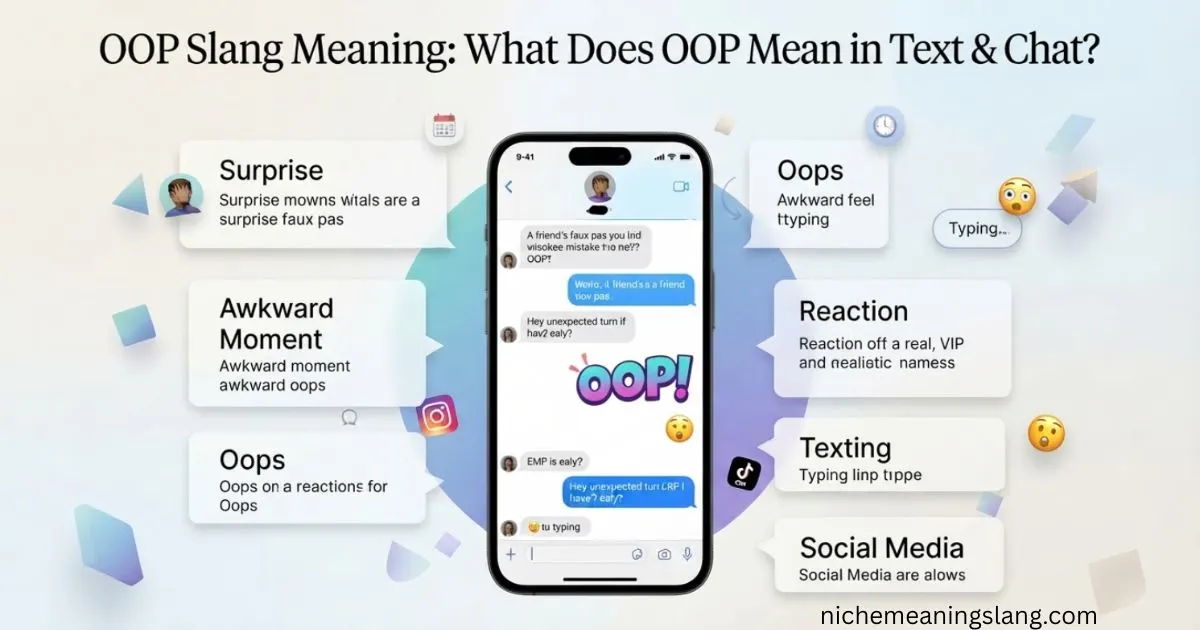
OOP Slang Meaning What Does OOP Mean in Text & Chat?
OOP slang usually means a quick reaction to something surprising, awkward, embarrassing, unexpected, or mildly mistaken. In everyday texting, it works much like “oops,” “oh,” or “uh-oh,” but its modern internet tone can also signal amusement, curiosity, or playful shock.
If you have ever received a sudden “OOP” and wondered whether you missed some hidden meaning, the context usually provides the answer. The punctuation, emoji, previous message, relationship, and platform all matter. After comparing current U.S. slang usage with established references, this guide separates the casual reaction from technical meanings and explains how the expression actually works online.
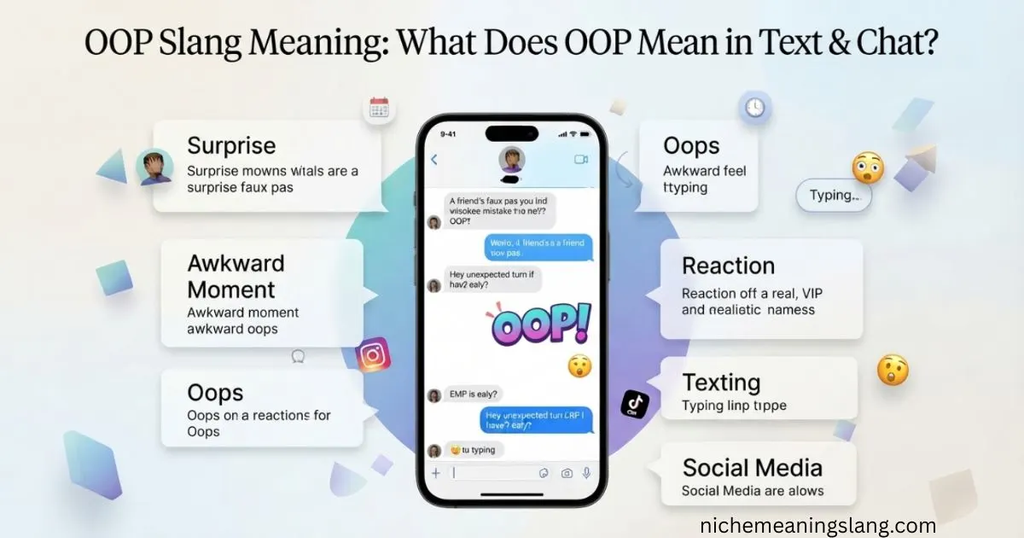
OOP slang: What Does OOP Mean in Text & Chat?
In casual texting, oop is an informal interjection used when something unexpected happens. It can signal surprise, awkwardness, embarrassment, sudden realization, or a small mistake. Unlike LOL or BRB, it normally does not expand into a fixed phrase; it works more like a written reaction sound.
For example, “Oop, I sent that to the wrong person” means something close to “Oops, I made a mistake.” But “OOP” after someone reveals unexpected gossip can mean “Wait, what?” or “Well, this just got interesting.” The emotional shade comes from the surrounding conversation rather than the word alone.
OOP slang: Full Form, Stands For & Short Meaning of OOP
When oop is used as internet slang, it generally has no official full form. It is an expressive interjection rather than an acronym. Depending on context, it can resemble “oops,” “oh,” “uh-oh,” “wow,” or “that was unexpected.” That makes it flexible across casual digital conversations.
Capitalized OOP, however, can represent completely different concepts. Dictionary.com lists object-oriented programming and out-of-print as established abbreviation meanings. Other contexts may use OOP for out-of-pocket or other specialized phrases, so capitalization and subject matter should never be ignored.
OOP slang: Origin, History & First Known Use of OOP
The modern internet association of oop is strongly connected to the viral phrase “and I oop.” Dictionary.com traces that phrase to a 2015 YouTube video by drag performer Jasmine Masters. The clip later spread widely online in 2019, turning the expression into a recognizable meme reaction.
The original viral moment helped establish “oop” as a humorous expression of shock, surprise, embarrassment, or interruption. Today, however, people do not necessarily reference the meme when they type “oop.” The standalone reaction has developed into broader casual internet language, appearing naturally in messages, comments, memes, and group chats.
OOP slang: How People Use OOP in Daily Conversations
People usually use oop as a quick reaction rather than the main subject of a sentence. It can appear after a mistake, unexpected revelation, embarrassing confession, surprising news, or funny contradiction. The short form is useful because it communicates an emotional response without requiring a full explanation.
Imagine a friend saying, “I accidentally liked my ex’s photo from 2019.” A natural response could be “OOP” The sender is not necessarily criticizing them; they are acknowledging the awkwardness. In another conversation, “OOP” may show curiosity after someone reveals a secret or unexpected relationship detail.
Texting Examples
Text messages commonly use oop before or after the moment being reacted to: “Oop, wrong chat,” “OOP” or “Oop, did you really say that?” The expression can accompany embarrassment, surprise, humor, realization, or playful teasing. Extra punctuation and emojis help reveal the intended tone.
Casual Situations
Among friends, oop can soften an awkward moment and make a reaction feel playful rather than judgmental. Someone might write “Oop, you got caught” after a friend contradicts themselves. In these casual exchanges, the expression often adds comedic timing while acknowledging that something unexpected just happened.
OOP slang OOP Meaning Across WhatsApp, Instagram, TikTok & Snapchat
Across major social platforms, the basic oop slang meaning remains relatively consistent: it is a reaction to something unexpected, awkward, surprising, embarrassing, or amusing. The platform changes the setting, but not necessarily the underlying definition. The message, caption, comment, emoji, and conversation provide the strongest clues.
This flexibility explains why “oop” feels natural in both private chats and public comments. On TikTok it can react to an unexpected plot twist; on Instagram it may respond to a revealing post; on Snapchat it can acknowledge a funny mistake. The expression works because readers understand the emotional timing from context.
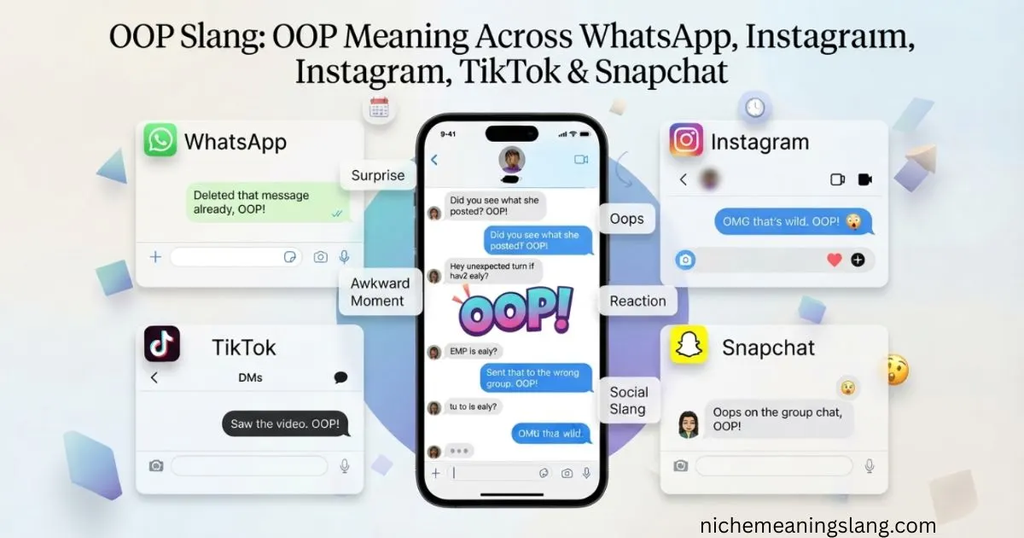
OOP on WhatsApp
On WhatsApp, oop commonly appears in private messages and group chats when someone makes a mistake or reveals something unexpected. “Oop, wrong person” is a straightforward example. The expression keeps the response short and casual, especially among friends who already understand each other’s humor.
OOP on Instagram
Instagram comments, Reels, Stories, and DMs can all use oop as a reaction. “OOP, things just got interesting” might respond to an unexpected reveal, while “Oop” could simply acknowledge a funny moment. The platform does not create a separate Instagram-specific definition.
OOP on TikTok
TikTok’s reaction-heavy culture makes oop particularly useful for unexpected moments, awkward reveals, jokes, and dramatic turns. A commenter might write “OOP” when a video suddenly changes direction. The phrase is generally about the viewer’s immediate reaction, not a literal description of what happened.
OOP on Snapchat
On Snapchat, oop works naturally in quick chats and reactions. “Oop, your dog just knocked over the plant” could simply acknowledge an unexpected event. There is no special Snapchat-only definition; the message before the reaction usually tells you whether the feeling is surprise, humor, embarrassment, or curiosity.
OOP slang: Different Meanings of OOP in Other Fields
Outside casual internet conversation, OOP has established meanings that have nothing to do with slang. In computer science, it commonly means Object-Oriented Programming. In publishing, it can mean out of print, while financial or healthcare contexts may use it for out-of-pocket expenses.
The sentence usually makes the intended meaning obvious. “I’m studying OOP in Java” is about programming, while “That book is OOP” may refer to publishing. By contrast, “OOP” in a group chat is almost certainly the informal reaction. Context is the semantic bridge between these otherwise unrelated meanings.
OOP in Programming
In programming, OOP means Object-Oriented Programming, a software-development approach organized around objects and classes. A developer might say, “This course teaches OOP in Python.” That usage is technical rather than slang and should not be confused with the casual lowercase reaction used in texting.
OOP slang: Common Confusions, Mistakes & Wrong Interpretations
The most common mistake is assuming oop always means “oops.” The expressions overlap, but “oop” can signal surprise or awkwardness even when nobody made a mistake. Another error is interpreting every uppercase OOP as internet slang when the conversation may actually involve programming or another technical field.
It is also easy to overread a one-word reaction. “OOP” might be curious, playful, teasing, or simply surprised. It does not automatically indicate flirting, anger, attraction, or disrespect. The surrounding message and relationship between the people involved are much stronger evidence than the abbreviation itself.
Mistaking OOP for Oops
Oop and oops can communicate almost the same reaction when someone notices a small mistake. However, oop has a broader internet-style use and can express surprise, awkwardness, or amusement without an actual error. That is why “OOP, she really said that” can sound perfectly natural online.
Thinking OOP Is Always Programming
Seeing capitalized OOP does not automatically mean programming. The surrounding words matter. “OOP uses classes and objects” clearly indicates software development, while “OOP I forgot” is casual slang. The same letters can therefore represent completely different semantic entities in different conversations.
Assuming OOP Is Rude
Oop is generally not inherently rude or offensive. Most casual uses are playful, surprised, embarrassed, or humorous. However, punctuation and context can make it sarcastic or pointed. “Oop” usually feels lighter than “Oop.” or “oop…” so the presentation can subtly change how the reaction is received.
OOP slang: Similar Terms, Alternatives & Related Slang
Several expressions overlap with oop slang, but each carries a slightly different emotional function. “Oops” points more directly toward a mistake, “uh-oh” suggests something may have gone wrong, “yikes” often signals discomfort, and “wow” expresses stronger surprise. Oop sits somewhere between these reactions and remains highly context-sensitive.
| Expression | Typical meaning | Common tone |
| Oop | Unexpected or awkward reaction | Playful |
| Oops | Small mistake | Casual |
| Uh-oh | Something may be wrong | Concerned |
| Yikes | Uncomfortable situation | Informal |
| Wow | Strong surprise | Excited |
| Whoa | Strong surprise or shock | Dramatic |
| Welp | Acceptance or resignation | Humorous |
| OMG | Strong surprise or disbelief | Emotional |
| LOL | Amusement | Humorous |
The closest everyday comparison is usually “oops,” but oop is more flexible. It can react to a mistake, a secret reveal, an awkward statement, a surprising announcement, or simply something that catches the sender off guard. That broader reaction function is what gives the slang its distinctive internet-native tone.
OOP slang: Examples of OOP in Real Chat Situations
Real conversations make oop slang much easier to understand because the emotional trigger appears immediately before the reaction. A mistake can produce “OOP,” unexpected news can produce “OOP” and playful teasing can simply produce “oop” The word is short, but the surrounding context carries its meaning.
For example, if someone says, “I forgot the deadline was yesterday,” a friend might respond “OOP” If another person admits, “Okay, maybe I have a crush on him,” the response “OOP” signals surprise and interest. Neither response requires the sender to spell out the entire emotional reaction.
Example 1: Small mistake
Alex: “I sent the email to the wrong person.”
Sam: “OOP”
Here, oop means something like “Oops, that is awkward.” The reaction acknowledges the mistake without turning it into a serious criticism. The crying emoji reinforces the humorous embarrassment.
Example 2: Unexpected news
Mia: “I’m moving to another city next month.”
Lena: “OOP”
Here, oop expresses surprise and curiosity rather than an actual mistake. The eyes emoji adds interest, suggesting that Lena wants to hear more about the sudden announcement.
Example 3: Embarrassing moment
Chris: “I accidentally called my teacher ‘Mom.’”
Jay: “OOP”
The expression highlights the awkwardness of the situation. The skull emoji intensifies the humorous reaction, suggesting that Jay finds the embarrassment painfully funny rather than genuinely upset.
Example 4: Playful teasing
Sara: “I said I wasn’t hungry and then ordered pizza.”
Nina: “Oop”
Here, oop is playful rather than serious. Nina is gently calling attention to Sara’s contradiction. The laughter emoji makes it clear that the reaction is friendly teasing, not criticism.
OOP slang: How to Reply When Someone Says OOP
There is no single correct response to oop because the best reply depends on why the person used it. If they reacted to your mistake, you can acknowledge it. If they are surprised by your news, explain further. If they are teasing you, a playful response usually keeps the conversation natural.
For a one-word “OOP,” short replies often work best. You might say “Haha, I know ” “My bad,” “What? ” or “You caught me.” If you genuinely cannot tell what they mean, asking “Why are you saying oop?” is clearer than guessing at a hidden message.
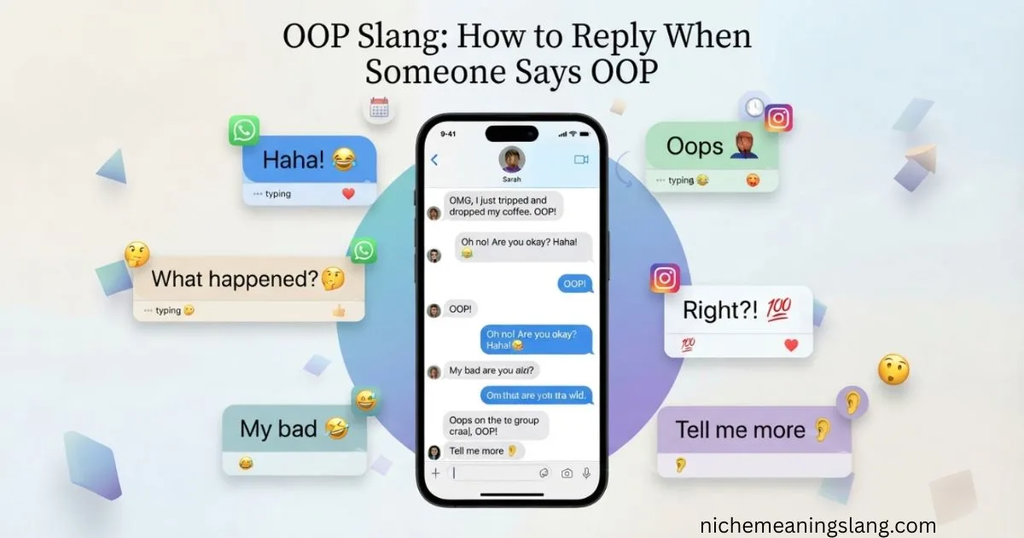
Casual Reply
A casual response such as “Haha, I know ” works when someone is reacting to an awkward or funny situation. It accepts the reaction without making the conversation unnecessarily serious. This style fits ordinary texting, group chats, DMs, and conversations between people who already share a relaxed tone.
Funny Reply
A funny response can mirror the playful energy of oop. Something like “Oop indeed ” or “Well… that happened” keeps the exchange light. This works particularly well when the original situation is mildly embarrassing rather than genuinely serious, allowing both people to laugh without overexplaining.
Friendly Reply
If someone says “OOP” after you reveal something unexpected, you can respond with “Wait, what did you notice? ” or explain the situation. A friendly answer keeps the conversation moving while acknowledging their curiosity. The goal is to match their tone rather than force a particular interpretation.
OOP slang: Is OOP Still Popular? Trends & Online Usage
Oop remains recognizable as casual internet language, especially in social-media comments, memes, DMs, and group chats. Its popularity is difficult to measure as a single fixed statistic because slang varies by community and age group. Some users prefer “oops,” “oh,” or emojis, while others continue using oop naturally.
Its cultural history also matters. The “and I oop” meme helped make the expression widely recognizable after the 2015 Jasmine Masters video became a viral phenomenon in 2019. Today, however, standalone “oop” has moved beyond that specific meme and functions as a general-purpose online reaction.
Conclusion
The clearest oop slang meaning is a short, informal reaction to something unexpected, awkward, embarrassing, surprising, or mildly mistaken. It often feels like a playful version of “oops,” but it can also communicate “oh,” “uh-oh,” “wait,” or “well, that happened.”
The important distinction is context. “OOP” in a group chat is very different from “OOP is used in Java” in a programming discussion. The first is internet slang; the second refers to Object-Oriented Programming. And the viral “and I oop” phrase associated with Jasmine Masters helped propel the expression into mainstream internet culture.
FAQs
What does OOP mean in a text message?
In casual texting, oop usually expresses surprise, awkwardness, embarrassment, realization, or a small mistake. It is similar to “oops,” “oh,” or “uh-oh,” but it can also react to unexpected information without any actual mistake.
Is OOP the same as oops?
Not exactly. They can have nearly the same meaning when someone notices a mistake, but oop is broader and can simply express surprise, awkwardness, amusement, or being caught off guard.
What does OOP mean on Instagram?
On Instagram, oop is generally a casual reaction to something surprising, awkward, funny, or unexpected. It can appear in comments, Reels, Stories, replies, or DMs.
What does OOP mean on TikTok?
On TikTok, oop commonly appears as a reaction to an unexpected reveal, awkward moment, funny mistake, or dramatic turn. Its basic meaning remains context-dependent rather than being a separate TikTok-only definition.
What does OOP mean in programming?
In programming, OOP means Object-Oriented Programming, a software-development approach based around objects and classes. This technical meaning is completely different from the casual internet reaction “oop.”
Is OOP rude?
Usually, no. Oop is generally playful and informal, although it can become sarcastic, dismissive, or pointed depending on the situation, punctuation, and relationship between the speakers.
What does OOP mean from a girl?
There is no special female-specific definition. A girl may use oop to show surprise, embarrassment, curiosity, teasing, or amusement. The word itself does not automatically indicate flirting or romantic interest.
Is OOP a flirty response?
Oop is not inherently flirty. It can become playful or flirty when the surrounding conversation is already romantic or teasing, but the romantic meaning comes from the broader exchange rather than the word itself.
Can OOP mean out of pocket?
Yes. OOP can be used as an abbreviation for “out of pocket” in financial or healthcare contexts. However, that meaning is different from lowercase oop used as an internet reaction.
Related Slang Words

Ryan Mitchell is a language enthusiast and writer who explores slang, modern expressions, and everyday language. At nichemeaningslang, he helps readers understand slang meanings, usage, and context in a simple and easy-to-follow way.