35+Trinidad Slang Trini Words, Meanings & Phrases
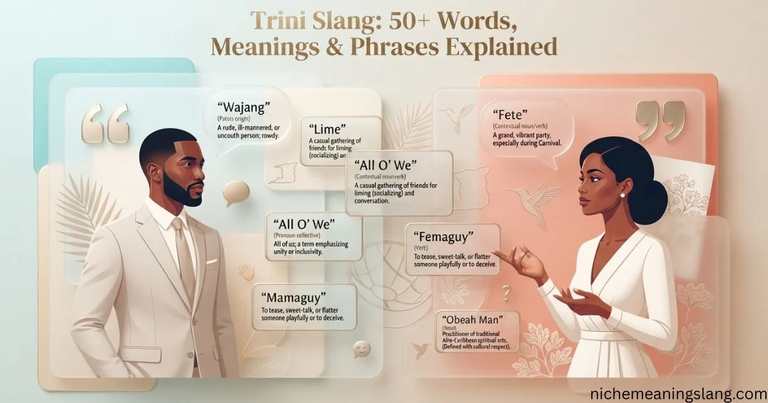
Trinidad slang is the colorful everyday language associated with Trinidad and Tobago, especially expressions such as lime, bacchanal, hoss, wam, weys, and waz di scene. It draws on Trinidadian Creole English and reflects Caribbean culture, Carnival, music, humor, and community life.
If you have ever read a Trini message and wondered why familiar English suddenly sounded completely different, you are not alone. I have found that the hardest part is rarely vocabulary alone; it is tone, context, pronunciation, and cultural meaning. This guide connects Trinidad slang with real conversational situations so visitors, readers, and Caribbean-culture fans can understand what they are actually seeing or hearing.
Trinidad slang: Essential Phrases for the Trini Newcomer
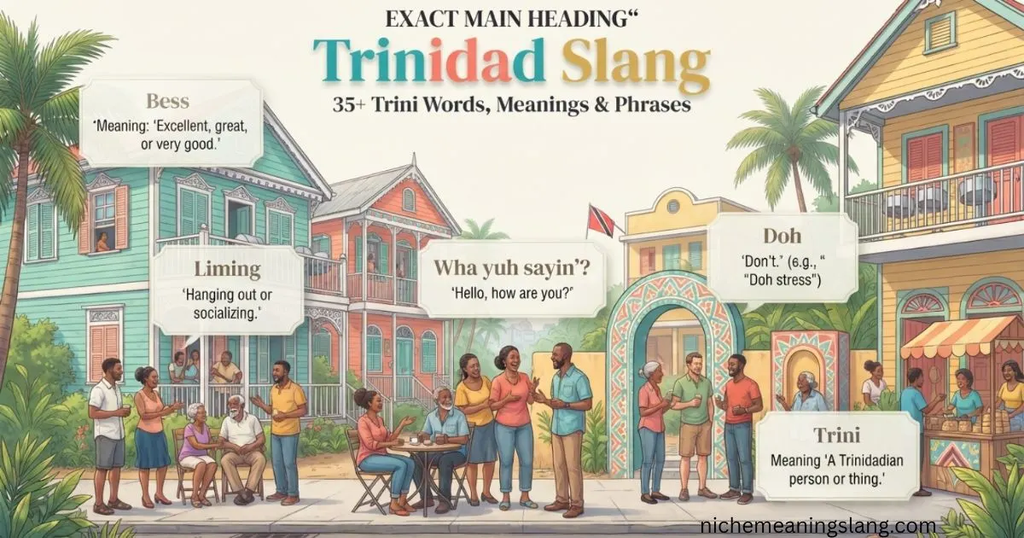
For someone discovering Trinidad slang, a few expressions unlock a surprisingly large part of everyday conversation. Trini, Caribbean slang, Trinidadian Creole, local expressions, and informal speech often work together. The written spelling can vary because Trinidadian speech does not have one standardized written orthography.
The key is not to memorize a pronunciation guide and immediately imitate it. Listen for context. A word such as hoss can address a friend, while lime can describe hanging out or a social gathering. Meaning often becomes clearer when you hear the expression inside a complete conversation rather than isolated in a dictionary.
Weys
Weys is an exclamatory Trinidad expression used around surprise, shock, or disbelief. In casual conversation, its emotional force depends heavily on delivery, making it closer to an expressive reaction than a simple one-word translation. That makes Trini speech, Caribbean expressions, conversation, tone, and informal language especially context dependent.
Lime
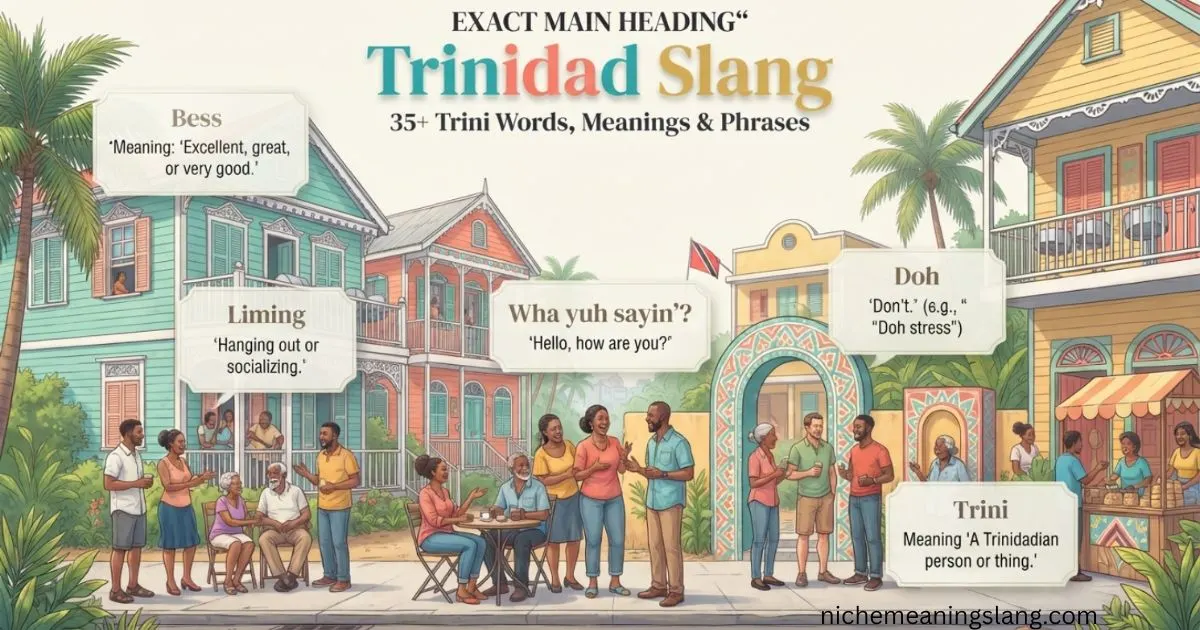
Lime means hanging out or gathering socially. Someone might ask, “When we limin’?” to mean when everyone is getting together. The word can function as both a noun and a verb, and liming, socializing, Caribbean culture, Trini slang, and everyday conversation are closely connected concepts.
Hoss
Hoss is a friendly way to address another person, broadly comparable to “dawg” or “buddy” in American informal speech. Matador notes that its usage has developed beyond simply meaning friend, showing how Trini vocabulary, friendship slang, local speech, Caribbean identity, and generational usage can overlap.
Wam
Wam can mean “what happened?” and, in a friendlier situation, function similarly to “what’s up?” Its meaning depends on tone and circumstance. That makes Trinidad expressions, greetings, informal questions, conversational tone, and Trini pronunciation important when translating the phrase for an American reader.
Trinidad slang: Common Expressions
Common Trinidad slang is especially expressive because the language does more than shorten words. It communicates attitude, humor, surprise, affection, criticism, and social connection. Bacchanal, Carnival culture, fete, liming, and Trini sayings frequently appear in conversations where the literal English translation does not capture the complete cultural meaning.
This is also where American readers can accidentally misunderstand a phrase. A familiar English word may have a distinctly Trinidadian meaning or use. For example, wine can refer to a Trinidadian dance, while bacchanal can describe drama as well as energetic party activity. Context is doing much of the linguistic work.
Bacchanal
Bacchanal is associated with drama, commotion, or conflict, but it can also describe lively partying and Carnival fun. Its range makes it a useful example of Trinidad culture, Carnival slang, party language, Caribbean expressions, and social drama converging in one word.
Waz di scene
Waz di scene literally asks about “the scene,” but in everyday Trinidadian usage it can function more naturally as “What are you doing?” or “What’s up?” It belongs to a broader group of Trini greetings, informal questions, conversational phrases, Caribbean slang, and social language.
Wine
In Trinidad and Tobago, wine or wining refers to a style of dance involving rhythmic hip movement. American readers should not automatically interpret the word as the beverage. Carnival, dancing, soca culture, Trinidadian slang, and Caribbean nightlife provide the surrounding context.
| Trinidad slang | Plain-English meaning | Typical context |
| Lime | Hang out / gathering | Friends and socializing |
| Hoss | Friend / buddy | Casual conversation |
| Weys | Surprise or disbelief | Reactions |
| Wam | What happened? / What’s up? | Casual conversation |
| Waz di scene | What’s up? / What are you doing? | Informal greeting |
| Bacchanal | Drama, commotion, lively partying | Social or Carnival context |
| Wine | Trinidadian dance | Carnival, parties, music |
| Bess | Awesome or sexy | Compliment |
| Owah | Or what? | Question ending |
| DDI | Down di Islands | Island trips and recreation |
The meanings above are drawn primarily from the current PAN Magazine and Matador coverage, with broader linguistic context checked against the Trinidadian English glossary.
Trinidad slang: Words to Know (And Maybe Avoid)
Some Trinidad slang is perfectly friendly, while other expressions depend heavily on who is speaking, the relationship between people, and the setting. Trini vocabulary, cultural context, Carnival expressions, local identity, and informal speech should therefore be treated as living language rather than a collection of interchangeable English translations.
This matters particularly for visitors from the United States. Copying a phrase because it looks funny online can sound unnatural when the cultural context is missing. PAN Magazine specifically highlights potentially misunderstood expressions involving dancing, locations, timing, and Carnival, showing why Trinidad etiquette, slang usage, social context, pronunciation, and cultural awareness belong together.
Bess
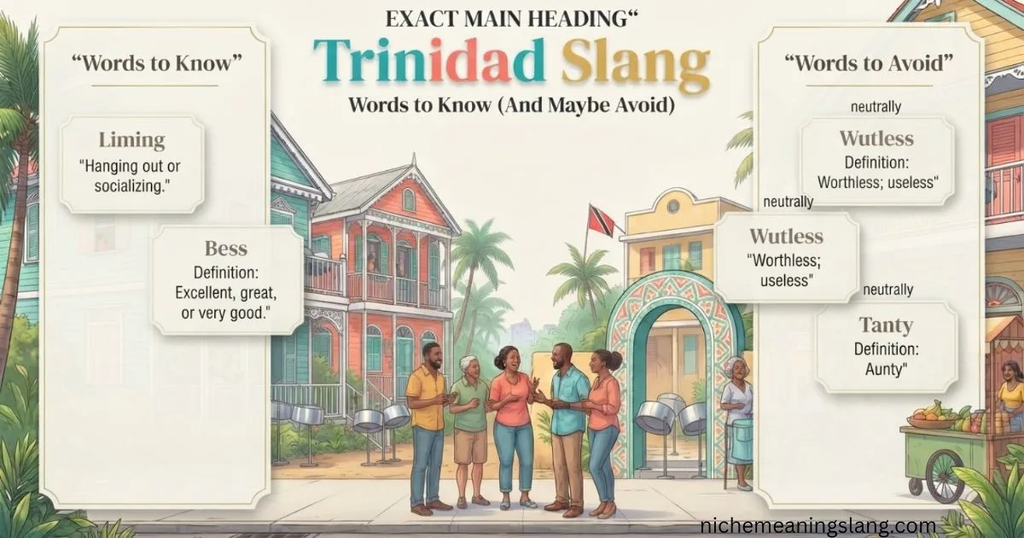
Bess can mean something like “awesome” or “sexy,” depending on what is being described. That flexibility makes surrounding context essential. In American English, the closest translation may shift between excellent, attractive, impressive, Trini slang, and Caribbean compliment language.
Owah
Owah is commonly placed at the end of a question and corresponds roughly to “or what?” It is a small expression, but it illustrates how Trinidadian speech uses compact words to shape conversational rhythm. Trini grammar, informal questions, Caribbean English, spoken language, and intonation all matter here.
DDI
DDI means “Down di Islands,” referring to islands off Trinidad’s northwest coast. The expression is connected with weekend recreation, boating, water activities, parties, and social gatherings. It therefore links Trinidad geography, island culture, local vocabulary, liming, and Trinidadian lifestyle rather than functioning as ordinary Internet slang.
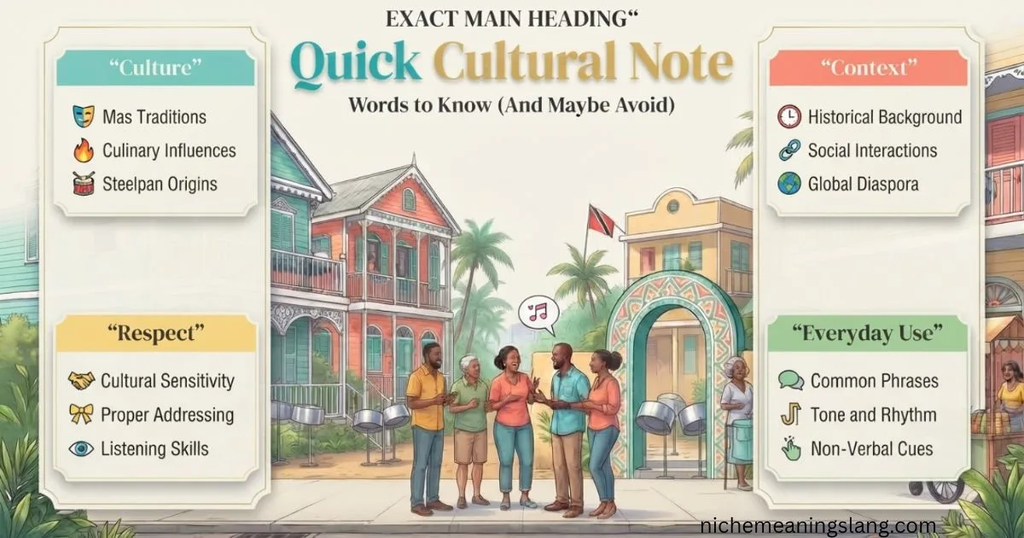
Quick cultural note
Trinidad slang is better understood as part of a broader linguistic ecosystem than as a simple list of “funny Caribbean words.” Wiktionary’s Trinidadian English glossary notes influences from French and French Creole, Spanish, West African languages, and Indic languages including Bhojpuri, Hindi, Urdu, Bengali, Telugu, and Tamil.
That history helps explain why the vocabulary can feel unusually layered to an American English speaker. Words may carry traces of migration, colonial history, African and Indian heritage, Carnival, food, music, and everyday neighborhood life. The result is language that communicates identity as much as information.
Conclusion
The most useful way to understand Trinidad slang is to connect each expression with its social setting. Lime points toward hanging out, hoss toward friendship, wam toward casual questioning, and bacchanal toward drama or lively celebration. Learning those relationships is more useful than memorizing translations alone.
For U.S. readers, the biggest lesson is simple: Trini language is not broken English or random slang. It is a culturally shaped form of communication with its own rhythms, vocabulary, influences, and meanings. Once you pay attention to tone and context, Trinidad slang becomes much easier and much more interesting to understand.
FAQ
What is Trinidad slang?
Trinidad slang refers to informal words, phrases, expressions, and speech patterns associated with Trinidad and Tobago. Much of this vocabulary exists within Trinidadian Creole English and everyday Trini speech.
What does “lime” mean in Trinidad slang?
“Lime” means to hang out or gather socially. “Limin’” is the corresponding verb and is strongly associated with relaxed Caribbean social life.
How do you say “what’s up” in Trinidad slang?
Expressions such as “Waz di scene?” and “Wam?” can communicate “What’s up?” depending on the context and tone.
What does “hoss” mean in Trinidad?
“Hoss” is a casual term used to address a friend, broadly comparable to “buddy” or “dawg” in American informal speech.
What does “bacchanal” mean in Trinidad?
“Bacchanal” can refer to drama, confusion, or commotion, but it can also describe lively partying, especially around Carnival.
Is Trinidad slang the same as Trinidadian Creole?
Not exactly. “Trinidad slang” is a broad informal label, while Trinidadian Creole English refers to a broader variety of English-based Creole speech used in Trinidad.
Why does Trinidad slang look different when written?
There is no single standardized orthography for representing Trinidadian speech, so spellings often attempt to reproduce pronunciation. Different writers may therefore spell the same expression differently.
Related Slang Words

Ryan Mitchell is a language enthusiast and writer who explores slang, modern expressions, and everyday language. At nichemeaningslang, he helps readers understand slang meanings, usage, and context in a simple and easy-to-follow way.