Costa Rica Slang: 60+ Words, Meanings & Examples
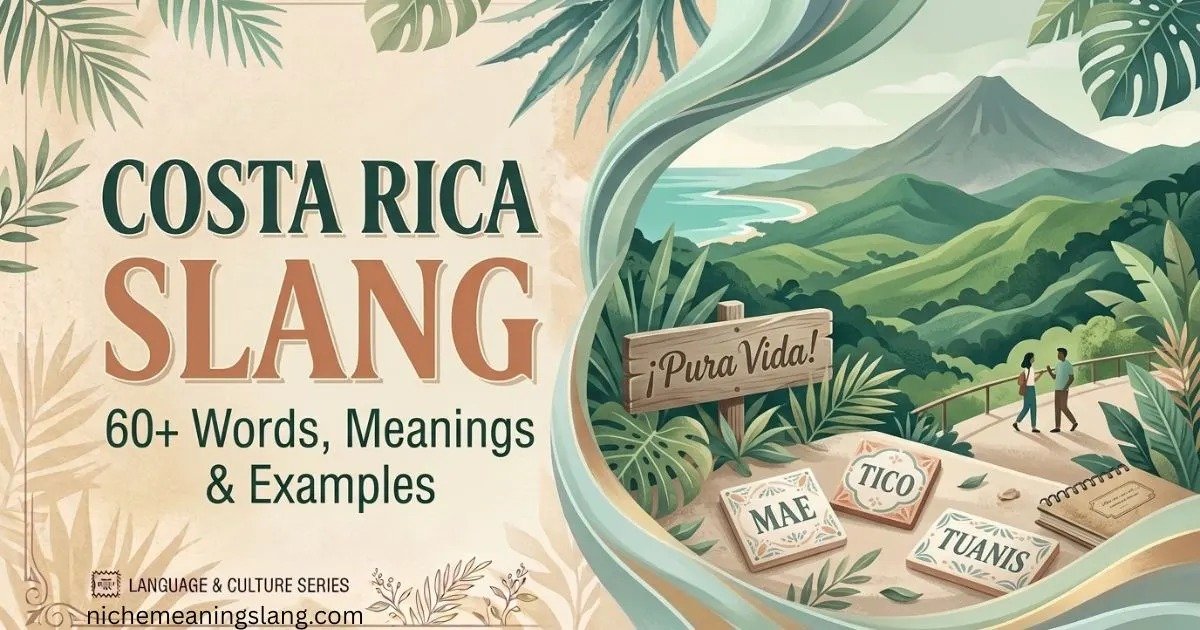
Costa Rica slang gives everyday Spanish a distinctive local flavor, from the famous phrase pura vida to casual expressions like mae, tuanis, and diay. Whether you’re planning a trip, learning Spanish, or chatting with Costa Rican friends, understanding these words can help you follow conversations and connect with local culture.
Costa Ricans are often called Ticos and Ticas, and their Spanish includes many regional expressions known as tiquismos. Some are friendly greetings, others describe everyday situations, and a few can sound rude if used in the wrong context. Here are more than 60 Costa Rica slang words and phrases, with meanings and examples to help you understand how they’re used.
What Is Costa Rica Slang?
Costa Rica slang refers to informal words, expressions, and regional vocabulary used in Costa Rican Spanish. These expressions help people communicate naturally in daily life, whether they’re greeting friends, talking about work, describing something exciting, or making plans.
Costa Rican Spanish shares much of its vocabulary with other Spanish-speaking countries, but terms such as mae, tuanis, brete, and chunche give local conversations a recognizable character. The phrase pura vida is especially well known and can express a greeting, gratitude, or the idea that everything is going well.
Not every expression is appropriate everywhere. Some words are very casual, and their meaning can change with tone, age, location, and relationship.
60+ Costa Rica Slang Words and Their Meanings
The following Costa Rica slang words are useful for understanding informal conversations. Meanings can vary by context, so treat the examples as practical illustrations rather than rules that apply to every speaker.
1. Common Costa Rica Slang Words
| Slang word | Meaning | Example |
| Pura vida | Great, all good, hello, goodbye, or thanks | “¡Pura vida, mae!” |
| Mae | Dude, bro, man, or person | “Mae, ¿vamos?” |
| Tuanis | Cool, nice, or great | “Tu carro está tuanis.” |
| Diay | Well, so, then, or what’s up? | “Diay, ¿qué pasó?” |
| Brete | Work or job | “Voy al brete.” |
| Chunche | Thing or object when you don’t know its name | “Pasame ese chunche.” |
| Vara | Thing, matter, situation, or sometimes nonsense | “¿Qué es la vara?” |
| Choza | House or home | “Estoy en la choza.” |
| Jupa | Head | “Me duele la jupa.” |
| Güila | Child, young person, or sometimes girlfriend or boyfriend, depending on context | “Ese güila juega bien.” |
| Tico | Costa Rican man or person; also used more broadly for a Costa Rican | “Él es tico.” |
| Tica | Costa Rican woman or girl | “Ella es tica.” |
| Chiva | Cool, awesome, or great | “¡Qué chiva!” |
| Salado | Unlucky, unfortunate, or tough luck | “¡Qué salado!” |
| Goma | Hangover | “Tengo goma.” |
| Chineado/a | Pampered, spoiled, or treated affectionately | “Está muy chineada.” |
| Bombeta | Someone who is showy, attention-seeking, or overly enthusiastic | “Ese mae es un bombeta.” |
| Jetón/jetona | Big talker or someone who exaggerates | “No sea jetón.” |
| A cachete | Excellent, very good, or going smoothly | “Todo está a cachete.” |
| Al chile | Seriously, really, or for real | “¿Al chile?” |
2. Costa Rica Slang for Everyday Conversations
| Expression | Meaning | Example |
| ¡Buenas! | A casual, all-purpose greeting | “¡Buenas! ¿Cómo está?” |
| ¿Todo bien? | Everything okay? | “Mae, ¿todo bien?” |
| ¿Qué hubo? | What’s up? | “¿Qué hubo, mae?” |
| ¿Qué madre? | A vulgar or emphatic expression whose meaning depends on context | “¡Qué madre!” |
| De fijo | Definitely, for sure | “De fijo voy mañana.” |
| Por dicha | Fortunately, luckily | “Por dicha no llovió.” |
| Qué madre | What a shame, how annoying, or how unfortunate | “Qué madre que no pudo venir.” |
| Ahí vamos | We’re getting by or moving along | “¿Cómo está? Ahí vamos.” |
| Todo tuanis | Everything is good or cool | “Por acá, todo tuanis.” |
| Con mucho gusto | You’re welcome; literally, with great pleasure | “Gracias.” “Con mucho gusto.” |
| Pura paja | Nonsense, empty talk, or a load of rubbish | “Eso es pura paja.” |
| Ni modo | Oh well, there’s nothing to be done | “Ni modo, será mañana.” |
| ¡Qué madre de presa! | What terrible traffic! | “Llegué tarde por la presa.” |
| Hacer feo | To reject, snub, or treat someone or something dismissively | “No le haga feo a la comida.” |
| Dar pelota | To pay attention to or give someone attention | “Ella no me da pelota.” |
3. Costa Rica Slang for Friends and Relationships
| Word or phrase | Meaning | Example |
| Mae | Dude, friend, or person | “Ese mae es mi compa.” |
| Compa | Buddy, pal, or friend | “Pura vida, compa.” |
| Amigo/a | Friend; standard Spanish, widely understood | “Es mi amiga.” |
| Güila | A young person or, in some contexts, a romantic partner | “Voy con mi güila.” |
| Jalar | To leave; in some contexts, to date or go out with someone | “Ya me voy a jalar.” |
| Caerle a alguien | To approach someone romantically or make a move | “Le quiere caer a ella.” |
| Dar pelota | To show interest or attention | “No me da pelota.” |
| Chinear | To pamper, cuddle, or treat affectionately | “Me gusta chinear a mi perro.” |
| Tuanis | Cool or good; useful among friends | “La gente es muy tuanis.” |
| Pura vida | A friendly expression of goodwill | “¡Pura vida, nos vemos!” |
4. Costa Rica Slang for Work, Money, and Daily Life
| Word | Meaning | Example |
| Brete | Job or work | “Tengo mucho brete.” |
| Bretear | To work | “Tengo que bretear hoy.” |
| Harina | Money, in colloquial usage | “No tengo harina.” |
| Rojo | A thousand-colón bill or amount in local money slang | “Me costó un rojo.” |
| Tucán | A five-thousand-colón bill in local money slang | “Solo ando un tucán.” |
| Chepe | Familiar nickname for San José | “Mañana voy a Chepe.” |
| Presa | Traffic jam | “Hay mucha presa.” |
| Pulpería | Small neighborhood shop | “Voy a la pulpería.” |
| Soda | A small, casual restaurant, often serving local food | “Almorcemos en una soda.” |
| Chante | House or place, in very informal speech | “Caigamos a mi chante.” |
| Chunche | An unnamed or unspecified object | “¿Dónde dejé ese chunche?” |
| Jupa | Head | “Usá la jupa.” |
| Jama | Food, in informal speech | “Vamos a buscar jama.” |
| Birra | Beer, informal Spanish also heard in Costa Rica | “Pidió una birra.” |
| Gallo | A small serving of food, often served in a tortilla; meaning depends on context | “Me comí un gallo de salchichón.” |
5. Costa Rica Slang for Emotions and Reactions
| Expression | Meaning | Example |
| ¡Qué chiva! | How cool! | “¡Qué chiva ese concierto!” |
| ¡Qué tuanis! | That’s great! | “¡Qué tuanis tu idea!” |
| ¡Qué madre! | How annoying or unfortunate! | “¡Qué madre, perdí el bus!” |
| ¡Qué salado! | How unlucky! | “¡Qué salado que llovió!” |
| Al chile | Seriously or for real | “¿Al chile pasó eso?” |
| De fijo | Definitely | “De fijo llego temprano.” |
| Por dicha | Thankfully or fortunately | “Por dicha, todo salió bien.” |
| Pura vida | Everything is fine, or a positive response | “¿Cómo estás?” “¡Pura vida!” |
| Diay | Well, so, or an expression of surprise | “Diay, no sabía.” |
| Qué madre de presa | What terrible traffic | “Qué madre de presa hay hoy.” |
6. More Costa Rican Expressions to Recognize
| Expression | Meaning |
| A cachete | Excellent or going very well |
| Dar pelota | Give attention or show interest |
| Hacer feo | Snub or reject |
| Jalar | Leave; sometimes date, depending on context |
| Caerle a alguien | Approach someone romantically |
| Echarse una birra | Have a beer |
| Estar de goma | Have a hangover |
| Ir a Chepe | Go to San José |
| Estar hasta la madre | Be fed up or extremely overwhelmed; vulgar in some contexts |
| Pura paja | Nonsense or empty talk |
| Ni modo | Oh well; accept the situation |
| De una | Sure, right away, or let’s do it |
| Ahí vemos | We’ll see; the meaning depends on tone and context |
| Qué madre de día | What a terrible day |
| Todo bien | Everything is fine |
Costa Rica Slang Phrases You Should Know
Individual words are useful, but short phrases show how Costa Rican slang works in conversation.
“Pura vida, mae”
Meaning: “All good, dude,” “Hey, bro,” or “Thanks, man,” depending on the situation.
Example:
“¿Cómo estás?”
“¡Pura vida, mae!”
This is one of the most recognizable combinations in Costa Rican Spanish. Pura vida has several everyday uses, while mae makes the exchange more informal.
“Diay, ¿qué pasó?”
Meaning: “Well, what happened?” or “So, what’s going on?”
Example:
“Diay, ¿qué pasó? Te esperamos ayer.”
This phrase is useful for opening a conversation or reacting when something unexpected happens. The precise meaning of diay depends heavily on tone and context.
“¡Qué tuanis!”
Meaning: “That’s cool!” or “How awesome!”
Example:
“Conseguí entradas para el concierto.”
“¡Qué tuanis!”
Use it to react positively to an idea, event, object, or experience.
“Tengo mucho brete”
Meaning: “I have a lot of work.”
Example:
“No puedo salir hoy; tengo mucho brete.”
Brete and bretear are informal terms for a job and working. They are useful to recognize in casual conversation.
“Por dicha, todo salió bien”
Meaning: “Thankfully, everything went well.”
Example:
“¿Cómo te fue en el examen?”
“Por dicha, todo salió bien.”
This expression communicates relief or gratitude that something had a positive outcome.
“No me da pelota”
Meaning: “They don’t pay attention to me” or “They’re not showing interest in me.”
Example:
“Me gusta esa muchacha, pero no me da pelota.”
The expression can refer to ordinary attention or romantic interest, depending on context.
What Does “Pura Vida” Mean in Costa Rica?
Pura vida literally translates to “pure life,” but its everyday meaning is broader. Costa Ricans use it as a greeting, a farewell, a way to say thank you, and a response meaning that everything is good. It is also associated with a positive, relaxed outlook on life.
Here are a few common uses:
- Greeting: “¡Pura vida! ¿Cómo está?” “Hey! How are you?”
- Positive response: “¿Todo bien?” “¡Pura vida!” “Everything’s great!”
- Thanks or acknowledgment: “Gracias por ayudarme.” “¡Pura vida!” “Thanks!” or “No problem!”
- Farewell: “Nos vemos mañana.” “¡Pura vida!” “See you tomorrow!”
The phrase is a genuine part of everyday Costa Rican speech, not simply a tourist slogan. You can use it naturally, but you don’t need to insert it into every conversation. https://diccionariousual.poder-judicial.go.cr/index.php/diccionario/pura-vida
Why Are Costa Ricans Called Ticos and Ticas?
Costa Ricans are commonly called Ticos (masculine or mixed groups) and Ticas (feminine). These are familiar, widely accepted terms that Costa Ricans use to describe themselves.
The nickname is associated with a diminutive pattern in Costa Rican Spanish: speakers may use endings such as -ico or -ica where other Spanish varieties commonly use -ito or -ita. For example, momentico can mean “just a little moment.”
You’ll hear Tico and Tica in conversations about Costa Rican culture, food, travel, and everyday life. https://www.costarica.com/culture/faqs
Is Costa Rica Slang Different From Mexican or Other Latin American Slang?
Yes. Although Spanish speakers across Latin America share a large amount of vocabulary, informal expressions differ by country and region.
| Costa Rica | Rough equivalent elsewhere | Meaning |
| Mae | Mexican güey | Dude or guy |
| Tuanis | Mexican chido | Cool or great |
| Brete | Mexican chamba | Work or job |
| Pura vida | No single exact equivalent | All good, thanks, hello, or goodbye |
| Diay | Context-dependent pues or entonces | Well, so, then, or what’s going on? |
These are approximate comparisons, not perfect translations. The words may carry different connotations or levels of informality depending on the country.
How to Use Costa Rican Slang Naturally
Learning local vocabulary is a good start, but the way you use it matters too.
- Start with common expressions. Learn pura vida, buenas, todo bien, and por dicha before trying more colorful slang.
- Listen to the context. A word such as mae can be friendly among close friends but may sound too casual in a formal meeting.
- Notice how people address each other. Costa Ricans often use usted even in familiar situations, so you don’t need to assume that tú is always the most natural option.
- Be careful with vulgar expressions. Some phrases that sound playful in one group can offend someone else.
- Don’t force every slang word into a sentence. Understanding the expression is more important than trying to sound like a local immediately.
- Learn complete phrases. Remembering “¿Todo bien, mae?” is often more useful than memorizing mae without context.
Conclusion
Costa Rica slang offers a useful window into the country’s everyday language and culture. Expressions such as pura vida, mae, tuanis, diay, and brete can help you understand conversations that might otherwise feel unfamiliar.
Whether you’re visiting Costa Rica, studying Spanish, or talking with Ticos online, begin with a few common phrases and pay attention to how native speakers use them. Remember that regional vocabulary changes with context, age, and relationships. With a little listening and practice, you’ll be better prepared to recognize Costa Rican expressions and use them respectfully.
FAQs
1. What is the most common slang in Costa Rica?
Pura vida is one of Costa Rica’s best-known expressions. Mae, tuanis, and diay are also common in informal conversation.
2. What does “mae” mean in Costa Rica?
Mae is an informal word similar to “dude,” “bro,” “man,” or “guy.” It is especially common in casual conversation among friends.
3. What does “tuanis” mean?
Tuanis means “cool,” “nice,” or “great.” For example, ¡Qué tuanis! means “That’s awesome!”
4. What does “diay” mean in Costa Rican Spanish?
Diay is a flexible conversational expression that can mean “well,” “so,” or “then,” or convey surprise or uncertainty. Its meaning depends on context and tone.
5. What does “brete” mean?
Brete means “work” or “job.” Bretear is the informal verb meaning “to work.”
6. What does “Tico” mean?
Tico refers to a Costa Rican man or person, while Tica refers to a Costa Rican woman or girl. Costa Ricans commonly use these terms for themselves.
7. Is “pura vida” only used by tourists?
No. Pura vida is a familiar expression used by Costa Ricans in everyday life, including as a greeting, farewell, expression of gratitude, or positive response.
8. What is Costa Rican slang for friend?
Mae and compa are informal ways to address a friend or buddy. Mae can also refer more generally to a person.
9. What does “goma” mean in Costa Rica?
In Costa Rican slang, goma commonly refers to a hangover or the unpleasant effects of drinking alcohol.
10. Is Costa Rican slang appropriate in formal situations?
Some expressions are perfectly friendly but very informal. In professional or unfamiliar settings, use standard Spanish and polite greetings until you know which expressions are appropriate.
11. What is a “soda” in Costa Rica?
A soda is a small, casual restaurant, often serving traditional Costa Rican meals. It doesn’t mean a soft drink in this context.
12. How can I learn Costa Rican slang quickly?
Start with a few common expressions, listen to Costa Rican speakers, watch local videos, and learn phrases in context. Practice recognizing slang before using more informal or vulgar expressions.

Ryan Mitchell is a language enthusiast and writer who explores slang, modern expressions, and everyday language. At nichemeaningslang, he helps readers understand slang meanings, usage, and context in a simple and easy-to-follow way.