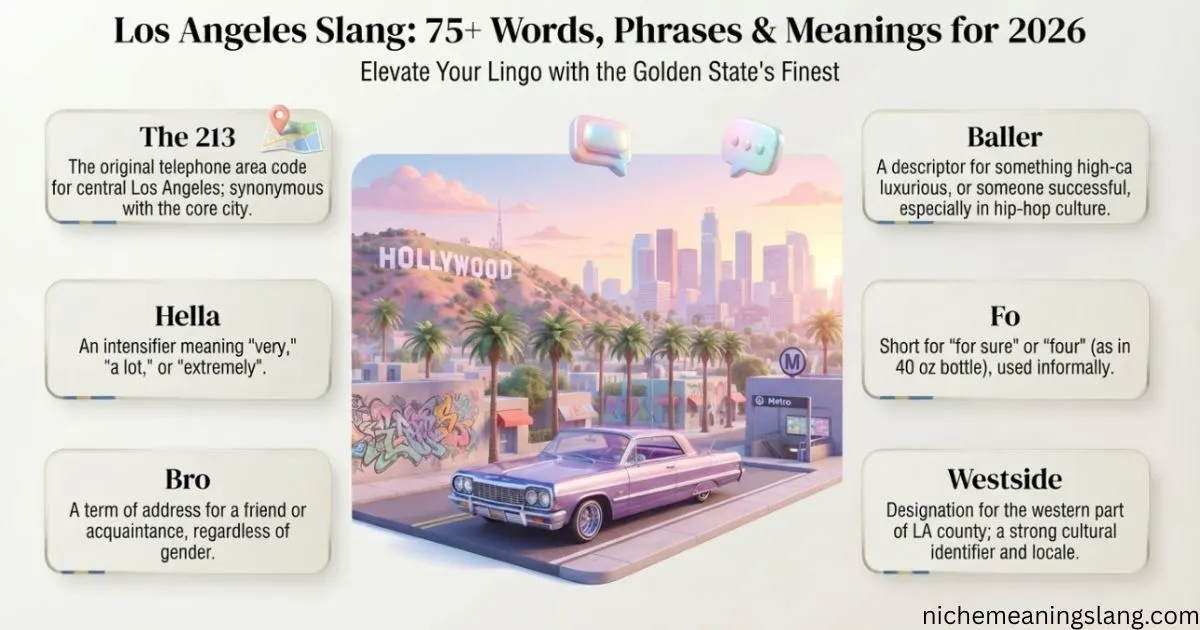
75+Los Angeles Slang Words, Phrases & Meanings for 2026
Los Angeles slang is the casual language shaped by neighborhoods, music, surf culture, Chicano communities, Hollywood, and online conversation. If you have ever heard “homie,” “fasho,” “stoked,” or “the 405” and wondered what they really mean, you are not alone. The key is context.
After researching current LA slang usage, regional language patterns, and modern examples, I found that the biggest mistake is treating every California expression as uniquely Angeleno. This guide separates local vocabulary from nationwide internet slang while explaining real meanings, tone, cultural context, and everyday use.
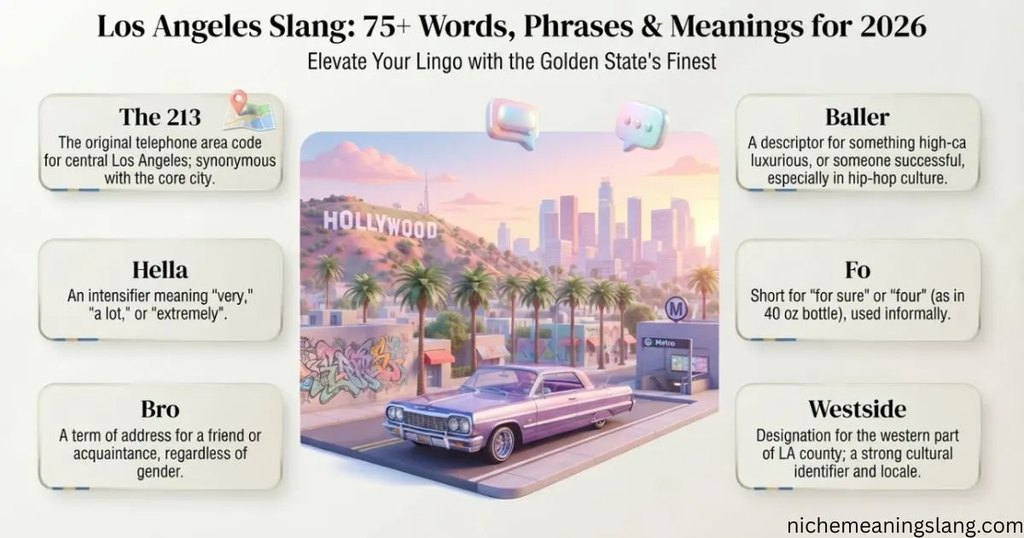
What Is Los Angeles Slang?
Los Angeles slang refers to informal expressions associated with everyday life across the city. It reflects West Coast English, AAVE, Mexican American and Chicano culture, surfing, skateboarding, hip-hop, Hollywood, fashion, and social media. That mixture gives LA vocabulary a distinctly regional but constantly changing character.
The important point is that Los Angeles slang is not one uniform dialect. Someone in South LA may use expressions differently from someone in the San Fernando Valley or a beach community. Age, neighborhood, cultural background, friend group, and setting all influence which words feel natural in conversation.
Is Los Angeles Slang Different From California Slang?
Los Angeles slang overlaps heavily with California slang, but the terms are not interchangeable. California is enormous, while LA has its own combination of entertainment culture, multicultural neighborhoods, urban vocabulary, surf traditions, and music influences. Some expressions spread statewide; others remain strongly associated with LA.
A useful example is “hella,” which is strongly associated with Northern California, while expressions such as “the 405,” “stoked,” and certain Hollywood or LA neighborhood references create a stronger Southern California connection. California English contains overlapping regional layers rather than one single vocabulary.
The Most Common Los Angeles Slang Words You’ll Actually Hear
Some familiar Los Angeles slang includes homie, bro, dude, fam, fire, legit, vibe, bet, lowkey, highkey, stoked, and chill. Many are no longer exclusive to LA, but they remain useful for understanding casual conversations, social posts, music, and everyday Southern California speech.
Context changes everything. “Fire” can describe excellent food, music, clothing, or an experience, while “homie” signals familiarity and “bet” can mean agreement. A phrase that sounds relaxed between friends may feel forced with a stranger, teacher, manager, or professional contact.
Los Angeles Slang by Community and Culture
Los Angeles slang reflects several overlapping cultural traditions rather than one source. USC Dornsife describes LA-area language through surf culture, Valley speech, Chicano slang, Hollywood, Spanish influence, and hip-hop. These influences interact over time, creating vocabulary that can move from neighborhoods into mainstream American English.
Black communities in South LA, Mexican American communities in East LA, surfers, skaters, musicians, actors, creators, and younger online communities have all contributed to the city’s linguistic landscape. It is therefore more accurate to describe LA slang as a network of influences than as a single neighborhood dialect.
Popular Los Angeles Slang Phrases You’ll Hear in Real Conversations
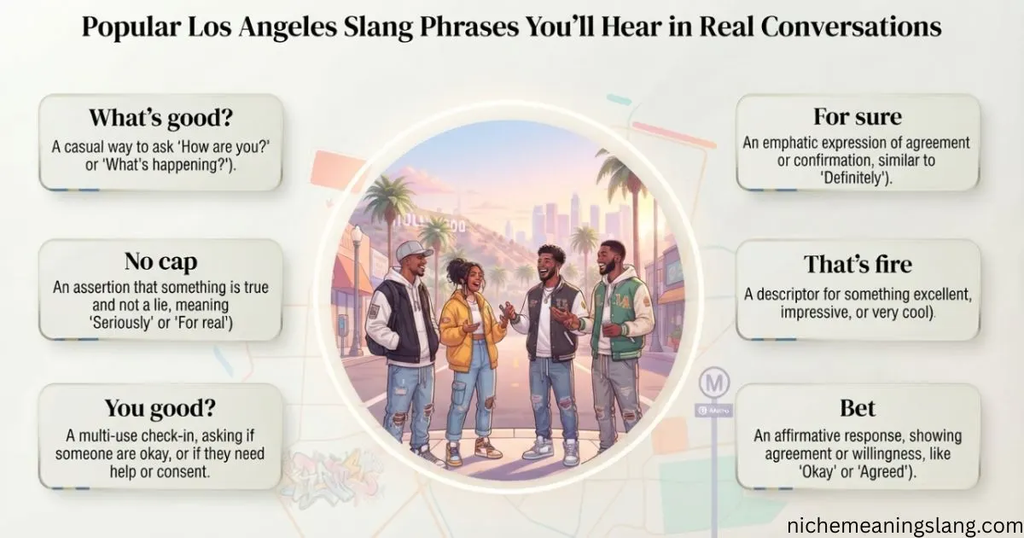
Complete phrases often reveal tone better than isolated vocabulary. “I’m down” means you are interested, “say less” signals understanding, “no cap” emphasizes honesty, and “I’m dead” can express intense laughter online. These phrases frequently appear in casual speech, texting, captions, and social media.
You may also hear “What’s good?”, “For real?”, “That’s on me,” and “It’s giving…”. None should be treated as secret LA codes; several are nationwide expressions that are simply common within contemporary Los Angeles communication. Their meaning depends heavily on the surrounding conversation and speaker relationship.
Which Los Angeles Slang Is Still Popular in 2026?
Current Los Angeles slang includes established expressions such as dude, bro, fire, legit, bet, vibe, chill, homie, lowkey, highkey, stoked, and say less. At the same time, social media continually introduces expressions such as ate, cooked, delulu, mid, and main character energy.
Older California vocabulary has not disappeared completely. Words such as rad and gnarly can still be understood and used, especially in surf, skate, nostalgic, or relaxed contexts, while expressions strongly associated with older movies may sound deliberately retro. USC also notes that slang survival is difficult to predict.
Los Angeles Slang vs. New York Slang vs. General American Slang
Los Angeles slang tends to reflect entertainment, beaches, traffic, surf and skate culture, hip-hop, and multicultural communities. New York vocabulary has its own regional history and urban references, while general American slang spreads through national media and internet culture. The boundaries overlap because social media moves language rapidly.
That is why a word appearing in an LA conversation does not automatically make it LA slang. Deadass, no cap, sus, lowkey, and bet, for example, can circulate nationally or online. The more useful question is whether a term has a documented local association, cultural history, or recognizable LA usage pattern.
How to Use Los Angeles Slang Naturally
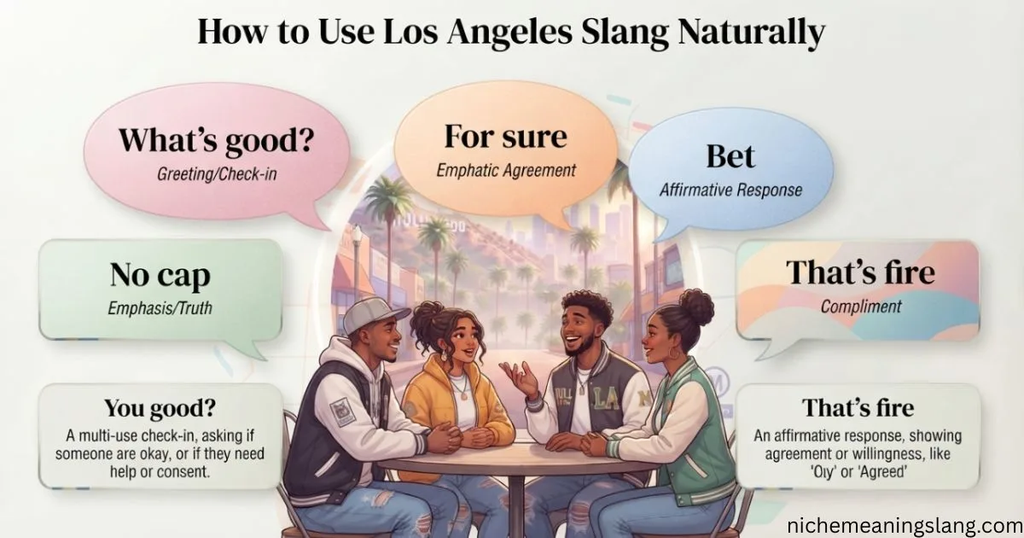
The easiest way to use Los Angeles slang naturally is to understand the situation before copying the vocabulary. Start with broadly understood expressions such as what’s up, I’m down, legit, fire, or for real. Listen to how people around you use them instead of forcing several terms into one sentence.
Audience matters just as much as vocabulary. A casual conversation with friends allows more slang than a job interview, classroom presentation, business email, or formal document. Natural speech usually mixes ordinary English with occasional slang; trying to sound constantly “local” can make the conversation feel less authentic.
Common Mistakes People Make With Los Angeles Slang
One common mistake is assuming every Californian speaks the same way. Los Angeles, San Diego, the Bay Area, Sacramento, and other regions have overlapping but distinct linguistic patterns. Another mistake is treating internet slang as automatically regional when many expressions now circulate across the entire United States.
Cultural context matters, too. Some terminology has connections to particular communities, neighborhood histories, or street cultures and may carry more weight than a simple dictionary definition suggests. Understanding where an expression comes from helps you recognize when casual imitation could sound inaccurate, insensitive, or out of place.
Why Los Angeles Slang Changes So Quickly
Los Angeles has an unusually powerful combination of entertainment, music, multicultural communities, youth culture, fashion, and digital media. A phrase can appear in a song, movie, TikTok, podcast, or influencer video and reach audiences far beyond Southern California. USC specifically connects LA vocabulary with entertainment, surfing, Spanish, Chicano language, and hip-hop.
Social media accelerates that cycle. TikTok, Instagram, YouTube, gaming communities, group chats, and memes can move expressions between neighborhoods and generations at remarkable speed. Some words become mainstream, some remain community-specific, and others disappear quickly. That constant reinvention is one defining feature of modern Los Angeles slang.
Los Angeles Slang Cheat Sheet
| Los Angeles slang | Meaning | Example |
| Homie | Close friend | “That’s my homie.” |
| Bro | Friend/person | “Bro, that was wild.” |
| Dude | Person/friend | “Dude, check this out.” |
| Fam | Close friend/group | “What’s good, fam?” |
| Fire | Excellent | “That taco spot is fire.” |
| Legit | Genuine/great | “That place is legit.” |
| Bet | Okay/agreed | “Meet at eight?” “Bet.” |
| Lowkey | Quietly/somewhat | “I lowkey want tacos.” |
| Highkey | Openly/strongly | “I’m highkey excited.” |
| Stoked | Very excited | “I’m stoked for the weekend.” |
| Gnarly | Extreme/intense | “That wave was gnarly.” |
| Vibe | Atmosphere/feeling | “The place has a good vibe.” |
| Chill | Relax/hang out | “We’re just chilling.” |
| Fasho | For sure | “Fasho, I’ll be there.” |
| Bool | Relax/chill | “We’re just boolin’.” |
| Trippin’ | Overreacting | “You’re trippin’.” |
| Guap | Money | “He saved some guap.” |
| Say less | I understand | “Need help?” “Say less.” |
| No cap | Honestly/no lie | “No cap, it was great.” |
| I’m down | I’m interested | “Taco run?” “I’m down.” |
The table combines recurring vocabulary from the current ranking guides, while remembering that several terms are now nationwide rather than uniquely Los Angeles.
Conclusion
Los Angeles slang is best understood as a living network of language rather than a fixed dictionary. Homie, dude, bro, fire, fasho, stoked, vibe, bet, lowkey, and dozens of other expressions connect everyday conversation with neighborhood identity, music, entertainment, surf culture, Chicano influence, and internet communication. Some are distinctly local; many have traveled far beyond LA.
The most useful approach is simple: learn the meaning, understand the context, notice who uses the expression, and avoid forcing words that do not fit your natural voice. That approach gives readers a much more accurate understanding of how Los Angeles slang actually works in 2026.
FAQs
What is the most common Los Angeles slang?
Commonly recognized examples include dude, bro, homie, fire, legit, vibe, chill, bet, lowkey, and I’m down. Usage varies by age, neighborhood, community, and social setting.
Is LA slang different from California slang?
Yes, although they overlap. Los Angeles has stronger associations with Hollywood, hip-hop, multicultural neighborhoods, surf culture, skateboarding, and entertainment, while California slang includes regional vocabulary from across the state.
Can tourists use Los Angeles slang?
Yes. Familiar expressions such as “What’s up?”, “I’m down,” “for real,” or “that’s fire” can work naturally in casual settings. The key is understanding tone and avoiding excessive imitation.
What slang is unique to Los Angeles?
Very few expressions are completely exclusive to LA. Some terms and references have especially strong local associations, including the way Angelenos refer to freeways such as the 405, along with vocabulary influenced by Hollywood, local neighborhoods, surf culture, and Chicano communities.
Is Los Angeles slang influenced by Spanish?
Yes. Spanish and English interact extensively in Los Angeles, particularly within Mexican American and Chicano communities. USC describes Spanish/Spanglish influence as part of the broader linguistic environment surrounding LA.
Does everyone in Los Angeles use the same slang?
No. Vocabulary varies according to neighborhood, age, cultural background, profession, interests, and social circles. The diversity of LA is one reason there is no single vocabulary that represents every Angeleno.
How often does Los Angeles slang change?
New expressions can emerge quickly through music, entertainment, youth culture, and social media. Some survive for decades, while others fade after a trend ends. Linguists cited by USC note that predicting which slang will survive is difficult.
Why is Los Angeles slang popular around the world?
Hollywood, music, streaming, social media, professional sports, influencers, and hip-hop give Los Angeles an unusually large cultural reach. Expressions connected to the city can therefore become familiar far outside California.
Related Slang Words

Ryan Mitchell is a language enthusiast and writer who explores slang, modern expressions, and everyday language. At nichemeaningslang, he helps readers understand slang meanings, usage, and context in a simple and easy-to-follow way.