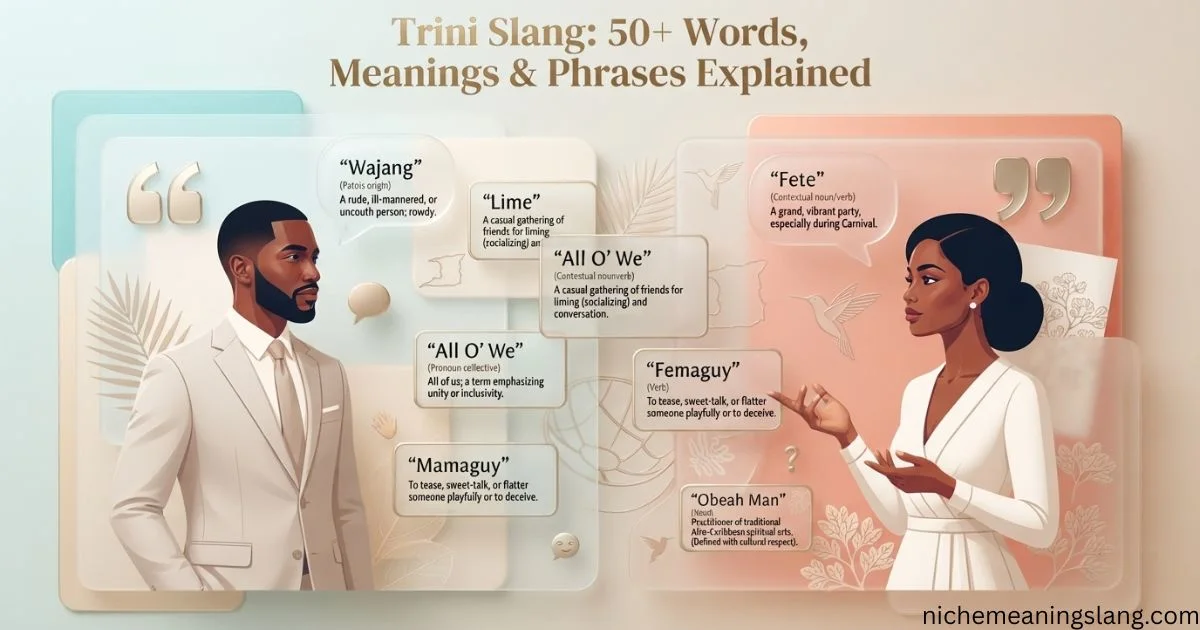
50+Trini Slang Words, Meanings & Phrases Explained
Trini slang is the informal vocabulary and expressive speech associated with Trinidad and Tobago, including words such as lime, bacchanal, maco, tabanca, and dotish. After researching Caribbean language and Trini expressions, I’ve found that the hardest part is rarely the dictionary meaning it’s understanding the tone, setting, and cultural context behind each phrase.
If you’re reading a Trini conversation and feeling completely lost, you’re not alone. Words such as liming, commess, cut eye, wine, eh heh, and Waz d scene can sound unfamiliar at first. This guide breaks down common expressions, everyday vocabulary, formal and informal speech, and regional differences so you can understand Trini slang without treating it like a simple word-for-word translation.
Essential Phrases for the Trini Slang Newcomer
If you are new to Trini slang, start with the expressions you are most likely to encounter in casual conversation. Lime means to hang out or socialize, while liming describes spending relaxed time with friends. Waz d scene? can function as a casual greeting, while Yuh good? asks whether someone is okay.
Another useful phrase is eh heh, whose meaning can change with tone. It may communicate surprise, agreement, acknowledgment, or skepticism. That is an important lesson with Trinidadian expressions: pronunciation, repetition, facial expression, and situation can carry as much meaning as the words themselves.
Common Trini Slang Expressions
Some Trini slang words describe emotions or social situations rather than simple objects. Bacchanal can refer to drama, confusion, or lively party activity. Maco describes someone who is overly interested in other people’s business, while commess is associated with drama, gossip, or confusion.
Then there are expressive terms such as tabanca, connected with painful romantic longing, and dotish, meaning foolish or silly. A phrase may sound harsh when translated literally but playful when spoken between friends. Always consider the relationship between speakers before assuming the emotional force of a word.
| Trini slang | Common meaning | Typical context |
| Lime / liming | Hang out or socialize | Friends, casual gatherings |
| Bacchanal | Drama, confusion, or lively party activity | Social life, Carnival |
| Maco | Nosy or overly curious | Teasing, criticism |
| Commess | Drama, confusion, gossip | Social situations |
| Dotish | Foolish or silly | Playful criticism |
| Tabanca | Romantic heartbreak or longing | Relationships |
| Cut eye | Disapproving look | Social interaction |
| Waz d scene? | What’s happening? / What’s up? | Casual greeting |
| Yuh good? | Are you okay? / How are you? | Everyday conversation |
| Lime spot | Social hangout | Friends and recreation |
Trini Slang Words to Know (And Maybe Avoid)
Understanding Trini slang also means knowing when not to use a phrase. Some expressions are harmless and widely understood, while others can sound disrespectful, overly familiar, or simply unnatural when used by someone unfamiliar with the culture. Maco, cut eye, dotish, and commess, for example, depend heavily on tone and relationship.
Visitors should also pay attention to words connected with dancing and Carnival. Wine, wining, jook, and jam can carry culturally specific meanings that are different from their ordinary American-English interpretations. Learning the meaning is useful; immediately copying every expression is not always necessary.
The same principle applies to humor. A Trinidadian speaker may use a word teasingly with a friend that would sound insulting from a stranger. Context protects you from the most common mistake in learning slang: memorizing a translation without learning the social situation in which it belongs.
Formal Ways to Speak Trini Slang
Trinidad and Tobago uses English as its official language, and formal communication generally follows Standard English rather than relying heavily on slang. In professional, academic, or official situations, a straightforward greeting, polite request, or conventional English expression is usually more appropriate than deliberately inserting informal Trini vocabulary.
That difference is important for language learners. Trini speech is not simply a replacement dictionary for American English. Speakers can move between more formal English and local Creole-influenced speech depending on audience and setting. Understanding that code-switching makes it easier to recognize Trini slang without assuming every local speaker uses it in every conversation.

Informal Ways to Speak Trini Slang
Informal conversation is where Trini slang becomes especially expressive. Liming describes relaxed socializing, while lime spot refers to a place where people gather. Waz d scene? can ask what is happening, and Yuh good? can work as a friendly check-in.
Tone matters just as much as vocabulary. A repeated word can intensify an idea, while a short expression may change meaning according to facial expression or intonation. That is why listening to real conversations, music, interviews, and local media can teach something a static glossary cannot: how Trini expressions actually feel in conversation.
Tips for Understanding and Using Trini Slang
The easiest way to understand Trini slang is to listen before trying to imitate it. Pay attention to who is speaking, who they are speaking to, what happened immediately beforehand, and whether the conversation is serious, playful, annoyed, or celebratory. Those details often reveal the intended meaning.
Immersion also helps. Listen for recurring expressions in Trinidadian music, conversations, interviews, and cultural coverage. If a phrase is unfamiliar, ask about it rather than guessing. Most importantly, avoid treating Trinidadian speech as “bad English.” Trinidad and Tobago’s vernaculars have their own linguistic histories and reflect influences from several cultural and language communities.
Examples of Regional Variations in Trini Slang
Trini slang is not completely uniform, and vocabulary can vary by speaker, generation, location, and cultural background. Some expressions may be widely understood while others have stronger regional or historical associations. Competitor research specifically notes examples such as chupidness and doux-doux when discussing regional variation.
Tobago also has distinctive local expressions and pronunciation patterns. Official Tobago tourism material lists expressions such as bacchanal, lime, maco, parang, steups/chups, tabanca, and Tobago love, showing how everyday vocabulary connects language with local culture and heritage. Regional variation does not mean every Trini phrase belongs to one fixed dialect; it means context matters.
The result is a vocabulary that can feel wonderfully alive: one expression may carry humor, history, music, family life, Carnival, or neighborhood culture all at once.
Conclusion
Trini slang becomes much easier to understand once you stop treating it as a direct translation exercise. Words such as lime, bacchanal, maco, tabanca, dotish, and cut eye are connected to social relationships, tone, Trinidadian culture, Carnival, and everyday communication. Official Tobago resources also demonstrate how expressions such as lime, bacchanal, maco, parang, and tabanca are embedded in local culture.
For a USA reader, the most useful approach is to learn the common meaning first, then pay attention to how Trinidadian speakers actually use the expression. The distinction between formal English and local Creole-influenced speech is especially important, because Trinidad and Tobago’s official educational language is English while local vernaculars reflect multiple linguistic influences.
FAQs
What does Trini slang mean?
Trini slang refers broadly to informal words, expressions, and speech patterns associated with Trinidad and Tobago. It overlaps with Trinidadian English Creole and local vernacular, although “slang” does not describe every feature of the language.
What does “lime” mean in Trini slang?
“Lime” means to hang out or socialize in Trinidad and Tobago. “Liming” describes the activity, while a “lime” can refer to a casual social gathering.
What does “bacchanal” mean in Trini slang?
“Bacchanal” can describe drama, confusion, gossip, or a lively party atmosphere. The intended meaning depends on context, making it one of the more flexible Trinidadian expressions.
What does “maco” mean in Trini slang?
“Maco” refers to someone who is overly interested in other people’s business. It can be teasing or critical depending on tone and the relationship between speakers.
What does “tabanca” mean?
“Tabanca” describes painful romantic longing, particularly the emotional feeling associated with a relationship ending or unrequited love.
Is Trini slang the same as Jamaican slang?
No. Trinidadian and Jamaican speech belong to different cultural and linguistic traditions. They may share some Caribbean influences or vocabulary, but Trini expressions should not automatically be interpreted as Jamaican slang.
Is Trini slang used in formal situations?
Generally, formal communication favors Standard English. Informal Trini expressions are more naturally associated with casual conversations, friendships, social gatherings, and cultural settings.
Can Americans understand Trini slang?
Yes, but some expressions require context. Words such as lime, bacchanal, maco, tabanca, and cut eye can be learned quickly, while pronunciation, tone, and local cultural references may take more exposure to understand naturally.
Trini Slang in Everyday Conversation
The biggest lesson is simple: Trini slang is more than a list of unusual words. Expressions such as lime, bacchanal, maco, tabanca, dotish, and cut eye connect language with relationships, humor, social life, music, Carnival, and everyday Trinidadian culture.
If you are learning these expressions for travel, conversation, cultural research, or simple curiosity, start with meaning and context rather than trying to sound local immediately. Once you understand how the expressions work, the vocabulary becomes much easier to recognize—and much more interesting to explore.
Related Slang Words

Ryan Mitchell is a language enthusiast and writer who explores slang, modern expressions, and everyday language. At nichemeaningslang, he helps readers understand slang meanings, usage, and context in a simple and easy-to-follow way.