50+Jamaica Slang Jamaican Words, Meanings & Phrases
Jamaica slang includes familiar expressions such as Wah gwaan, irie, big up, mi deh yah, likkle more, and walk good, many of which are associated with Jamaican Patois, also called Patwa. These expressions can sound like a completely different language to an English speaker, especially when pronunciation, rhythm, and context change the literal meaning.
After studying Jamaican expressions across dictionaries, language guides, and cultural sources, one lesson stands out: Jamaica slang is easier to understand when you learn the situation, tone, and meaning together. This guide brings those pieces together with pronunciation help, natural examples, Jamaican Patois vocabulary, greetings, farewells, and cultural context so you can understand the language without reducing it to stereotypes or word-for-word translations.
The Eight Jamaica Slang Phrases That Do the Most Work
A small group of Jamaica slang expressions appears again and again in everyday conversation: Wah gwaan, Mi deh yah, Mi soon come, Nuff respec, Likkle more, Walk gud, Big up yuhself, and Yes mi dear. LearnPatois highlights these as high-frequency phrases because they perform important social functions rather than simply transferring information.
That is useful for beginners because memorizing a giant dictionary can feel overwhelming. Start with greetings, responses, respect, farewells, and everyday expressions. You will quickly recognize the rhythm of Jamaican Patois in messages, conversations, music, and travel situations without pretending that every expression has one rigid English translation.
Wah Gwaan?
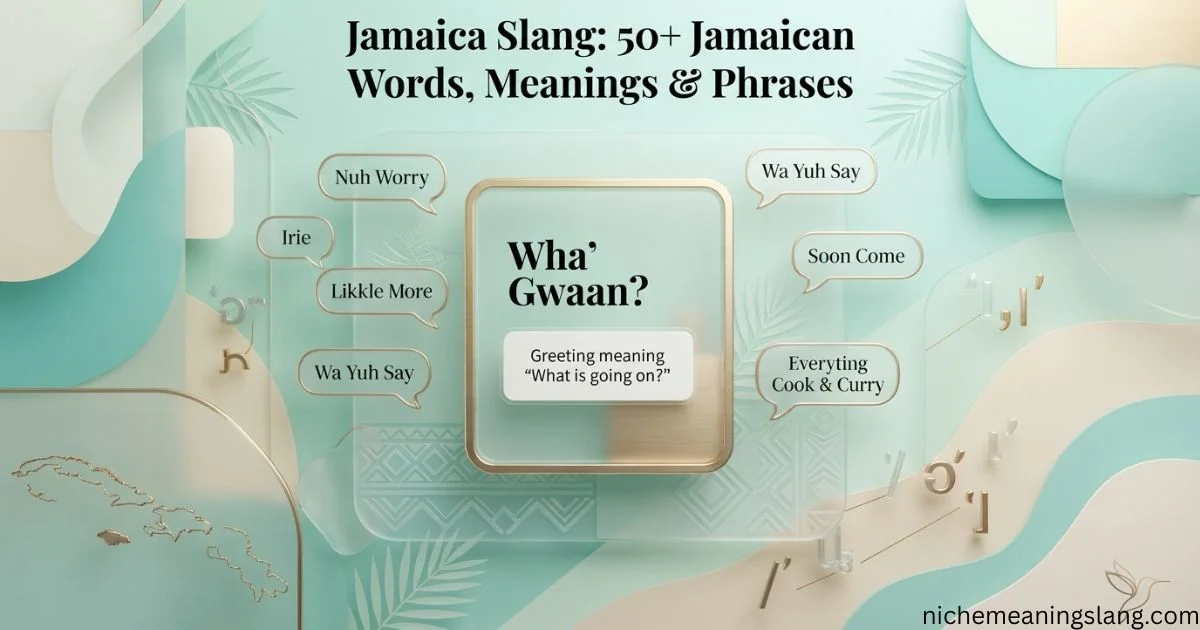
Wah gwaan? means roughly “What’s going on?”, “What’s up?”, or “How are you?” It is one of the best-known Jamaican greetings and is informal. Jamaican Patois sources commonly give the pronunciation as roughly “wah gwahn,” although spelling and pronunciation can vary in informal writing.
Mi Deh Yah
Mi deh yah can mean “I’m here,” “I’m doing okay,” or “I’m getting by,” depending on context. It is especially recognizable as a response to Wah gwaan. The literal components do not fully capture its conversational meaning, which is why context matters.
Mi Soon Come
Mi soon come generally means “I’ll be back shortly” or “I’ll come soon.” LearnPatois includes it among high-frequency everyday expressions, while other Jamaican guides note that the phrase can be flexible about exactly how soon someone will return.
Likkle More
Likkle more is a friendly farewell meaning “See you later” or “Until next time.” It demonstrates how Jamaican Patois often uses familiar English-derived vocabulary in forms that sound different from Standard English. The phrase is informal and works naturally in relaxed social interactions.
Walk Gud
Walk gud means something like “Take care” or “Take care on your way.” The phrase is especially interesting because a literal English translation does not capture its social function. It can be a warm farewell, particularly when someone is leaving or traveling.
Big Up Yuhself
Big up yuhself expresses praise, recognition, encouragement, or respect. Big up can also be directed toward another person as a positive acknowledgment. Jamaican dictionaries describe it as showing respect, praise, congratulations, or recognition.
Greeting Somebody With Jamaica Slang, and Getting Away Again
Greetings are an important part of Jamaican conversation, and Jamaican Patois provides several options depending on familiarity, time, and situation. Wah gwaan, gud mawnin, bless up, likkle more, and walk gud can all perform different social functions, so simply memorizing one greeting misses the conversational pattern.
For an American English speaker, this is similar to learning that “Hey,” “Good morning,” “What’s up?” and “Take care” are not interchangeable. Jamaican language has its own social rhythm. Learning when an expression belongs in a conversation is often more valuable than memorizing a literal translation.
Gud Mawnin
Gud mawnin means “Good morning.” It is one of the safer expressions for learners because the meaning is straightforward and the situation is easy to recognize. LearnPatois lists time-of-day greetings as useful expressions that can work across a range of social situations.
Bless Up
Bless up can function as a greeting or a warm farewell and conveys a sense of blessing or goodwill. It is widely recognizable in Jamaican and Caribbean cultural contexts and can appear in everyday conversation, music, and online communication.
Asking How Somebody Is With Jamaica Slang
Jamaica slang and Patois often make a simple social question compact and expressive. Phrases such as How yuh feel?, Yuh good?, and Wah gwaan? can ask about someone’s state without necessarily inviting a long explanation. The expected response may be brief, friendly, and conversational.
That is an important cultural distinction for learners. Translating every word literally can make a short greeting sound more complicated than it really is. Listen for the social function: is the speaker greeting you, checking on you, asking what you are doing, or simply opening a conversation?
How Yuh Feel?
How yuh feel? means “How are you feeling?” or “How are you doing?” It belongs to the family of conversational questions used to check on someone. The natural answer can be short rather than a detailed account of everything happening in your life.
Everyting Criss
Everyting criss means that everything is fine, good, or okay. It can answer a question about someone’s well-being and is listed by Jamaican Patois sources as an everyday response. The phrase is positive and informal, making it useful for understanding casual conversations.
Agreeing, Refusing and Doubting With Jamaica Slang
Jamaican Patois contains compact ways to agree, refuse, question, or express uncertainty. This conversational layer is important because language is not only about naming objects; it also manages relationships. Expressions such as yes, ya mon, mi nuh know, and a lie can signal agreement, uncertainty, or disagreement depending on delivery.
Context can dramatically affect tone. A phrase that looks blunt in written English may sound playful when spoken among friends. Conversely, an expression that seems harmless to an outsider can carry stronger social meaning in a particular Jamaican setting. Learning the relationship between words, tone, audience, and situation prevents awkward translations.
| Expression | Approximate meaning | Context |
| Ya mon | Yes / okay / affirmative | Casual |
| Mi nuh know | I don’t know | Everyday |
| A lie! | That’s a lie / no way | Strong disagreement |
| Nuh problem | No problem | Reassurance |
| Yes mi dear | Yes, of course | Warm agreement |
| Same way | Much the same / likewise | Conversational |
These are approximate translations rather than rigid substitutions. Jamaican Patois has its own grammatical and expressive system, so the best English equivalent depends on the surrounding sentence and relationship between speakers.
Getting Attention Without Being Rude With Jamaica Slang
Getting someone’s attention in Jamaica slang is not simply about inserting a random Patois word into an English sentence. Tone, familiarity, and respect determine whether an expression sounds natural. LearnPatois treats attention-getting as its own conversational category because speakers need ways to direct attention without automatically sounding aggressive.
Expressions such as pree can also carry meanings connected with looking, watching, noticing, or paying attention. David’s Been Here translates pree as thinking about something or watching something closely. This illustrates why a dictionary definition alone can be insufficient: context tells you what action the speaker intends.
A practical learner’s rule is simple: understand first, imitate second. If you hear a Jamaican expression in a song, conversation, or social-media post, consider who said it, who heard it, and what happened immediately before it. That approach produces much more accurate understanding than translating isolated words.
Affection, Praise and Encouragement in Jamaica Slang
Jamaican slang includes many expressions of respect, friendship, affection, encouragement, and admiration. Terms such as big up, respek, bredren, sistren, mi love yuh, and one love can communicate warmth or solidarity, although their exact use depends on relationship and setting.
This social vocabulary is one reason Jamaican expressions have traveled so widely through reggae, dancehall, Caribbean communities, migration, entertainment, and social media. An American listener may recognize “one love” or “big up” without knowing the wider linguistic system behind it. Understanding that system adds cultural depth to the phrase.
| Jamaica slang | General meaning |
| Big up | Respect, praise, recognition |
| Respek | Respect |
| Bredren | Male friend/brother |
| Sistren | Female friend/sister |
| Mi love yuh | I love you |
| One love | Unity, goodwill, farewell in some contexts |
| Tallawah | Brave, strong, resilient |
David’s Been Here includes these terms in its vocabulary guide, while broader Jamaican Patois resources emphasize that meanings can vary by context, speaker, and situation.
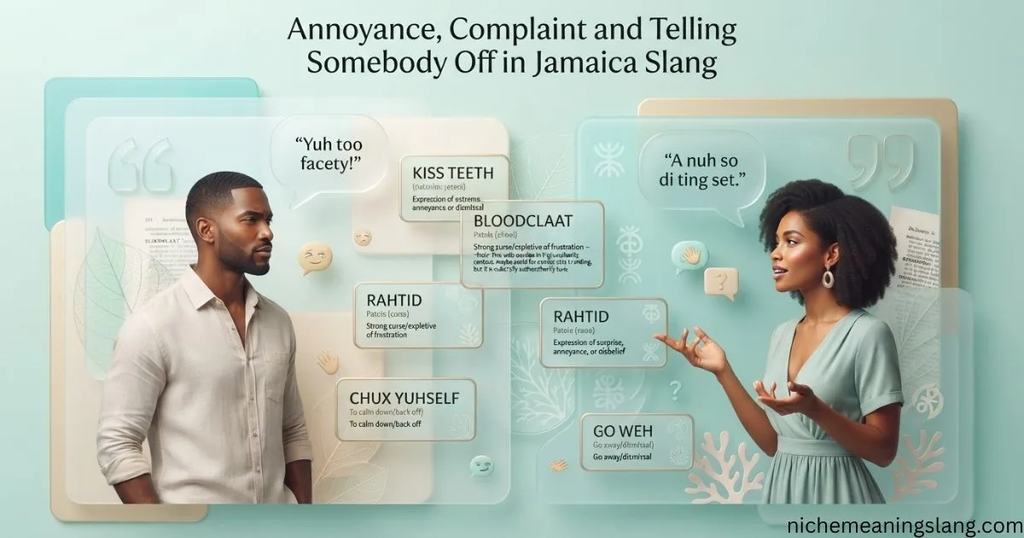
Annoyance, Complaint and Telling Somebody Off in Jamaica Slang
Not all Jamaica slang is warm or celebratory. Jamaican speech also includes expressions for annoyance, frustration, complaints, insults, and disagreement. Words such as vex, gweh, tek weh yuself, facety, and mash up can carry negative or corrective meanings depending on how they are delivered.
This is where cultural context becomes especially important. Some expressions can be humorous between close friends but disrespectful toward a stranger or elder. Stronger Jamaican profanity also exists, and modern dictionaries explicitly mark offensive language so learners can recognize it without assuming that every colorful expression is appropriate for casual imitation.
If your goal is simply to understand Jamaican slang, recognition is enough. You do not need to repeat every insult you encounter. Learning meaning, strength, audience, and setting is the more respectful approach, especially when the expression comes from a cultural tradition you did not grow up speaking.
The Small Words That Hold Jamaica Slang Together
One of the biggest breakthroughs for a learner comes from understanding a few small Patois words. Mi, yuh, wi, unu, nuh, deh, and gwaan appear repeatedly across everyday expressions. Once these patterns become familiar, longer sentences stop looking like random spellings and begin to show recognizable grammatical relationships.
That is also why Jamaican Patois should not simply be described as “bad English.” It is a living English-lexified creole with its own vocabulary, grammar, pronunciation, and history. Babbel and current Patois learning resources both emphasize the distinction between Jamaican Patois and Standard English.
Mi
Mi commonly corresponds to “I,” “me,” or “my,” depending on the sentence. For example, Mi hungry can be understood as “I am hungry.” Learning this small pronoun unlocks many common Jamaican expressions because it appears repeatedly in everyday conversation.
Yuh
Yuh commonly corresponds to “you” or “your.” It appears in phrases such as Wah yuh a seh? and Big up yuhself. Because the same written form can represent different grammatical functions, sentence context is important when translating Jamaican Patois into Standard English.
Nuh
Nuh can express “not” or “don’t,” depending on the construction. In Mi nuh know, it contributes the meaning “I don’t know.” This small word appears frequently enough that recognizing it can make unfamiliar Patois sentences much easier to decode.
Gwaan
Gwaan relates to “going on” or “happening.” In Wah gwaan?, the phrase naturally functions as a greeting meaning something like “What’s going on?” or “How are you?” It is a good example of why natural meaning is more important than literal word-for-word translation.
Phrases That Translate Word for Word and Then Mean Something Else in Jamaica Slang
One of the most interesting features of Jamaica slang is the gap between literal wording and natural meaning. Wah gwaan? literally contains an idea related to “what is going on,” but socially it works as a greeting. Walk gud is not normally an instruction to improve your walking; it functions as a farewell meaning “take care.”
This is common in living languages. Expressions become fixed social units, and their meaning comes from repeated use rather than individual words. LearnPatois specifically separates phrases that translate word-for-word from phrases whose natural meaning is different, reinforcing the importance of context, pronunciation, tone, and conversational purpose.
| Jamaican expression | Literal idea | Natural meaning |
| Wah gwaan? | What is going on? | What’s up? / How are you? |
| Mi deh yah | I am here | I’m okay / I’m doing fine |
| Walk gud | Walk good | Take care |
| Likkle more | Little more | See you later |
| Big up | Make big / raise up | Respect / praise |
| Mi soon come | I soon come | I’ll be back soon |
| Pree | Watch/consider | Look closely / pay attention |
These differences are precisely why a good Jamaica slang guide should teach phrases in context rather than simply providing English substitutions. A learner who understands the social function is much less likely to use an expression awkwardly.
Jamaica Slang: What Is Jamaican Patois?
Jamaican Patois, also called Patwa or Jamaican Creole, is a broader language variety associated with Jamaica and the Jamaican diaspora. It is not simply a collection of slang words. It has its own vocabulary, grammatical structures, pronunciation patterns, and history, with strong English and West African influences.
Jamaica’s official language is English, but Patois plays a major role in everyday communication and cultural expression. It is especially visible in reggae, dancehall, literature, social conversation, and Jamaican popular culture. Understanding this distinction makes the term “Jamaica slang” more accurate: many expressions people call slang are actually pieces of a larger language system.
Jamaican Slang vs. Jamaican Patois
These terms overlap, but they are not identical. Jamaican Patois refers to the broader creole language variety, while Jamaica slang is commonly used online as a convenient label for informal Jamaican words and expressions. Calling every Patois word “slang” can hide the language’s grammar, history, and cultural significance.
Jamaican Slang and Pronunciation
Patois is primarily spoken, so spelling varies. The same expression may appear differently in texts, captions, dictionaries, or phonemic transcription systems. JamaicanPatois.com explicitly notes that spelling variation is normal because Patois has historically been more heavily spoken than standardized in writing.
Jamaican Slang and Culture
Jamaican expressions cannot be separated completely from Jamaican culture. Language has been shaped by colonial history, African linguistic heritage, music, migration, community identity, and popular culture. Reggae and dancehall helped expose Patois vocabulary to international audiences, while the Jamaican diaspora continues to carry and evolve these expressions worldwide.
Conclusion
Jamaica slang is best understood as a collection of informal Jamaican expressions closely connected with the broader Jamaican Patois language. Words and phrases such as Wah gwaan, irie, big up, mi deh yah, likkle more, bredren, sistren, pree, and walk good become much easier to understand once you learn their context instead of translating them mechanically.
The biggest takeaway is that Jamaican Patois is more than slang. It is a living language variety with its own grammar, pronunciation, vocabulary, history, and cultural identity. If you are learning Jamaica slang for travel, music, conversation, or curiosity, focus on meaning and context first. That will help you understand the expressions more naturally and use them more respectfully.
FAQs
What are some common Jamaican slang words?
Common Jamaican slang and Patois expressions include Wah gwaan, irie, big up, mi deh yah, likkle more, walk good, bless up, bredren, sistren, gyal, pickney, nyam, pree, and tallawah. Their exact meaning can change according to sentence, speaker, and context.
What does “Wah Gwaan” mean?
Wah gwaan? is a casual Jamaican greeting meaning roughly “What’s going on?”, “What’s up?”, or “How are you?” It is one of the most recognizable Jamaican Patois expressions and is generally used in relaxed conversation.
What does “Irie” mean in Jamaican slang?
Irie generally communicates that things are good, peaceful, pleasant, or alright. It can describe a person’s state of mind or the general situation. For example, Everything irie can mean “Everything is good.”
What does “Big Up” mean in Jamaican slang?
Big up means to show respect, praise, recognition, or congratulations. It can be used when acknowledging a person’s achievement or simply showing appreciation.
What does “Mi Deh Yah” mean?
Mi deh yah literally relates to being “here,” but conversationally it can mean “I’m okay,” “I’m doing fine,” or “I’m getting by.” It is commonly used as a response to Wah gwaan.
What does “Likkle More” mean?
Likkle more is a friendly farewell meaning “See you later” or “Until next time.” It is commonly used in informal conversation.
What does “Walk Good” mean?
Walk good is a farewell expression that means roughly “Take care” or “Travel safely.” The phrase demonstrates why Jamaican Patois should not always be translated word for word.
Is Jamaican Patois the same as Jamaican slang?
Not exactly. Jamaican Patois is a broader creole language variety with its own grammar, vocabulary, and pronunciation. “Jamaican slang” is a popular informal label for many Jamaican expressions, particularly those unfamiliar to Standard English speakers.
Is Jamaican slang the same as Jamaican Creole?
In many informal sources, Jamaican Patois, Patwa, and Jamaican Creole are used as names for the broader language variety. “Jamaican slang” generally refers to informal expressions within or associated with that language, so the terms overlap but are not perfectly interchangeable.
What does “Bredren” mean?
Bredren generally refers to a male friend, brother, or close male companion. Sistren is a related term used for a female friend or sister. These expressions are part of Jamaican social vocabulary and can communicate familiarity or solidarity.
What does “Pree” mean in Jamaican slang?
Pree can mean to look at, watch closely, observe, or think about something. David’s Been Here gives meanings including thinking about something or watching something closely. The exact translation depends on the surrounding sentence.
What does “Pickney” mean in Jamaican slang?
Pickney means a child or kid. It is one of the Jamaican Patois words that English speakers may encounter in everyday conversation, music, or cultural content.
What does “Nyam” mean?
Nyam means to eat. The word is included in Jamaican Patois vocabulary guides and has linguistic connections to West African languages.
Can non-Jamaicans use Jamaican slang?
People outside Jamaica can certainly learn and understand Jamaican expressions. The important part is using them with cultural awareness and appropriate context, rather than exaggerating an accent or treating Patois as a costume. Learning the language respectfully is different from imitating stereotypes.
Is Jamaican slang appropriate in formal situations?
Most expressions commonly categorized as Jamaican slang are informal. Standard English is generally more appropriate for formal business, academic, legal, or professional settings unless the context specifically calls for Jamaican Patois. Some expressions may also be vulgar or offensive.
Why does Jamaican slang have different spellings?
Jamaican Patois has historically been primarily spoken rather than standardized in writing. As a result, expressions may have multiple spellings based on pronunciation, community conventions, or informal texting. This is why Wah gwaan, pronunciation guides, and other expressions can appear with slightly different written forms.
Related Slang Words

Ryan Mitchell is a language enthusiast and writer who explores slang, modern expressions, and everyday language. At nichemeaningslang, he helps readers understand slang meanings, usage, and context in a simple and easy-to-follow way.