10+Cheers in Spanish Slang Ways to Say It Naturally
Cheers in Spanish slang is most commonly expressed as ¡Salud!, meaning “health,” but casual speakers also use ¡Chin chin!, ¡Por nosotros!, and playful toast phrases. If you’re traveling, meeting Spanish speakers, or simply want to sound natural, knowing when each expression fits matters more than memorizing a direct translation.
The tricky part is that Spanish toasts vary by country, setting, and relationship. Spain, Mexico, and Latin America may share ¡Salud!, yet casual expressions can sound more regional. This guide explains the most useful Spanish toast phrases, pronunciation, informal expressions, celebration vocabulary, and etiquette, so you can raise your glass confidently without sounding overly formal or using slang in the wrong setting.
Quick Answer: Cheers in Spanish Slang
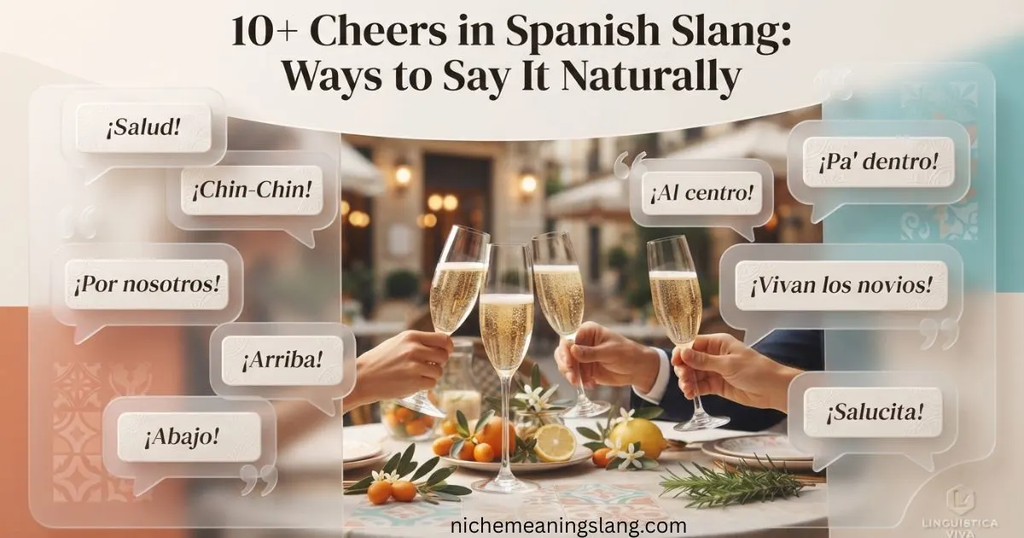
The most universal answer to cheers in Spanish slang is ¡Salud!, pronounced approximately “sah-LOOD.” It literally means “health,” making it a short wish for good health and well-being. It works across Spain and Latin America and is appropriate for everything from casual drinks to celebrations.
For a more playful atmosphere, ¡Chin chin! is another option, particularly associated with informal toasting. You can also say ¡Por nosotros! (“To us!”), ¡Por ti! (“To you!”), or ¡Brindemos! (“Let’s toast!”). Your safest choice when you are unsure of the regional preference is still ¡Salud! because it is broadly understood.
Other Ways to Say Cheers in Spanish Slang
Besides ¡Salud!, Spanish speakers have several ways to raise a glass. ¡Chin chin! is casual and playful, while ¡Por…! introduces the person, occasion, or idea being celebrated. ¡A tu salud! means “to your health” and can make a toast feel more personal.
Another familiar expression is ¡Salud, dinero y amor!, meaning “health, money, and love.” Longer phrases are often associated with celebrations and social gatherings rather than everyday drinking. The expression you choose can therefore communicate not just the toast itself, but also the mood and relationship between the people involved.
Chin chin
¡Chin chin! is a cheerful, informal way to say cheers in Spanish slang. It is especially associated with casual settings and is widely recognized in Spain. Because it has a playful tone, chin chin works better among friends or at relaxed celebrations than during a serious business dinner.
Brindemos
¡Brindemos! means “Let’s toast!” and comes from the verb brindar, meaning “to make a toast.” It is useful when you want to invite everyone to raise their glasses before giving the reason for the celebration. For example, ¡Brindemos por la amistad! means “Let’s toast to friendship.”
Por nosotros
¡Por nosotros! means “To us!” and makes a warm, personal toast for friends, couples, teammates, or family. You can change the phrase according to what you are celebrating: ¡Por ti! means “To you,” while ¡Por el futuro! means “To the future.”
Arriba, abajo, al centro, pa’ dentro
This playful Spanish toast means roughly “up, down, to the center, down the hatch.” People may move their glasses upward, downward, toward the center, and then drink. It is casual and energetic, making it better suited to parties than formal occasions.
Examples of Cheers in Spanish Slang
Real examples make cheers in Spanish slang much easier to remember. For a simple gathering, you can raise your glass and say ¡Salud! If celebrating a group, ¡Salud, amigos! or ¡Por nosotros! feels natural. For a specific achievement, add por and name what you are celebrating.
For example, ¡Salud por tu nuevo trabajo! means “Cheers to your new job!” At a wedding, ¡Por los novios! means “To the newlyweds!” At a birthday celebration, ¡Por tu cumpleaños! means “To your birthday!” These examples show why Spanish toasting often uses por to identify the reason for the toast.
| Spanish phrase | English meaning | Best context |
| ¡Salud! | Cheers! / To your health! | Almost any toast |
| ¡Chin chin! | Cheers! | Casual, playful settings |
| ¡Por nosotros! | To us! | Friends, couples, family |
| ¡Por ti! | To you! | Personal toast |
| ¡Brindemos! | Let’s toast! | Starting a toast |
| ¡A tu salud! | To your health! | Personal toast |
| ¡Por los novios! | To the newlyweds! | Wedding |
| ¡Por tu cumpleaños! | To your birthday! | Birthday |
| ¡Por nuestra amistad! | To our friendship! | Friends |
| ¡Salud, dinero y amor! | Health, money, and love! | Celebration / traditional expression |
Basic Toast
A basic toast can be extremely simple: ¡Salud! You can make it warmer with ¡Salud, amigos!, meaning “Cheers, friends!” or ¡Salud por nosotros!, meaning “Cheers to us!” The important part is the social moment, not producing a complicated Spanish sentence.
Full Spanish Toast
For a playful group toast, you may hear ¡Arriba, abajo, al centro, pa’ dentro! The phrase accompanies movements of the glass before drinking and is especially associated with relaxed gatherings. Because it is energetic and informal, it is best used when the group is already in a festive mood.
Special Occasions
Spanish toasts easily adapt to birthdays, weddings, friendships, new jobs, and other milestones. ¡Salud por los novios! celebrates newlyweds, while ¡Brindo por tu éxito! means “I toast to your success.” The construction brindo por + reason is particularly useful when making a more deliberate toast.
Regional Variations of Cheers in Spanish Slang
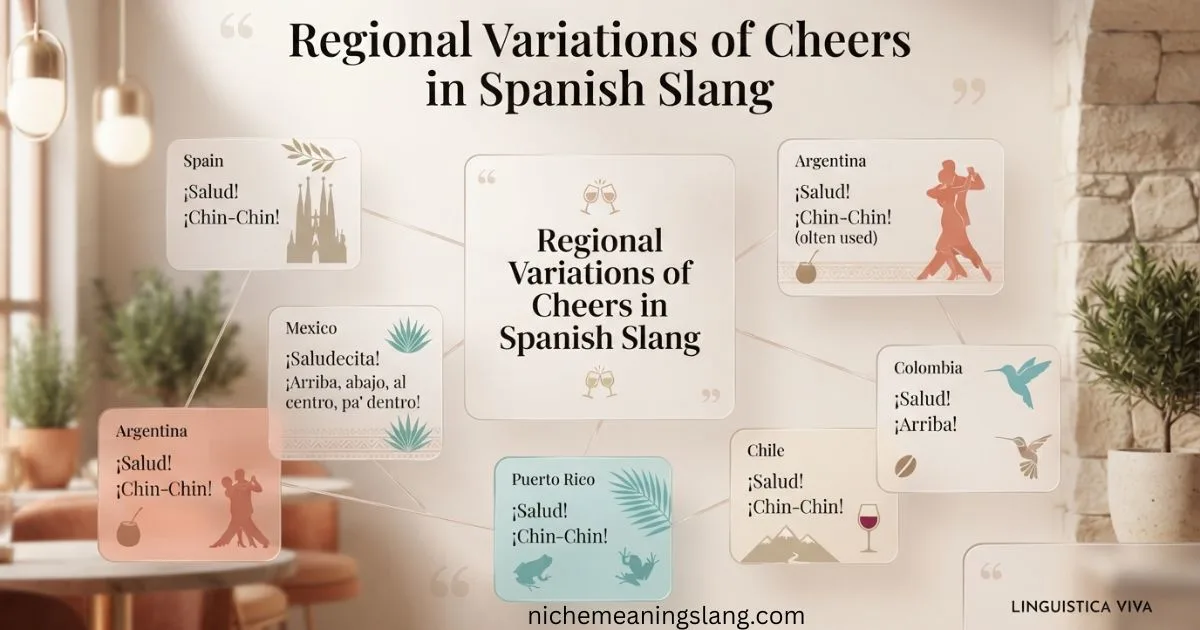
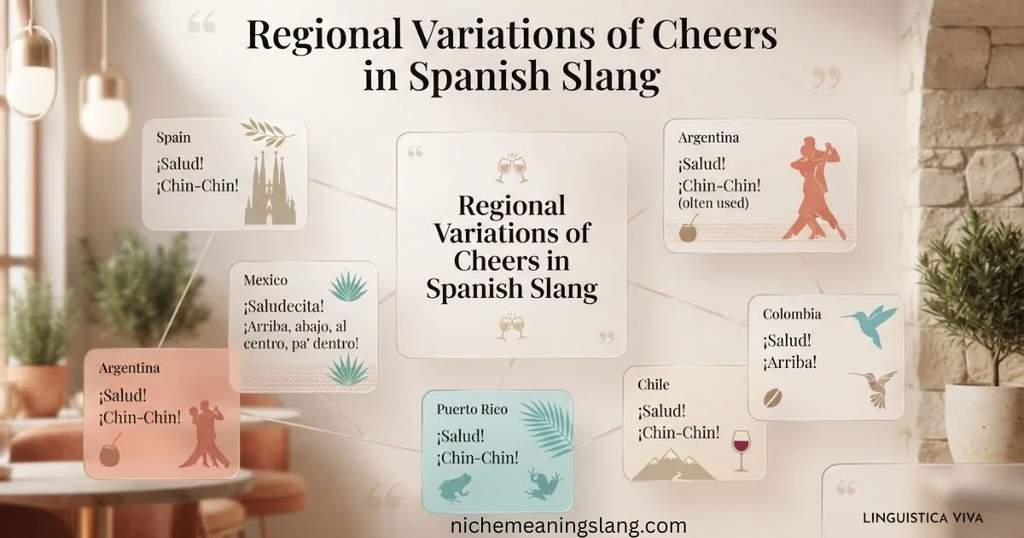
The basic expression remains remarkably consistent across Spanish-speaking regions: ¡Salud! is widely understood in Latin America and Spain. However, informal choices can differ. LearnSpanish.org identifies ¡Chin chin! as common in Spain and notes regional differences in longer party expressions, including the Mexican ¡Arriba, abajo, al centro y pa’ dentro!
This is why learning cheers in Spanish slang requires more than memorizing one translation. Spanish-speaking countries have different social customs, accents, and preferences. If you’re unsure what locals normally say, ¡Salud! is the reliable choice. Once you understand the setting, you can experiment with more playful expressions without forcing a phrase that sounds unnatural.
General (Latin America)
Across Latin America, ¡Salud! is the most broadly useful toast. The word literally means “health,” so the expression functions as a wish for well-being. It can accompany wine, beer, cocktails, or another drink and does not require an elaborate ceremony.
Spain
In Spain, ¡Salud! is also standard, while ¡Chin chin! is a familiar informal alternative. The difference is mostly one of tone: ¡Salud! is the dependable everyday toast, while chin chin can feel lighter and more playful.
Mexico
Mexico uses ¡Salud! as the standard toast, but you may also hear the longer ¡Arriba, abajo, al centro y pa’ dentro! at casual parties. The phrase describes the movements made with the glass and gives the toast a more interactive, playful character.
Argentina & Chile
Both ¡Salud! and ¡Chin chin! are recognized in Argentina and Chile. As with other Spanish-speaking regions, local habits can vary between families, generations, and social settings, so listening to the people around you is more reliable than assuming one expression represents everyone.
How to Make a Toast in Spanish Slang
A simple Spanish toast can follow a clear pattern: introduce the reason, name what you are celebrating, invite the group, and finish with ¡Salud! For example, Quisiera brindar por nuestra amistad. ¡Salud! means “I would like to toast to our friendship. Cheers!”
The verb brindar is especially useful because it lets you build a more complete toast. Brindo por nuestra amistad means “I toast to our friendship,” while Brindemos por el futuro means “Let’s toast to the future.” Notice the preposition por, which connects the toast with its reason.
| Toast step | Spanish | Meaning |
| Introduce | Quisiera decir unas palabras | I would like to say a few words |
| Begin | Quisiera brindar por… | I would like to toast to… |
| Reason | Por nuestra amistad | To our friendship |
| Invite | ¡Brindemos! | Let’s toast! |
| Finish | ¡Salud! | Cheers! |
Toast Etiquette in Spanish Slang
Saying ¡Salud! is simple, but the social ritual around a toast can matter. In many Spanish-speaking settings, people raise or lightly clink glasses while making eye contact. However, customs differ between countries and occasions, so it is better to observe the group rather than assuming one rule applies everywhere.
Alcohol is not essential to the meaning of a toast. You can say ¡Salud! with sparkling water, juice, soda, coffee, or another non-alcoholic drink. The important part is the shared expression of goodwill. A good toast should fit the occasion rather than turn every dinner into a loud party ritual.
Let the Host Set the Pace
At a formal dinner or organized celebration, wait for the host or speaker to begin. When everyone raises their glasses, simply follow along, say ¡Salud!, and take your drink. This keeps your behavior natural and prevents you from interrupting a planned toast.
Clinking Is Common, Not Compulsory
Clinking glasses is common when saying ¡Salud!, but it is not an absolute requirement. Some people simply raise their glasses toward one another. If you do clink, a light touch is enough; the gesture should feel friendly rather than theatrical.
Alcohol Is Never Required
A toast is a social gesture, not a requirement to drink alcohol. You can participate with water, juice, soda, coffee, or another beverage. ¡Salud! expresses the good wish regardless of what is inside your glass.
Common Mistakes When Saying Cheers in Spanish Slang
One common mistake is assuming that every English use of “cheers” translates to ¡Salud! In English, especially British English, “cheers” can also mean “thank you” or “goodbye.” In Spanish, ¡Salud! is specifically associated with the toast, while “thank you” is gracias and “goodbye” can be adiós or another farewell.
Another mistake is using an overly playful expression in a formal setting. Chin chin and arriba, abajo, al centro, pa’ dentro can be fun among friends, but ¡Salud! is a safer option when you do not know the social expectations. Context is what makes Spanish slang sound natural rather than forced.
Saying salud like an English word
Pronounce ¡Salud! approximately as sah-LOOD, with the stress on the final syllable. Regional pronunciation varies, particularly in the final consonant, so beginners should focus first on getting the stress and vowel sounds comfortable rather than chasing a perfect accent.
Using chin chin everywhere
¡Chin chin! is valid Spanish, but it has a stronger informal association and is particularly familiar in Spain. If you are unsure about the local preference, ¡Salud! remains the safer and more universally understood option.
Giving a long toast without a reason
A long toast is not automatically better. At a casual dinner, ¡Salud! or ¡Por nosotros! may be all you need. Save a longer Quisiera brindar por… speech for birthdays, weddings, graduations, work celebrations, or other moments that genuinely call for it.
Treating every gathering like a party
Spanish-speaking cultures are diverse, and a family dinner, wedding, business event, and night out can have very different social rhythms. Match your expression to the moment. A relaxed ¡Salud! usually works better than forcing a theatrical party chant into a quiet or formal gathering.
Conclusion
If you only remember one expression for cheers in Spanish slang, make it ¡Salud!. It is short, natural, widely understood, and literally wishes everyone good health. For a more playful moment, ¡Chin chin! works well, while ¡Brindemos!, ¡Por nosotros!, and ¡Por ti! help you create a more personal toast.
The biggest key is context. Spanish-speaking countries do not all follow identical social customs, so listen to the people around you and match the occasion. When you’re unsure, raise your glass, smile, and simply say ¡Salud! you’ll rarely go wrong.
FAQs
How do you say “cheers” in Spanish slang?
The most common way to say “cheers” in Spanish is ¡Salud!, which literally means “health.” In casual settings, you may also hear ¡Chin chin!, ¡Por nosotros!, or ¡Brindemos!
What does “¡Salud!” mean in Spanish?
¡Salud! literally means “health,” but when used during a toast, it means “Cheers!” or “To your health.” It is the safest and most widely understood Spanish toast.
Is “chin chin” Spanish slang for cheers?
Yes. ¡Chin chin! is an informal and playful way to say “cheers” in Spanish. It is especially familiar in Spain and is generally more casual than ¡Salud!
How do you say “cheers” in Mexican Spanish?
In Mexico, ¡Salud! is the standard way to say “cheers.” At casual parties, you may also hear ¡Arriba, abajo, al centro, pa’ dentro!, a playful group toast.
What does “brindemos” mean?
¡Brindemos! means “Let’s toast!” It comes from the Spanish verb brindar, meaning “to make a toast” or “to toast.”
What does “por nosotros” mean in a Spanish toast?
¡Por nosotros! means “To us!” It is commonly used when friends, couples, or groups want to celebrate their relationship, friendship, or shared experience.
What is the Spanish toast “arriba, abajo, al centro, pa’ dentro”?
It is a playful toast that roughly means “Up, down, to the center, down the hatch.” It is generally associated with informal parties and group celebrations.
Is “salud” used only when drinking?
No. Salud also means “health” and can be used in other situations. For example, Spanish speakers commonly say “¡Salud!” after someone sneezes as a wish for good health.
How do you pronounce “¡Salud!”?
¡Salud! is approximately pronounced “sah-LOOD,” with the emphasis on the final syllable. The exact pronunciation can vary slightly between Spanish-speaking regions.
What is the difference between “salud” and “chin chin”?
¡Salud! is the more universal and dependable Spanish toast, while ¡Chin chin! has a more casual, playful tone. When you’re unsure which expression to use, ¡Salud! is the safest choice.
Related Slang Words

Ryan Mitchell is a language enthusiast and writer who explores slang, modern expressions, and everyday language. At nichemeaningslang, he helps readers understand slang meanings, usage, and context in a simple and easy-to-follow way.