Como Slang: Meaning, Uses & Examples
Have you seen the word “como” in a text message, TikTok comment, or Spanish conversation and wondered what it means? Como usually means “like,” “as,” or “I eat” in Spanish, while cómo with an accent usually means “how.” Although people sometimes search for it as slang, it is primarily a standard Spanish word whose meaning depends on the sentence and context.
In online conversations, you may see someone write “¿Cómo?” to express confusion, surprise, or disbelief, similar to saying “What?” or “Come again?” in English. Understanding the difference between como and cómo can help you interpret Spanish messages, bilingual conversations, and social media posts more accurately. This guide explains the word’s meanings, common uses, texting examples, and related Spanish slang expressions.
What Does Como Mean in Slang?
When people search for “como slang,” they are often trying to understand a Spanish word they have encountered in a message or online post. The word itself is not exclusively slang. It is part of everyday Spanish, but informal speakers may use it in casual conversations and digital communication.
Without an accent, como can mean “like” or “as” when making a comparison. It can also mean “I eat,” depending on the sentence. With an accent, cómo usually means “how” in a question or exclamation.
For example, “Corre como el viento” means “He or she runs like the wind.” By contrast, “¿Cómo estás?” means “How are you?” If someone simply replies “¿Cómo?” after hearing unexpected information, they may be asking “What?” or “Come again?”
The important point is that como does not have one universal slang meaning. You need to examine the sentence, punctuation, and surrounding conversation to understand what the person intends.
What Is the Difference Between Como and Cómo?
The accent mark changes the word’s grammatical function and can change its meaning. This distinction is especially useful when reading Spanish texts, where punctuation and accent marks are sometimes omitted.
| Word | Common meaning | Example | English translation |
| Como | Like or as | Corre como un atleta. | He runs like an athlete. |
| Como | I eat | Como pizza. | I eat pizza. |
| Cómo | How | ¿Cómo estás? | How are you? |
| Cómo | How or what, in an exclamation | ¡Cómo! | How! or What! depending on context |
| ¿Cómo? | What? or Come again? | ¿Cómo? No te escuché. | What? I didn’t hear you. |
In correctly written Spanish, question words such as cómo generally carry an accent. However, informal messages may omit accent marks because of typing habits, keyboard settings, or speed.
Why Do People Write “Como” Without an Accent?
People sometimes leave out accent marks when texting or posting online. As a result, someone may write “como estas” when the correctly written question is “¿Cómo estás?”
In that situation, the intended meaning is usually clear from the sentence, even though the accent is missing. This is one reason readers searching for “como slang” may encounter several different explanations.
It is helpful to distinguish between a spelling shortcut and a slang expression. Omitting an accent does not automatically turn a standard Spanish word into slang.
How Is Como Used in Text Messages?
In Spanish-language texting, the word can appear in ordinary sentences, comparisons, questions, or short reactions. Its meaning depends on how it fits into the conversation.
Here are some common examples:
| Text message | Meaning in English |
| ¿Cómo estás? | How are you? |
| ¿Cómo así? | What do you mean? or How so? |
| ¿Cómo? | What? or Come again? |
| Es como un sueño. | It’s like a dream. |
| Como algo y luego salgo. | I’ll eat something and then leave. |
| Hazlo como quieras. | Do it as you wish. |
| ¿Cómo que no? | What do you mean, no? |
| Habla como su hermano. | He or she speaks like their brother. |
These examples show why translating the word alone can be misleading. A translator that ignores the rest of the sentence may give an incomplete or incorrect answer.
Does “Como??” Mean Someone Is Confused?
It can. When someone replies “¿Cómo?” or “Como??” to surprising information, they may be asking for clarification or expressing disbelief.
For example:
Person A: “I finished the entire project in one hour.”
Person B: “¿Cómo??”
Likely meaning: “What? How did you do that?”
The repeated question marks can emphasize surprise, confusion, or skepticism. The exact tone depends on the relationship between the speakers and the subject being discussed.
Can Como Mean “Like” as a Filler Word?
Yes, como can sometimes function similarly to “like” in English, particularly when speakers are comparing something, approximating an amount, or expressing themselves informally.
For example:
- “Era como muy raro.” “It was, like, really strange.”
- “Llegó como a las ocho.” “He or she arrived around eight.”
- “Es como una mezcla de dos estilos.” “It’s like a mixture of two styles.”
In these examples, como helps communicate comparison, approximation, or a less definite description. However, this is an ordinary feature of Spanish usage, not evidence that the word has a single special internet-slang definition.
What Does Como Mean on TikTok and Social Media?
On TikTok, Instagram, Snapchat, and other platforms, como may appear in Spanish captions, comments, memes, or bilingual conversations. Its meaning still depends on the language and sentence in which it appears.
For example, a Spanish-speaking user might comment “¿Cómo?” under an unexpected video to express surprise. Someone might use como in a caption to compare a situation to something else. A bilingual user may also switch between English and Spanish while chatting with friends.
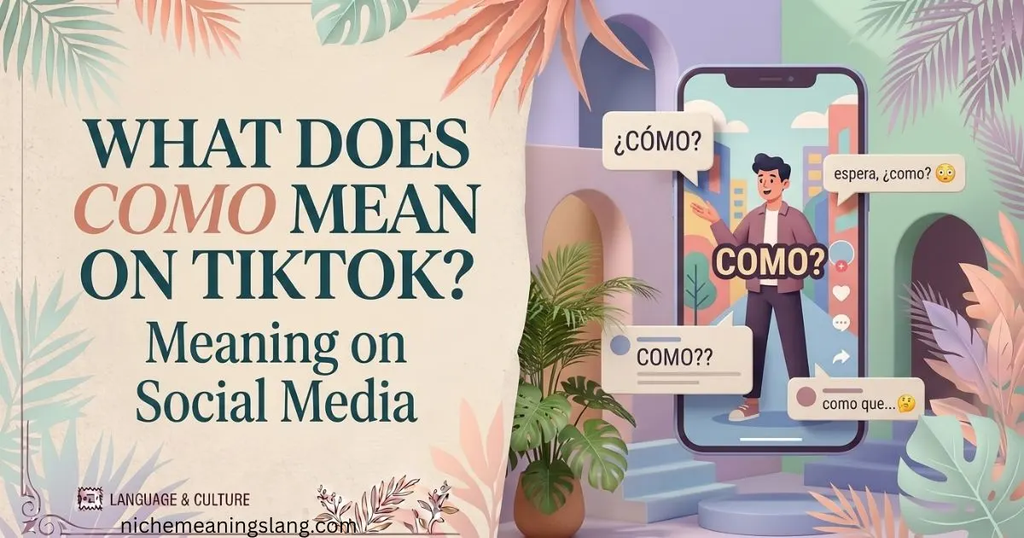
Here are three examples:
Example 1: A surprising video
Comment: “¿Cómo hizo eso?”
Translation: “How did they do that?”
Example 2: A funny reaction
Comment: “¿Cómo?? 😂”
Possible meaning: “What? How is that even possible?”
Example 3: A comparison in a caption
Caption: “Se siente como verano.”
Translation: “It feels like summer.”
These are ordinary Spanish uses that can appear on social media. The platform itself does not give the word a new, fixed slang meaning.
Is Como an English Slang Word?
Generally, no. Como is a Spanish word, and the form como also exists in Portuguese. It is not a widely established standalone English slang term with one agreed definition.
English speakers may use Spanish words in jokes, memes, captions, or bilingual chats. In those situations, a word may become part of an informal online exchange, but its intended meaning still depends on how the speaker uses it.
If you see como in an English-language message, consider whether the sender speaks Spanish, is quoting a Spanish phrase, or is reacting to something with “¿Cómo?” They may mean “How?”, “What?”, or “Come again?” rather than using an English slang abbreviation.
Common Spanish Slang Words Related to Online Conversations
If you’re interested in Spanish expressions you might encounter alongside como, the following words and phrases are useful to recognize. Their usage varies by country and community.
| Word or phrase | General meaning | Example |
| Güey / wey | Dude or guy in informal Mexican Spanish | ¿Qué onda, güey? |
| Qué onda | What’s up? or what’s going on? | ¿Qué onda? |
| No manches | No way! or You’re kidding! in Mexican Spanish | ¡No manches! |
| Neta | Truth or seriously in Mexican Spanish | ¿Neta? |
| Chido | Cool or great in Mexican Spanish | Está chido. |
| Guay | Cool in Spain | ¡Qué guay! |
| Vale | Okay or all right, commonly used in Spain | Vale, nos vemos. |
| Tío / tía | Informal “dude,” “mate,” or “guy/girl” in Spain | ¿Qué pasa, tío? |
| Chevere | Cool or great in several Latin American varieties | ¡Qué chévere! |
| Bacán | Cool or great in some Latin American countries | Está bacán. |
These words are not interchangeable across all Spanish-speaking countries. Some are strongly associated with particular regions, and certain expressions can be too informal or offensive in specific situations.
How to Translate Como Correctly
If you encounter como in a message and are unsure what it means, follow these simple steps.
1. Read the complete sentence
Avoid translating the word in isolation. “Como pizza” means “I eat pizza,” whereas “como tú” can mean “like you.” The words around como usually reveal its function.
2. Look for a question
If the word appears in a question such as “¿Cómo funciona?”, it generally means “how.” If someone sends “¿Cómo?” on its own, they may be asking you to repeat or explain something.
3. Check the punctuation and tone
Question marks, exclamation marks, and emojis can help communicate surprise or disbelief. However, punctuation alone does not guarantee a particular meaning.
4. Consider the speaker’s language
If the conversation is primarily in Spanish, begin with the standard Spanish meanings. If the message is bilingual, consider whether the sender is switching languages or quoting an expression.
5. Use a reliable translator or dictionary
A Spanish-English dictionary can help distinguish como from cómo. For ambiguous messages, compare the translation with the full context instead of relying on a single-word result.
Conclusion
The meaning of “como slang” depends on what the person is trying to understand. In most cases, como is a standard Spanish word meaning “like” or “as,” or it is the verb form meaning “I eat.” The accented form cómo generally means “how” and can also express confusion or surprise when used as a short question.
On social media, you may see accent marks omitted, so “como” might be intended as “cómo.” Rather than assuming it is a special slang word, look at the full message, punctuation, and conversational context. Understanding these differences will help you interpret Spanish texts more accurately and recognize other informal expressions you encounter online.
FAQs
1. What does como mean in slang?
Como is primarily a Spanish word meaning “like,” “as,” or “I eat,” depending on context. People sometimes search for it as slang because they encounter it in casual messages or online conversations.
2. What does cómo mean in English?
Cómo usually means “how.” In a short reaction such as “¿Cómo?”, it can also mean “What?” or “Come again?” when someone is confused or surprised.
3. What is the difference between como and cómo?
Como without an accent often means “like,” “as,” or “I eat.” Cómo with an accent is generally used to mean “how” in questions and exclamations.
4. Does como mean “like” in Spanish?
Yes. For example, “Ella canta como su madre” means “She sings like her mother.” In other sentences, como can have a different meaning.
5. What does “¿Cómo?” mean in texting?
It often means “What?”, “How?”, or “Come again?” depending on the conversation. It can express confusion, a request for clarification, or surprise.
6. Is como an English slang word?
Not generally. It is primarily a Spanish word, although English speakers may use it in bilingual conversations, memes, or informal messages.
7. Why do people write como instead of cómo online?
Some people omit accent marks when typing quickly or using keyboards that make accented characters less convenient. The intended meaning can often be understood from the sentence.
8. Does como have a hidden meaning on TikTok?
There is no single, widely established hidden slang meaning for como on TikTok. It usually retains its Spanish meaning, although a particular meme or conversation may give it a special contextual meaning.
9. Can como mean “I eat”?
Yes. In Spanish, como is the first-person present-tense form of comer, meaning “to eat.” For example, “Como arroz” means “I eat rice” or “I’m eating rice,” depending on context.
10. How can I tell what como means in a message?
Read the complete sentence, check whether it is a question or comparison, and consider the surrounding conversation. If the meaning remains unclear, consult a Spanish-English dictionary or ask the sender what they meant.
Related Slang Words

Ryan Mitchell is a language enthusiast and writer who explores slang, modern expressions, and everyday language. At nichemeaningslang, he helps readers understand slang meanings, usage, and context in a simple and easy-to-follow way.