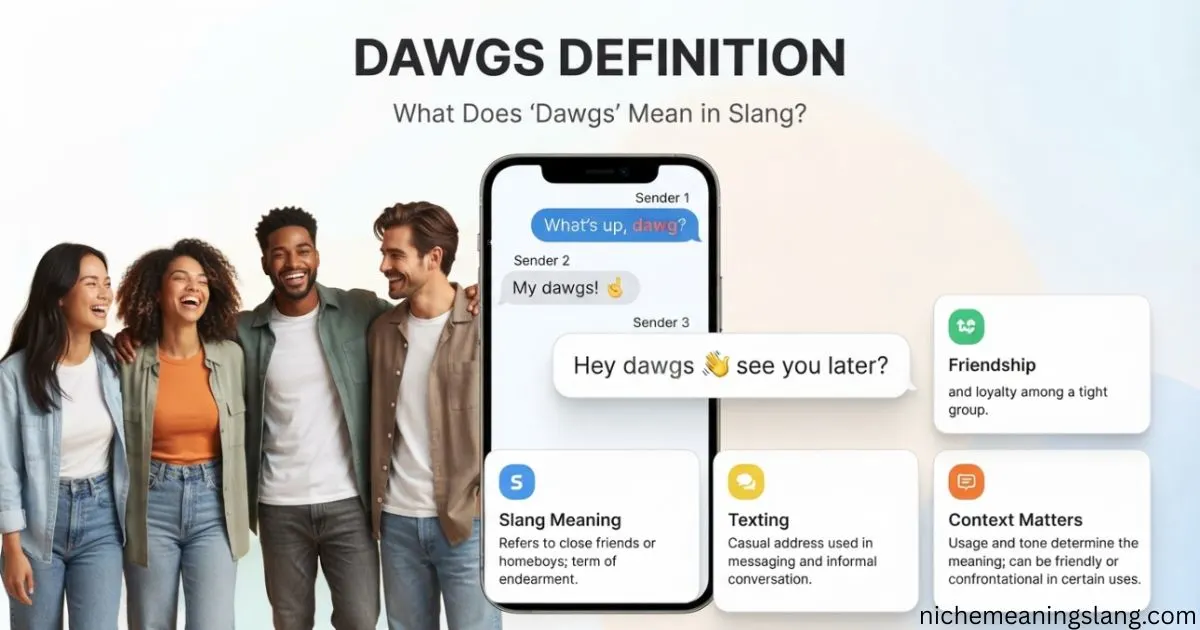
Dawgs Definition What Does “Dawgs” Mean in Slang?
The simplest dawgs definition is close friends, buddies, or a trusted group of people. Singular dawg usually refers to one friend or works as a casual way to address someone, while dawgs refers to several friends. In American slang, the spelling signals an informal, friendly meaning rather than literal animals.
If you have ever seen “what’s good, my dawgs?” in a group chat and wondered whether someone was talking about dogs, you are not alone. The surrounding context usually gives the answer. In texting, gaming, sports, TikTok comments, and casual conversation, dawg can communicate friendship, loyalty, respect, hype, or simply a relaxed greeting.
What Does Dawgs Mean in Slang?
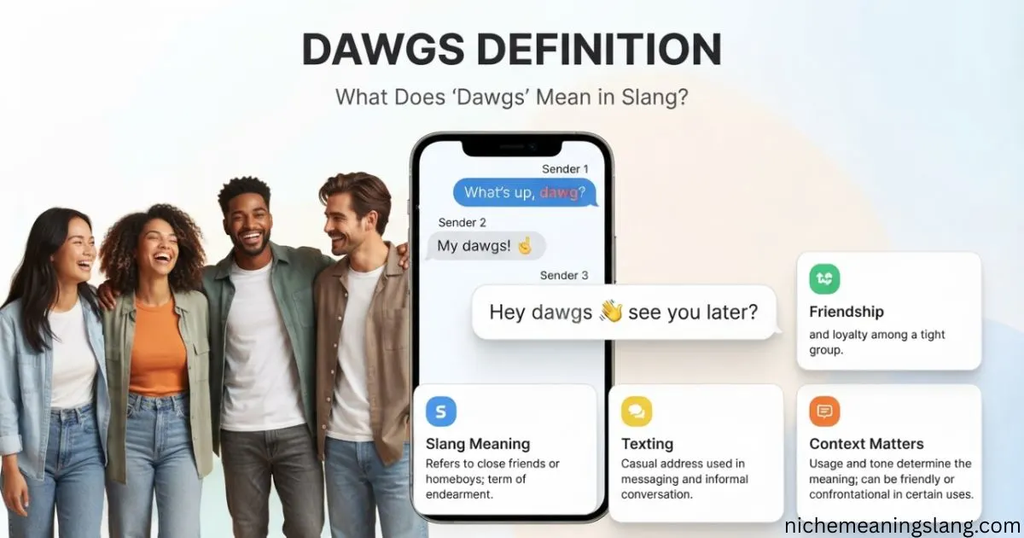
The slang dawgs usually means close friends, trusted buddies, or members of someone’s inner circle. Think my people, my crew, my homies, or my friends. The word carries an informal feeling of familiarity and camaraderie, especially when someone is talking about people they know and trust.
Singular dawg can work differently because it often addresses one person directly. “What’s up, dawg?” means something like “Hey, man” or “Hey, buddy.” “Those are my dawgs” shifts the meaning to a group. The plural therefore describes relationships, while the singular often functions as direct address.
Simple Definition
A simple dawgs definition is a group of close friends or trusted companions. It is informal American slang, not standard formal English. Depending on context, “dawg” can also describe a person admired for toughness, determination, skill, or effort, giving the word a stronger praise-oriented meaning.
Dawg Versus Dawgs
Dawg is generally singular: “That’s my dawg” or “What’s up, dawg?” Dawgs is plural: “My dawgs are coming over.” The distinction is straightforward, but the emotional meaning stays similar both forms suggest familiarity, friendliness, loyalty, or casual respect between people.
What Does My Dawgs Mean?
My dawgs usually means “my close friends” or “my crew.” It can refer to longtime friends, teammates, classmates, gaming partners, or people someone considers part of their trusted circle. The phrase often carries a stronger feeling of loyalty than the neutral word “friends.”
What Does Yo Dawg Mean?
Yo dawg is a casual greeting similar to “Hey, man,” “What’s up, buddy?” or “Hey, bro.” It does not usually contain a hidden romantic or serious meaning. The tone is typically relaxed and familiar, although delivery can make it playful, sarcastic, surprised, or emphatic.
What Does Dawgs Mean in Text?
In text messages, dawgs almost always depends on the surrounding conversation. “With the dawgs tonight” normally means someone is spending time with friends. “What’s up, dawg?” is a direct greeting. “My dawgs came through” expresses appreciation for a group of friends who showed support.
Texting makes tone harder to see, so punctuation, emojis, capitalization, and the relationship between the people matter. “Dawg 😂” can sound playful, while “DAWG!!!” may express shock or excitement. A reader should interpret the entire message rather than treating the spelling as a fixed definition.
How It Entered Mainstream Texting
The modern slang sense of dawg became widely recognizable through American popular culture, including hip-hop, music, sports, movies, television, and later social media. The underlying spelling has a much older history as a pronunciation or dialectal form of dog, while the friendly address developed later.
Origin and History of Dawg as Slang
The spelling dawg is connected to the word dog, but its modern slang use is not simply another word for the animal. Dictionary.com dates an early dialectal form to the nineteenth century and records the modern slang sense for a guy or buddy much later. The word subsequently became strongly associated with American informal speech.
Its cultural journey is more complicated than one simple “invented by” story. Contemporary slang references frequently connect its widespread modern use with African American Vernacular English and hip-hop culture, but the spelling itself has older dialectal roots. That distinction matters when explaining the word accurately rather than assigning its entire history to one source.
It’s Not Always About Friendship, Though
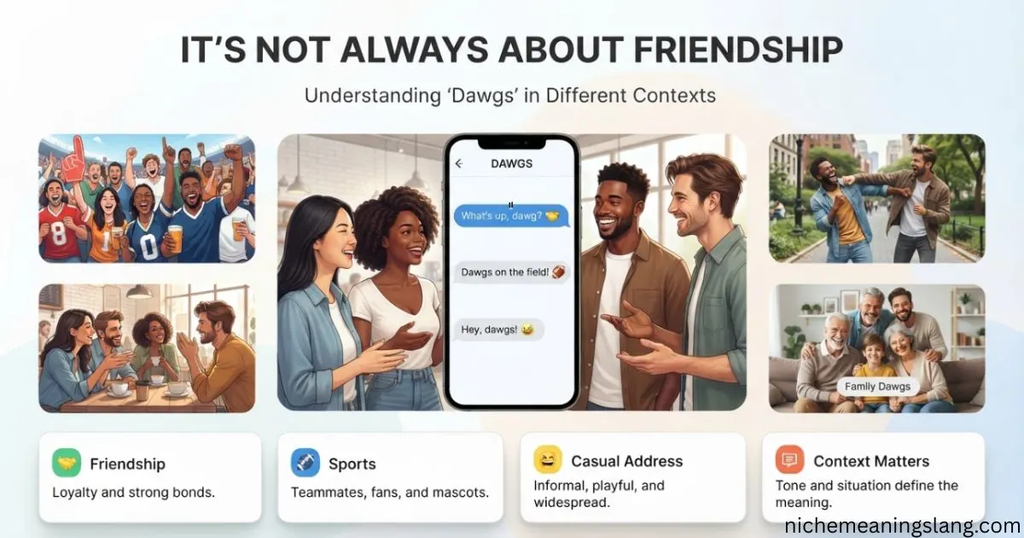
One of the most useful pieces of context is that dawg does not always mean friend. Someone saying “he’s a dawg” after an impressive athletic performance may be praising his toughness, competitiveness, effort, or determination. In that situation, dawg is closer to “beast,” “legend,” or “competitor” than “buddy.”
This is why the surrounding sentence matters. “That’s my dawg” focuses on friendship and loyalty. “He’s a dawg on the field” focuses on performance and grit. “Yo, dawg” is simply direct address. Three sentences can contain the same word while communicating three slightly different social meanings.
When It Sounds Like a Compliment
Dawg can be strongly positive when it praises loyalty, effort, courage, or skill. Saying “that’s my dawg” can express affection and trust, while “he’s got that dawg in him” often praises determination or competitive spirit. The compliment is emotional and contextual rather than dictionary-literal.
When It Can Sound Dismissive
Although dawg is usually friendly, tone can change how it lands. A curt “Okay, dawg” may sound dismissive, especially during an argument. Someone unfamiliar with the expression may also hear it as overly casual. Relationship, punctuation, previous messages, and emotional context all influence the interpretation.
Quick Real-Life Examples
Here are natural ways the word can appear:
| Situation | Example | Likely meaning |
| Greeting | “Yo dawg, what’s good?” | Friend/buddy |
| Friend group | “I’m out with my dawgs.” | Close friends |
| Loyalty | “That’s my dawg right there.” | Trusted friend |
| Sports | “He’s a dawg on defense.” | Tough competitor |
| Gaming | “Good play, dawg!” | Friendly praise |
| Group chat | “Where my dawgs at?” | Calling friends together |
| Support | “My dawgs came through.” | Loyal friends |
| Surprise | “Dawg, are you serious?” | Emotional emphasis |
The easiest way to learn slang is to see it functioning naturally. Notice that none of these examples requires the literal meaning of dog. The spelling and social context point toward the human slang meaning.
Dawg Meaning on TikTok, Snapchat, and Instagram
On TikTok, Snapchat, and Instagram, dawg can function as a quick reaction, greeting, compliment, or expression of disbelief. Short comments such as “dawg 😭” or “bro is a dawg” rely heavily on the surrounding video. The same spelling can communicate amusement, admiration, shock, or friendship.
Social platforms also accelerate slang spread. A phrase that once felt strongly associated with a particular community can become familiar to millions of users through memes, sports clips, music, and viral comments. That does not mean every user shares the same cultural relationship with the term, so natural usage still depends on context.
Dawg on TikTok
TikTok comments often use dawg as a reaction to something surprising, funny, impressive, or emotionally intense. “Dawg 😭” may express disbelief, while “that’s my dawg” can praise someone. The video provides the missing context, so the word itself should not be interpreted in isolation.
Dawg on Snapchat and Instagram
On Snapchat and Instagram, dawg commonly appears in direct messages, comments, captions, and friend-group conversations. “My dawgs” can refer to a group pictured together, while “yo dawg” works as a quick greeting. Emojis can make the intended warmth or humor easier to recognize.
Dawg Meaning in Gaming and Online Chats
Gaming communities favor short, expressive language, which makes dawg a natural term of address. Players may call teammates “dawg” during matches, celebrate a good play with it, or use it when reacting to an unexpected move. The word generally signals relaxed camaraderie rather than a formal relationship.
Discord and other online communities add another layer because people may become familiar with one another before ever meeting in person. In those spaces, dawg can become part of the group’s shared communication style. Still, using it naturally matters more than repeating it simply to sound like an insider.
Dawg in Discord and Voice Chats
In Discord and voice chats, dawg can be a quick substitute for “bro,” “man,” or “buddy.” Players might say “nice one, dawg” after a successful play or “dawg, what just happened?” after something unexpected. The meaning comes from the interaction, not from the spelling alone.
Dawg in Sports Culture
Sports culture gives dawg another powerful meaning: a person with toughness, determination, competitive energy, or relentless effort. “He’s a dawg” may therefore praise an athlete rather than identify a friend. This usage connects the word with grit, intensity, resilience, and performance.
Dawg vs Bro, Dude, and Homie
These words overlap, but their flavor differs. Bro is extremely broad and casual. Dude is casual but often more neutral. Homie emphasizes closeness or shared community. Dawg tends to combine friendship with familiarity, loyalty, and a recognizable American slang flavor.
| Term | Typical meaning | Tone |
| Dawg | Friend, buddy, familiar address | Casual, loyal |
| Bro | Friend or male companion | Very casual |
| Dude | Guy, person, friend | Casual, neutral |
| Homie | Close friend | Familiar, close |
| Buddy | Friend or acquaintance | Friendly, broadly understood |
| Friend | Person you know and like | Neutral |
Choosing among them is mostly about voice. If “dawg” is not part of the way you normally communicate, forcing it into every message can sound unnatural. Slang works best when it matches your relationship, personality, and conversational setting.
Dawg vs Dog: What Is the Difference?
Dog is the standard spelling for the animal. Dawg is commonly used as a playful spelling of dog or as informal slang for a person, especially a friend or male acquaintance. Cambridge explicitly identifies dawg as mainly U.S. informal and gives its use with a male friend as an example.
Context usually makes the distinction obvious. “I took my dog outside” is about an animal. “What’s up, dawg?” is a greeting. “My dawgs are coming over” refers to friends. The unusual spelling is therefore a useful signal that the writer is using the informal human meaning.
Quick Comparison
| Phrase | Meaning |
| “My dog is sleeping.” | Literal animal |
| “That dawg is my best friend.” | Slang/friendly person |
| “What’s up, dawg?” | Casual greeting |
| “My dawgs are here.” | Friend group |
| “He’s a dawg on the field.” | Tough/impressive competitor |
Common Mistakes People Make When Using Dawg
The biggest mistake is assuming dawg always means friend. It can also function as direct address, praise someone’s performance, or simply add emotional emphasis. Another mistake is using it in formal communication, where the slang can look unprofessional or forced.
It is also possible to overdo the word. If someone never normally says “dawg” and suddenly puts it in every sentence, readers may notice the performance rather than the meaning. Good slang feels natural because it fits the speaker, audience, relationship, and setting.
Is Dawg Appropriate in Professional Conversations?
Usually, no. Dawg belongs most naturally in informal conversations, friendships, gaming communities, sports culture, and relaxed social-media interactions. A workplace email, job interview, client message, academic assignment, or formal request normally calls for neutral language such as “colleague,” “friend,” “teammate,” or the person’s name.
That does not mean the word is inherently rude. It simply has a strong informal register. The same principle applies to many slang terms: a word can be friendly in a group chat and completely out of place in a professional email.

Better Alternatives for Formal Communication
Instead of “dawg,” use friend, colleague, teammate, buddy, or simply the person’s name depending on the relationship. If you are writing professionally, clarity matters more than trying to reproduce casual speech. Save dawg for situations where informal language is genuinely part of the conversation.
Who Can You Call Dawg?
You can generally call a close friend, teammate, or familiar person dawg when the relationship and setting support casual language. The term is especially natural among people who already communicate informally. With strangers, authority figures, customers, or professional contacts, it can feel too familiar.
The safest approach is to observe the existing tone. If the other person naturally uses casual slang with you, “dawg” may fit. If their communication is formal or reserved, a neutral form of address is safer. Slang should build rapport, not force it.
Can You Call Someone You Just Met Dawg?
Sometimes, but caution helps. Some people casually call strangers “dawg,” especially in relaxed American social settings or online communities. Others may find it overly familiar or performative. If you have just met someone, matching their tone is usually better than introducing slang they have not used.
Is Dawg Still Used in 2026?
Yes. Dawg remains recognizable in American informal language, especially across texting, social media, sports, gaming, and popular culture. Current slang pages continue to document active use in 2026, while major dictionaries still identify the informal sense.
Its longevity is notable because many internet slang terms disappear quickly. Dawg has survived partly because it is flexible: it can address a friend, praise someone, express disbelief, or add emotional emphasis. That flexibility gives it more staying power than a trend tied to one specific meme.
Gen Z
Gen Z may encounter dawg frequently in memes, gaming, TikTok comments, sports content, and group chats. Its meaning can shift toward reaction language, especially when used alone with an emoji. However, seeing a term online does not automatically mean every Gen Z speaker uses it naturally.
Millennials
Millennials are also familiar with dawg, particularly through sports, hip-hop, television, music, and early social-media culture. For some speakers, it has a distinctly 2000s flavor; for others, it remains an ordinary casual address. Personal speech habits vary considerably.
Older Generations
Older speakers may recognize dawg without using it themselves. They may interpret it through older slang, sports culture, or popular media. If someone does not normally use the term, a neutral word such as “friend” or “buddy” will usually sound more natural.
How to Respond When Someone Calls You Dawg
A good response depends on the tone. If someone says “What’s up, dawg?” a simple “What’s good?” or “I’m good, man” works naturally. If they say “That’s my dawg,” a friendly “Appreciate you” can match the warmth without forcing the slang.
You can also mirror the word if it already feels natural: “Yeah, dawg!” or “You already know, dawg.” The goal is not to sound more slang-heavy than the other person. Good conversational style usually comes from matching the existing tone.
Does Dawgs Always Mean Friends?
No. Dawgs usually refers to friends when the subject is people, but dog/dogs can still have their literal animal meaning. Singular dawg can also praise someone’s performance or toughness. Context therefore determines which semantic relationship is active.
Look at the verbs and surrounding nouns. “My dawgs are coming over” points toward friends. “He’s got that dawg in him” points toward determination or competitive ability. “My dogs need food” is literal. The surrounding language is the quickest way to tell.
How to Tell the Difference
Ask three questions: Is the message about people? What is the speaker doing with the word? What is the tone? A greeting suggests friend or buddy. A sports or performance context may suggest toughness. A pet-related conversation usually points to literal dogs.
Conclusion
The clearest dawgs definition is close friends, trusted buddies, or a familiar friend group. Singular dawg can mean a friend, buddy, or casual form of address, while dawgs normally refers to several people. In sports and online conversations, the word can also praise someone for toughness, skill, effort, or determination.
The most important clue is context. “My dawgs” usually means close friends, “yo dawg” is a casual greeting, and “he’s a dawg” can praise someone’s competitive spirit. The spelling comes from the broader history of dog/dawg, but modern usage has developed its own social meaning in American slang. Use it naturally, keep it casual, and avoid forcing it into formal communication.
FAQs
The recurring questions across the ranking pages include the meaning of dawgs, the singular/plural distinction, origin, appropriateness, whether it is still used, and whether it always refers to friends. These are competitor-derived questions rather than a claim that Google displayed a particular live PAA box.
What is the dawgs definition?
Dawgs is informal slang for close friends, trusted buddies, or a friend group. It is the plural form of dawg. In casual American English, it expresses familiarity, loyalty, and camaraderie.
What does dawg mean in slang?
Dawg usually means friend, buddy, man, or fellow, especially as an informal way to address someone. Cambridge identifies it as mainly U.S. informal and gives its use with a male friend.
What does “my dawgs” mean?
“My dawgs” means my close friends, my crew, or my trusted people. It normally refers to a group rather than one individual.
Is dawg short for dog?
It is related to dog and is also a playful spelling of the word, but modern slang dawg has a separate informal human sense. Dictionary.com documents both the playful spelling and the slang meaning of guy, man, fellow, or buddy.
Is dawg a compliment?
It can be. In “That’s my dawg,” it expresses friendship or loyalty. In “He’s a dawg,” especially in sports, it can praise toughness, effort, or competitive ability.
Is dawgs a bad word?
Generally, no. Dawgs is casual slang rather than inherently offensive language. However, slang can feel inappropriate or disrespectful depending on the speaker, audience, relationship, and tone.
Is dawg still used in 2026?
Yes. Current dictionary definitions and 2026 slang resources continue to document the term, and it remains recognizable in texting, gaming, sports, and social media.
What is the difference between dawg and dawgs?
Dawg is singular and often refers to one person. Dawgs is plural and usually refers to a group of friends. For example, “my dawg” means one friend, while “my dawgs” means several friends.
What does “yo dawg” mean?
“Yo dawg” is a casual greeting similar to “Hey, man,” “What’s up, buddy?” or “Hey, bro.”
What does “top dawg” mean?
“Top dawg” generally refers to the leader, highest-ranking person, or most respected person in a group or situation. It extends the positive status associated with dawg beyond ordinary friendship.
Can you call a stranger dawg?
You can, but it depends on the setting and the person. Some speakers use dawg broadly as casual address, while others reserve it for friends. With strangers, professionals, or authority figures, neutral language is safer.
Is dawg formal or informal?
Dawg is informal. It is best suited to casual conversations, social media, sports, gaming, and friend groups rather than formal writing or professional communication.
Related Slang Words

Ryan Mitchell is a language enthusiast and writer who explores slang, modern expressions, and everyday language. At nichemeaningslang, he helps readers understand slang meanings, usage, and context in a simple and easy-to-follow way.
One Comment