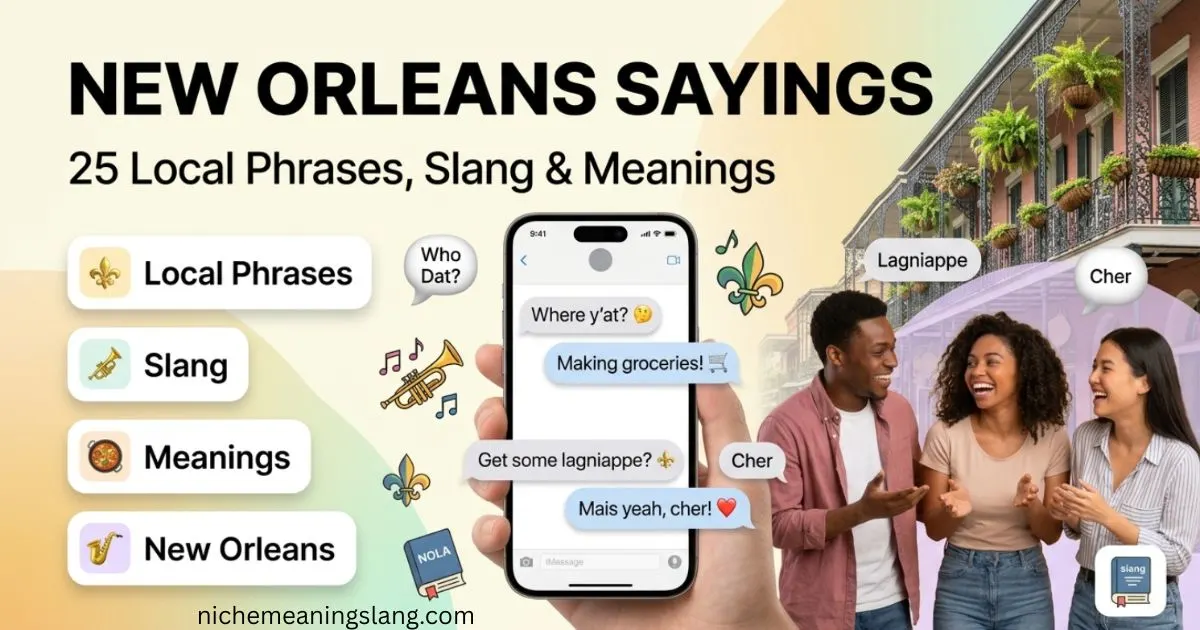
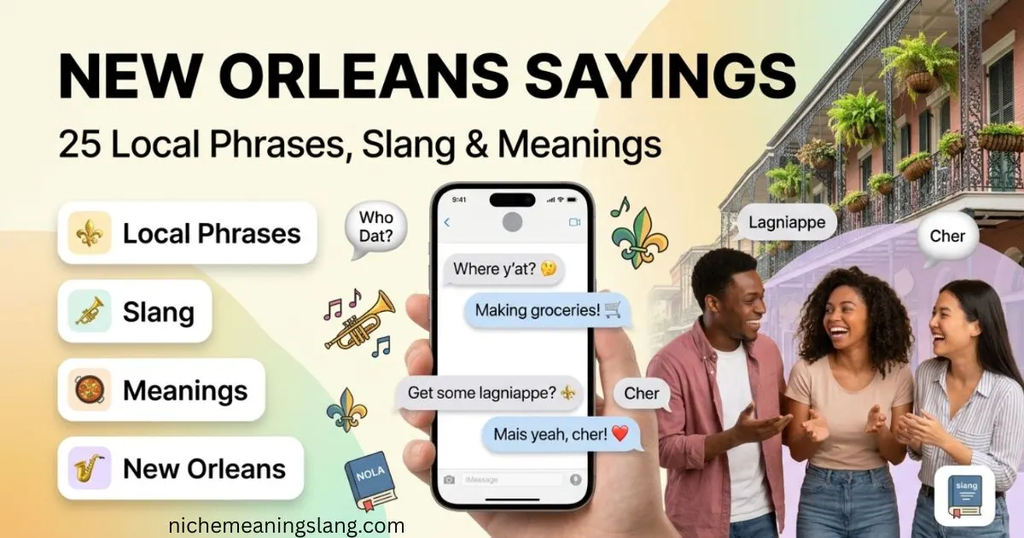
New Orleans Sayings 25 Local Phrases, Slang & Meanings
New Orleans sayings are colorful local expressions shaped by the city’s unusual mix of language, neighborhood culture, food, music, family life, and celebration. Think Where y’at?, making groceries, neutral ground, lagniappe, and Who Dat? ordinary words in the Crescent City that can completely confuse an outsider.
When I first began digging into New Orleans slang, the surprising part was how much context matters. Louisiana sayings, Yat expressions, Cajun vocabulary, Creole culture, and Mardi Gras terminology overlap without being identical. This guide separates them carefully, explains what locals actually mean, and gives practical examples so you can understand the language without turning it into a caricature.
Why Louisiana Talk Sounds Nothing Like Anywhere Else
Many New Orleans sayings make sense only after you understand the cultural layers behind Louisiana English. French and Spanish colonial history, African and Caribbean communities, later European immigration, Southern English, Creole traditions, and Louisiana French all contributed vocabulary and speech patterns that developed differently across the state.
That is also why calling every Louisiana expression “Cajun slang” misses an important distinction. New Orleans English, rural Cajun speech, Creole terminology, Acadiana vocabulary, and general Southern phrases overlap, but they are not interchangeable. Even within New Orleans, language can vary by community, neighborhood, generation, and family background.
Everyday Louisiana Slang You’ll Hear Constantly
Some famous New Orleans sayings describe incredibly ordinary things: shopping, directions, family, affection, food, or agreement. Expressions such as making groceries, neutral ground, lagniappe, cher, and yeah you right feel memorable precisely because everyday ideas are expressed through distinctly Louisiana vocabulary and local linguistic history.
For visitors, learning these New Orleans phrases is more useful than attempting an accent. You can understand a street direction, order a po’boy correctly, recognize a greeting, or follow a family conversation without pretending to be local. That context-first approach also makes Louisiana slang sound less mysterious.
Making Groceries
Making groceries means grocery shopping, not manufacturing food. Historical writing about New Orleans describes it as a traditional local expression for buying food, while New Orleans & Company connects it with French faire son marché. It remains one of the best-known examples of French influence on local English.
Neutral Ground
In New Orleans, the grassy or paved median separating lanes of traffic is commonly called the neutral ground. The name is associated with Canal Street, whose broad median historically separated the old French/Creole section from the newer American side of the growing city.
Lagniappe
Lagniappe means a little extra traditionally a small bonus or gift given with a purchase. Merriam-Webster traces English usage through French-speaking Louisiana to American Spanish la ñapa, ultimately connecting the word with Quechua yapa, meaning something added. Its recorded English use dates to 1844.
| New Orleans saying | Common meaning | Typical context |
| Where y’at? | How are you?/What’s going on? | Greeting |
| Making groceries | Grocery shopping | Everyday errands |
| Neutral ground | Street median | Directions |
| Lagniappe | Something extra | Shopping/hospitality |
| Ya mom’n’em | Your family | Social conversation |
| Yeah you right | Strong agreement/approval | Casual speech |
| Dressed | Po’boy with standard toppings | Food |
| Who Dat? | Saints rallying expression | Football/local pride |
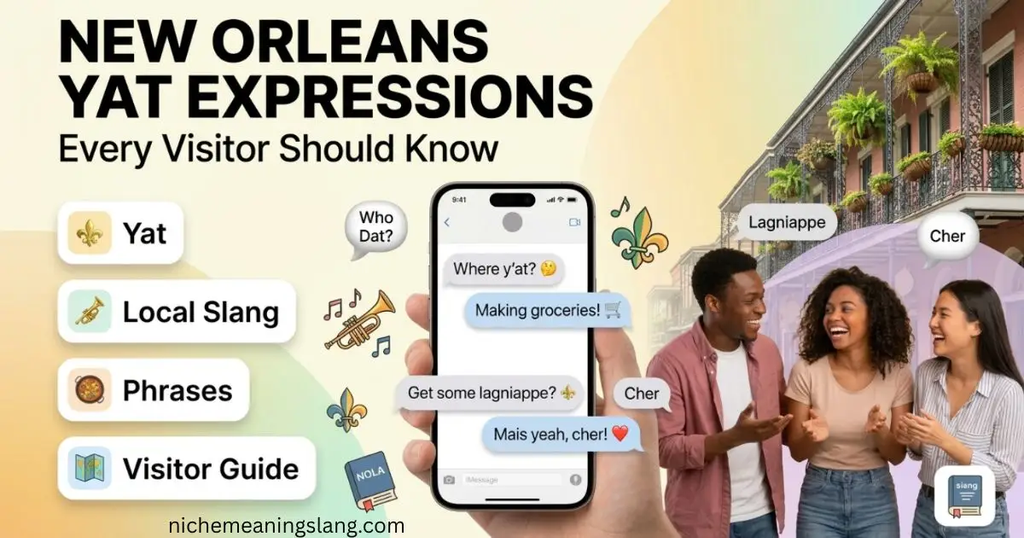
New Orleans Yat Expressions Every Visitor Should Know
The Yat dialect takes its popular name from Where y’at?, one of the expressions most strongly associated with New Orleans speech. New Orleans English can surprise visitors expecting a stereotypical Deep South accent, because parts of the local speech tradition developed in dense urban immigrant communities rather than following one uniform Southern pattern.
Yet not everyone in New Orleans speaks identically. Age, neighborhood, ethnicity, family background, and social setting all affect vocabulary and pronunciation. That variation matters when discussing New Orleans sayings because a phrase may be familiar citywide while another expression may feel old-fashioned, neighborhood-specific, or more Louisiana-wide than exclusively New Orleans.
Where y’at?
Where y’at? is normally a greeting, not a request for your GPS location. New Orleans & Company glosses it essentially as “How are you?” or “What’s going on?” That simple phrase became so closely associated with local speech that Yat developed into a label connected with New Orleans English.
How’s ya mama an’ them?
This warm family-centered expression essentially asks how someone’s mother and the rest of their family are doing. Variants such as ya mom’n’em compress an entire group of loved ones into one conversational phrase, illustrating how New Orleans lingo often encodes familiarity, community, and personal connection.
Come see
In local usage, come see can function more like “come here” than a literal invitation to inspect something visually. That difference regularly confuses outsiders. A New Orleanian may say it simply because they want you closer for a conversation, story, instruction, or bit of neighborhood news.
Beloved New Orleans Catchphrases
A few New Orleans sayings have grown beyond ordinary conversation into symbols of city identity. Where y’at? signals local speech, while Who Dat? evokes Saints fandom. Mardi Gras expressions, second-line language, and neighborhood vocabulary similarly connect speech with New Orleans music, sports, celebration, history, and communal pride.
The useful distinction is between understanding an expression and performing it. Visitors can recognize New Orleans slang, appreciate its cultural meaning, and use occasional phrases naturally without exaggerating pronunciation. That respect becomes especially important with expressions whose histories intersect with race, migration, regional identity, or older popular entertainment.
Who dat?
Today, Who Dat? is inseparable from New Orleans Saints culture, especially the chant asking who can beat the Saints. Its history, however, predates the NFL team; historical reporting traces earlier versions through performance traditions before the Saints-associated chant became firmly established during the early 1980s.
Food Words That Confuse First-Time Visitors
New Orleans sayings are deeply connected with eating because food is central to daily culture. Visitors encounter vocabulary around po’boys, crawfish, pralines, sno-balls, gumbo, and other Louisiana traditions. Knowing the terminology helps because some familiar-looking words carry a highly specific local meaning at restaurants and neighborhood shops.
The distinction between New Orleans and broader Cajun food language matters here too. Creole cuisine, Cajun cuisine, French Louisiana vocabulary, and New Orleans restaurant terminology constantly interact, but they represent different cultural histories. Treating every gumbo-related or crawfish-related phrase as identical “Cajun talk” flattens those differences.
Dressed
Order a New Orleans po’boy dressed and you are asking for its standard complement of toppings commonly lettuce, tomato, pickles, and mayonnaise. The expression demonstrates why understanding NOLA slang can have an immediate practical payoff: one small local word can specify how your entire sandwich arrives.
Mardi Gras Words You Need Before Parade Season
Carnival adds another vocabulary layer to New Orleans sayings. A krewe organizes a parade or Carnival event, throws are items tossed from floats, and Lundi Gras refers to the Monday immediately before Mardi Gras. The famous spectator calls and parade terminology transform ordinary streets into their own linguistic environment.
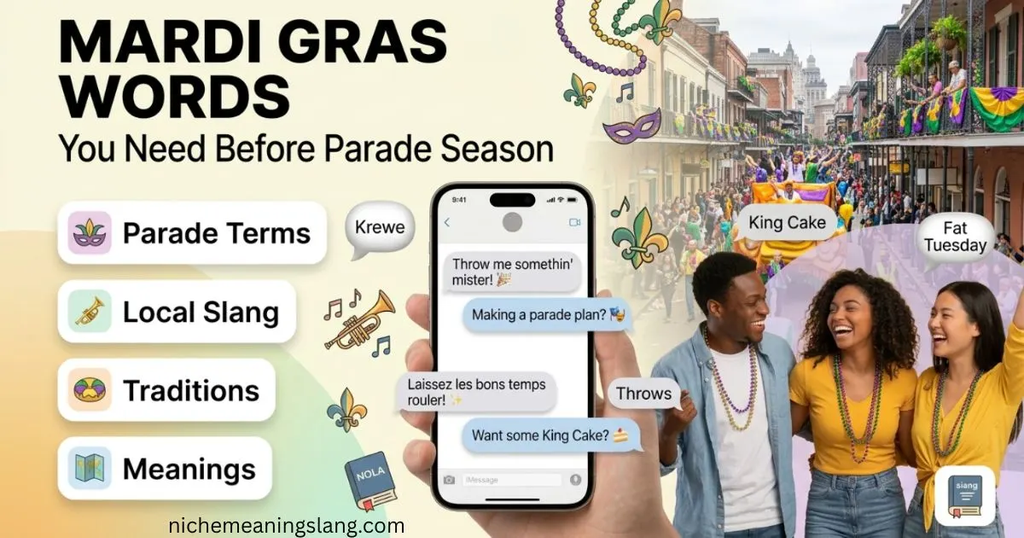
Other Louisiana expressions often appear alongside Mardi Gras language, including laissez les bons temps rouler, usually understood as “let the good times roll.” However, readers should distinguish festive Louisiana branding from everyday speech; something printed constantly on souvenir merchandise is not necessarily something every New Orleanian says every morning.
Throw me somethin’, Mister!
Throw me somethin’, Mister! is a classic parade call directed toward float riders in hopes of receiving beads or other throws. It is tied to Mardi Gras participation rather than ordinary daily conversation, making context essential when learning this and other celebration-specific New Orleans phrases.
How to Use Louisiana Slang Respectfully as a Visitor
The easiest way to use New Orleans sayings naturally is to understand first and imitate second. Knowing that Where y’at? is a greeting or neutral ground means a median is useful. Forcing an exaggerated Cajun, Creole, or Yat accent around locals can instead sound like performance rather than appreciation.
It is also worth remembering that Louisiana culture contains several distinct speech communities. Listen to how the people around you use a phrase, respect pronunciation without mocking it, and ask when you genuinely do not understand. Competitor guidance similarly emphasizes contextual use rather than treating Louisiana slang as a costume.
Common Mistakes Outsiders Make With Local Terms
One common mistake is assuming every unusual Louisiana word belongs to Cajun French. New Orleans sayings may reflect French, Spanish, African, Caribbean, Creole, Southern, immigrant, neighborhood, sports, and contemporary influences. Who Dat, neutral ground, and making groceries, for example, do not all share one simple linguistic origin.
Another mistake is interpreting expressions too literally. Where y’at? usually does not ask where you are; making groceries does not mean producing groceries; come see may simply mean come here; and neutral ground is not usually a political statement. Meaning follows local context rather than dictionary-looking English alone.
Conclusion
The charm of New Orleans sayings goes far beyond unusual words or funny expressions. Phrases like Where y’at?, making groceries, neutral ground, lagniappe, and Who Dat? reflect the city’s history, neighborhoods, food culture, family traditions, sports, and Mardi Gras spirit.
What makes New Orleans language especially interesting is that it does not come from one single source. Yat speech, Louisiana English, French influence, Creole culture, Cajun traditions, and modern local slang have all helped shape the way people communicate. Learn the meaning and context first, and you’ll understand the culture behind the words not just the words themselves.
FAQs
What does “Where y’at?” mean in New Orleans?
“Where y’at?” is a traditional New Orleans greeting that generally means “How are you?” or “What’s going on?” It usually isn’t asking for your physical location.
What is a famous New Orleans saying?
“Where y’at?” is one of the best-known New Orleans expressions. “Who Dat?” is another iconic phrase, especially associated with New Orleans Saints culture and local football pride.
What does “making groceries” mean?
“Making groceries” means going grocery shopping. It is a distinctive Louisiana expression and one of the classic examples of local vocabulary that can confuse visitors unfamiliar with New Orleans speech.
What does “neutral ground” mean in New Orleans?
A neutral ground is the median or central strip separating lanes of traffic. In New Orleans, this term is commonly used instead of the more widespread American term “median.”
What does “lagniappe” mean?
Lagniappe means a little something extra, especially a small bonus or complimentary gift. It is strongly associated with Louisiana culture and has a fascinating multilingual history.
What does “Who Dat?” mean?
“Who Dat?” is a famous New Orleans Saints expression. It is part of the well-known “Who Dat?” football chant and has become a major symbol of New Orleans sports identity.
Are New Orleans sayings the same as Cajun sayings?
No. New Orleans sayings and Cajun expressions overlap, but they are not identical. New Orleans has its own urban linguistic traditions, including Yat speech and Creole influences, while Cajun language and culture are particularly associated with Acadiana and southern Louisiana.
What does “dressed” mean when ordering a po’boy?
When a po’boy is ordered “dressed,” it generally means the sandwich comes with traditional toppings such as lettuce, tomato, pickles, and mayonnaise. It is an important piece of New Orleans food vocabulary.
What does “ya mom’n’em” mean?
“Ya mom’n’em” refers casually to your mother and the rest of your family or close people. It is a familiar expression that reflects the importance of family and social connections in local conversation.
Should tourists use New Orleans slang?
Yes, but naturally and respectfully. Learning expressions and using a few appropriately is fine; exaggerating a New Orleans accent or imitating local speech for entertainment can come across as disrespectful. Understanding context is more important than trying to sound local.
Related Slang Words

Ryan Mitchell is a language enthusiast and writer who explores slang, modern expressions, and everyday language. At nichemeaningslang, he helps readers understand slang meanings, usage, and context in a simple and easy-to-follow way.