Cowboy Slang Words: 60+ Old West Terms & Meanings
Cowboy slang words bring the spirit of the American West to life. From saying “howdy, partner” to telling someone to “hold your horses,” these expressions reflect the humor, independence, and rugged lifestyle associated with cowboys. Many originated in ranch work, cattle drives, and everyday frontier life, while others became popular through Western movies, books, and television.
Whether you are researching Old West slang, writing a Western story, watching a cowboy movie, or simply curious about American expressions, this guide explains more than 60 cowboy slang words and phrases. You will find their meanings, simple examples, funny sayings, and traditional ranch terms that help you understand cowboy language.
What Is Cowboy Slang?
Cowboy slang is the informal language associated with cowboys, ranch hands, cattle drives, rodeos, and the American frontier. It includes casual greetings, colorful expressions, ranch vocabulary, and phrases used to describe people, animals, and everyday situations.
Cowboy language developed through a mixture of regional American English and Spanish-influenced ranching traditions. Mexican vaqueros played an important role in shaping cowboy horsemanship, equipment, and vocabulary. Words such as lariat, rodeo, and bronco reflect this cultural influence. Texas Parks & Wildlife Department provides educational definitions of several terms connected with these traditions.
Not every expression commonly called cowboy slang originated in the nineteenth-century Old West. Some are genuine ranch terms, while others are broader American idioms that later became associated with cowboy culture.
Common Cowboy Slang Words and Their Meanings
Here are familiar cowboy expressions that are useful for understanding Western dialogue and adding a little frontier flavor to everyday conversations.
| Cowboy slang word or phrase | Meaning | Example |
| Howdy | An informal way to say hello | “Howdy, folks! Welcome to the ranch.” |
| Partner or pardner | A friendly way to address someone | “How are you doing, partner?” |
| Reckon | Think, suppose, or believe | “I reckon we’ll leave before sunrise.” |
| Y’all | Informal plural form of “you all” | “Are y’all ready to ride?” |
| Yonder | Over there or at a distance | “The barn is over yonder.” |
| Mosey | To walk or move at a relaxed pace | “Let’s mosey down to the store.” |
| Fixin’ to | Getting ready or planning to do something | “I’m fixin’ to saddle the horse.” |
| Ain’t | Informal form of “am not,” “is not,” or “are not” | “That ain’t my hat.” |
| Dang | A mild expression of surprise or frustration | “Dang, that was a long ride!” |
| Dadgum | A folksy expression of frustration or emphasis | “That dadgum gate won’t open.” |
| Git | A pronunciation or spelling representing “get” in informal speech | “Git your boots and let’s go.” |
| Giddy-up | An expression used to encourage a horse to move | “Giddy-up, we’ve got miles to cover.” |
| Yee-haw | An exclamation of excitement or celebration | “Yee-haw! We won the rodeo.” |
| Hoss | A colloquial or dialectal form of “horse” | “That hoss can run.” |
| Cowpoke | A cowboy or cattle worker | “The cowpoke checked the herd.” |
| Cowhand | A person who works with cattle on a ranch | “The cowhand started work at dawn.” |
| Buckaroo | A cowboy, especially in some Western regional traditions | “The young buckaroo learned to rope cattle.” |
| Greenhorn | A beginner or inexperienced person | “I’m a greenhorn when it comes to ranch work.” |
| Tenderfoot | Someone unfamiliar with difficult outdoor or frontier life | “The tenderfoot struggled with the dusty trail.” |
| Trail boss | The person in charge of a cattle drive | “The trail boss chose the route.” |
These words are not all exclusive to cowboys. Several remain part of regional American speech, and others are used mainly when imitating a Western style.
Old West Slang Words and Expressions
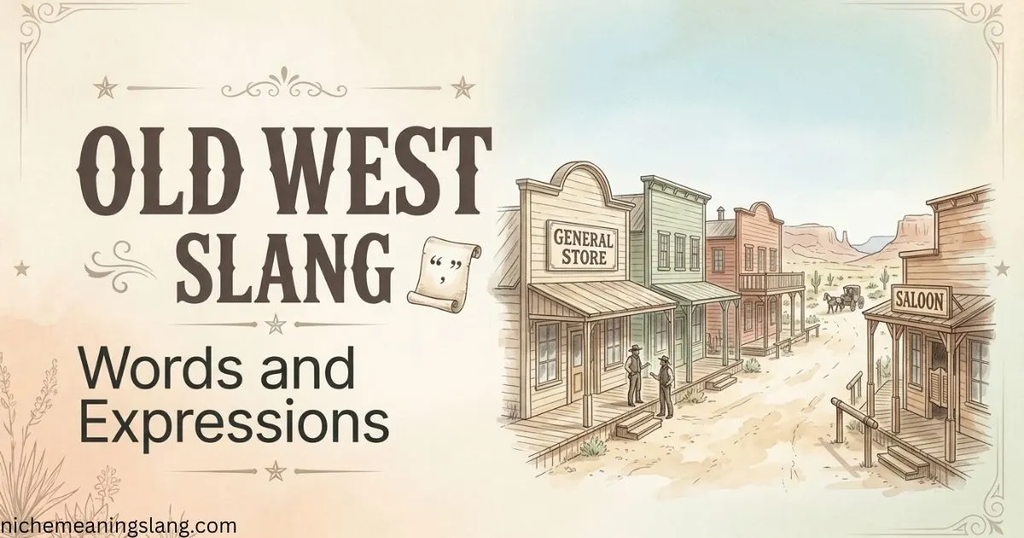
Traditional Old West slang includes expressions associated with frontier life, traveling, gambling, work, and the colorful storytelling tradition of the American West.
| Old West expression | Meaning | Example |
| All hat and no cattle | Someone who boasts but lacks ability or substance | “He talks like a champion, but he’s all hat and no cattle.” |
| Bite the dust | To fall, fail, or be defeated | “Our old truck finally bit the dust.” |
| Hold your horses | Wait or be patient | “Hold your horses; we haven’t finished packing.” |
| Ride herd on | To supervise or keep a close watch on someone or something | “She has to ride herd on the entire crew.” |
| Pull in your horns | Stop being aggressive or confrontational | “Pull in your horns and listen for a minute.” |
| A tall tale | An exaggerated or entertaining story | “Uncle Joe told a tall tale about a giant steer.” |
| Hornswoggle | To trick or deceive someone | “Don’t let that salesman hornswoggle you.” |
| A lick and a promise | A quick, incomplete attempt at doing something | “He gave the fence a lick and a promise.” |
| Fair to middling | Average or reasonably satisfactory | “How’s the weather? Fair to middling.” |
| Belly up to the bar | Come up to the bar to order a drink | “The travelers bellied up to the bar.” |
| Ace in the hole | A hidden advantage or reserve plan | “Her experience was the ace in the hole.” |
| Acknowledge the corn | Admit a mistake or acknowledge the truth | “He finally acknowledged the corn and apologized.” |
| Yellow-bellied | Cowardly or lacking courage | “He called the villain a yellow-bellied coward.” |
| Crooked as a snake | Dishonest or untrustworthy | “That outlaw was crooked as a snake.” |
| Hog-killin’ time | A particularly good or enjoyable time | “We had a hog-killin’ time at the dance.” |
Some of these expressions have broader American origins rather than exclusively cowboy origins. They fit the Old West style, but their presence in modern Western dialogue does not prove that every historical cowboy used them.
Funny Cowboy Slang Words
Funny cowboy slang often uses exaggeration, animal comparisons, and playful insults. These expressions can help create a humorous Western character or make a casual conversation sound more colorful.
| Funny expression | Meaning | Example |
| Slow as molasses | Extremely slow | “That old wagon is slow as molasses.” |
| Happy as a pig in mud | Very happy and comfortable | “He’s happy as a pig in mud at the ranch.” |
| Madder than a wet hen | Extremely angry | “She was madder than a wet hen.” |
| Grinning like a possum | Grinning broadly or mischievously | “He was grinning like a possum after winning.” |
| Ugly as homemade sin | An exaggerated, humorous way to call something unattractive | “That old truck is ugly as homemade sin.” |
| Higher than a kite | Very high up or, depending on context, intoxicated | “The balloon floated higher than a kite.” |
| All hat and no cattle | Full of talk but short on results | “He promised everything, but he’s all hat and no cattle.” |
| Don’t squat with your spurs on | A humorous warning to watch what you’re doing | “Careful with that chair—don’t squat with your spurs on!” |
| Too big for your britches | Acting more important or confident than you should | “He’s getting too big for his britches.” |
| Not my first rodeo | I’m experienced and have done this before | “Relax, this isn’t my first rodeo.” |
Some humorous expressions are associated with rural or Southern American speech more broadly. Their cowboy flavor comes from the setting, delivery, and Western storytelling tradition.
Cowboy Slang for Horses and Ranch Life
Cowboy language is especially rich in terms connected with horses, cattle, ropes, and ranch work. These words often describe practical activities rather than casual slang.
| Term | Meaning | Example |
| Bronco | A horse that is untamed or difficult to ride | “The rider climbed onto the bronco.” |
| Mustang | A free-roaming horse of the American West | “A mustang crossed the open range.” |
| Lariat | A rope used for catching livestock | “The cowboy coiled his lariat.” |
| Lasso | A rope with a loop used to catch an animal | “She practiced throwing a lasso.” |
| Roping | Using a rope to catch livestock | “Roping takes patience and practice.” |
| Roundup | Gathering livestock, especially cattle, together | “The ranch scheduled its spring roundup.” |
| Stampede | A sudden, often uncontrolled rush of animals | “The herd scattered during the stampede.” |
| Rustler | Someone who steals cattle or horses | “The sheriff investigated the cattle rustler.” |
| Chuckwagon | A wagon used to carry food and cooking supplies on a cattle drive | “The crew gathered around the chuckwagon.” |
| Remuda | A group of horses kept for cowboys to ride | “The riders selected horses from the remuda.” |
| Chaps | Protective coverings worn over trousers while riding or working | “He wore leather chaps while working cattle.” |
| Maverick | A person who acts independently; historically, an unbranded animal in some Western usage | “She’s a maverick who makes her own decisions.” |
| Drover | A person who drives livestock from one place to another | “The drover guided the cattle toward market.” |
| Trail drive | Moving a herd of cattle along a route | “The trail drive took weeks to complete.” |
| Trail dust | Dust raised by people, horses, or cattle traveling along a trail | “Trail dust covered his boots.” |
The Texas Parks & Wildlife Department vocabulary guide explains terms such as drover, lasso, rodeo, and roundup. For more specialized ranch vocabulary, the CowboyWay dictionary offers a broader reference.
Classic Cowboy Phrases and Sayings
Cowboy sayings are often short, memorable expressions about patience, courage, honesty, and common sense. Some are traditional idioms, while others became familiar through popular Western entertainment.
1. “This isn’t my first rodeo.”
Meaning: The speaker has experience and knows what to expect.
Example: “I’ve handled difficult clients before. This isn’t my first rodeo.”
2. “Save a horse, ride a cowboy.”
Meaning: A playful, flirtatious slogan associated with modern country and Western pop culture.
Example: Someone might use it as a humorous caption for a country-themed photo.
3. “Every cowboy sings his own tune.”
Meaning: Everyone has an individual personality, style, or way of doing things.
Example: “Let him work in his own way; every cowboy sings his own tune.”
This is best treated as a creative Western-style saying rather than a firmly established historical proverb.
4. “Never kick a cow chip on a hot day.”
Meaning: A humorous warning against making a bad situation worse.
Example: “Don’t start an argument while everyone’s upset. Never kick a cow chip on a hot day.”
This is a playful, modern-style variation, not a saying that should automatically be attributed to nineteenth-century cowboys.
5. “Ride tall in the saddle.”
Meaning: Show confidence, pride, or courage.
Example: “Whatever happens tomorrow, ride tall in the saddle.”
6. “Keep your powder dry.”
Meaning: Stay prepared for trouble or future challenges.
Example: “The negotiations aren’t over yet, so keep your powder dry.”
This expression is associated with older military and frontier language, not solely cowboy speech.
7. “Don’t count your chickens before they hatch.”
Meaning: Don’t assume success before it actually happens.
Example: “We haven’t signed the deal, so don’t count your chickens before they hatch.”
This is a general English proverb rather than a uniquely Western phrase.
8. “Head ’em up and move ’em out!”
Meaning: A command to get moving or begin driving a herd.
Example: “The crew was ready, so the foreman called, ‘Head ’em up and move ’em out!’”
The phrase is strongly associated with popular Western entertainment.
How to Talk Like a Cowboy
You don’t need to memorize dozens of expressions to sound Western. Start with a few familiar words and use them naturally rather than forcing cowboy slang into every sentence.
| Ordinary English | Cowboy-style version |
| Hello, friend. | Howdy, partner. |
| I think we’ll leave early. | I reckon we’ll leave early. |
| Let’s walk over there. | Let’s mosey on over yonder. |
| Wait a minute. | Hold your horses. |
| I’m getting ready to go. | I’m fixin’ to head out. |
| Are you all ready? | Y’all ready? |
| That person is inexperienced. | That person’s a greenhorn. |
| Let’s get moving. | Let’s hit the trail. |
| I have experience with this. | This ain’t my first rodeo. |
| That sounds like a good idea. | I reckon that’s a mighty fine idea. |
Example Cowboy Conversation
Jake: “Howdy, partner! Where are you headed?”
Sam: “I’m fixin’ to mosey over to the old barn.”
Jake: “Hold your horses. We need to check the cattle first.”
Sam: “Fair enough. I reckon we should get moving before sundown.”
Jake: “That’s the spirit. Let’s hit the trail!”
This conversation combines familiar Western expressions with informal speech. It is an illustrative example, not a historical quotation.
Are Cowboy Slang Words Still Used Today?
Yes. Many cowboy expressions remain familiar in the United States, especially in country music, ranch communities, rodeos, Western films, and everyday conversation. Phrases such as “hold your horses,” “not my first rodeo,” and “all hat and no cattle” can be used outside a ranch setting.
Some terms, including remuda, lariat, and drover, are more closely connected with horses, livestock, or historical ranching. Others, such as howdy and reckon, are associated with regional speech and informal conversation.
Modern Western entertainment has also shaped the way people imagine cowboy language. A phrase may sound authentically Western without being exclusive to cowboys or reliably documented as common speech in the nineteenth century.
For historical accuracy, it helps to distinguish practical ranch vocabulary from general American idioms and expressions popularized by movies. That distinction makes cowboy slang easier to understand and more useful for readers, writers, and Western history enthusiasts.
Conclusion
Cowboy slang words offer a glimpse into the language, humor, and working traditions of the American West. From everyday expressions such as “howdy,” “reckon,” and “mosey” to ranch terms such as “lariat,” “remuda,” and “roundup,” these words help explain how cowboys communicated and how Western culture influenced American English.
Whether you’re writing a Western story, learning regional expressions, or simply looking for a colorful way to say hello, these 60-plus cowboy slang words give you a useful starting point. Remember that not every Western-sounding phrase is historically authentic, but understanding the difference between ranch vocabulary, traditional idioms, and movie-inspired sayings makes the language even more interesting.
Saddle up, partner, and keep exploring the expressions that make the American West so memorable.
FAQs
What are some common cowboy slang words?
Common examples include howdy, partner, reckon, mosey, yonder, greenhorn, cowpoke, buckaroo, and yee-haw. Their meanings range from friendly greetings to descriptions of ranch workers and everyday actions.
What is the most famous cowboy slang phrase?
“Howdy, partner” is one of the most recognizable cowboy-style greetings. “Yee-haw” is another famous expression associated with excitement, rodeos, and Western entertainment.
What did cowboys call their friends?
Cowboys and Western characters often use partner or the stylized spelling pardner as a friendly form of address. Actual usage varied by person, region, and period.
What does “reckon” mean in cowboy slang?
“Reckon” means to think, suppose, or believe. For example, “I reckon we’ll get there before dark” means “I think we’ll get there before dark.”
What does “greenhorn” mean?
A greenhorn is someone inexperienced or new to a job, activity, or unfamiliar environment. The word can describe a beginner without necessarily being a serious insult.
What does “all hat and no cattle” mean?
It describes someone who talks big or tries to appear impressive but lacks the experience, ability, or results to support those claims.
What did cowboys call horses?
Cowboys generally used the ordinary word horse, but ranch vocabulary also included more specific terms. A bronco can refer to an untamed or difficult horse, while a mustang is a free-roaming horse of the American West.
What does “mosey” mean?
“Mosey” means to move or walk in a relaxed, unhurried way. “Let’s mosey over to the store” means “Let’s walk over to the store without rushing.”
Is cowboy slang still used today?
Yes. Cowboy expressions remain in ranching communities, country culture, Western entertainment, and everyday American English. Some terms are still practical ranch vocabulary, while others are mostly conversational or humorous.
Where did cowboy slang come from?
Cowboy slang developed through regional American speech, frontier life, cattle work, and cultural exchange with Spanish-speaking vaqueros. Western books, films, and television later helped popularize many expressions.
Related Slang Words

Ryan Mitchell is a language enthusiast and writer who explores slang, modern expressions, and everyday language. At nichemeaningslang, he helps readers understand slang meanings, usage, and context in a simple and easy-to-follow way.
9 Comments