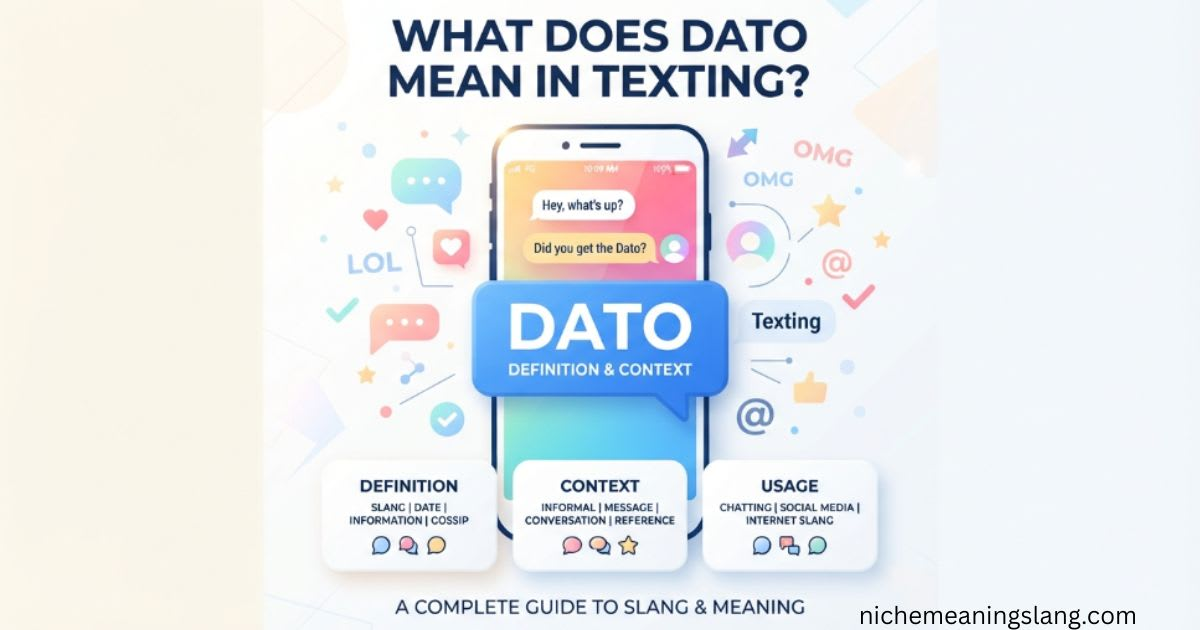
Dato Meaning What Does Dato Mean in Text & Slang?
Dato meaning depends heavily on context: it can refer to a Spanish word meaning a fact or piece of information, a rare texting acronym, or a newer internet-slang usage. That is why seeing “dato” in a message can be confusing. The surrounding words, language, audience, and platform matter more than capitalization alone. Spanish-language references define dato around information and facts, while slang sites attach additional online meanings to it.
If you searched dato meaning because someone dropped the word into a text, you are probably looking for a quick translation rather than a linguistic lecture. I’ve found the safest approach is to identify the context first: Spanish conversation, texting acronym, gossip slang, or meme-style usage. That prevents a common mistake assuming every “dato” has the same definition.
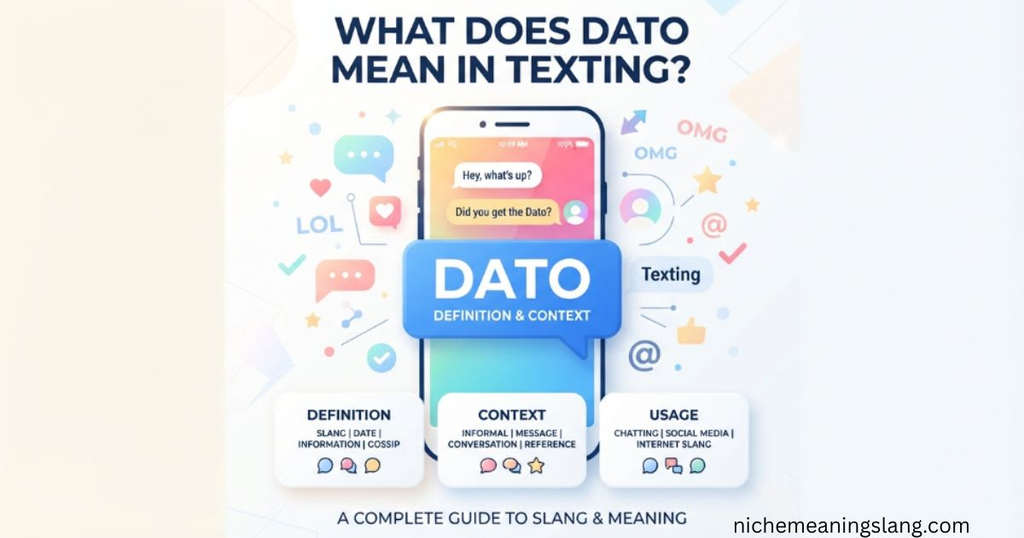
What Does DATO Mean in a Text?
In texting, DATO has been documented as an acronym for “Dining at the Office.” CyberDefinitions describes this as a rare abbreviation used by adults and teenagers and specifically warns that the meaning may change when the conversation provides different context.
That matters because other acronym databases list different expansions, including “Dining at the O” and “Dining At The Orifice.” These conflicting entries show why capitalization alone cannot establish the intended meaning. If you received DATO in a message, read the surrounding sentence before choosing an interpretation.
What does Dato mean?
In Spanish, dato commonly means a fact, piece of information, or data point. For example, Este dato es interesante means roughly “This fact/information is interesting.” The plural datos means data or multiple pieces of information.
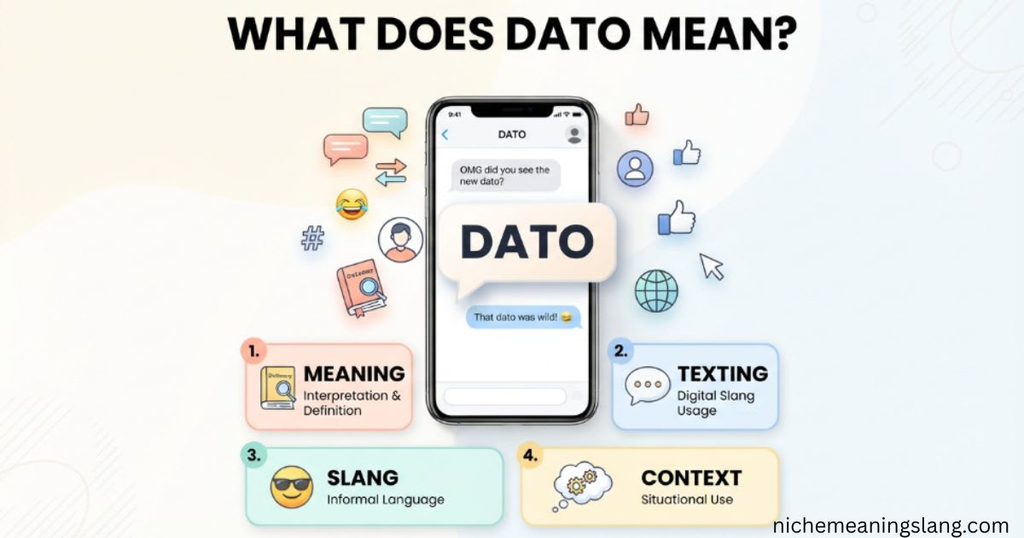
In some conversational contexts, especially among Spanish speakers, el dato can also carry the sense of “the details” or information someone is passing along. That semantic bridge helps explain why slang interpretations can drift toward gossip, insider information, or “tea.”
The Gossip Gospel: Origins and Evolution
Slang.org describes dato as gossip, juicy information, or a surprising piece of knowledge and connects that interpretation with the Spanish word for information. However, its page is community-driven and provides no references confirming that this is a broadly established U.S. slang meaning.
Cultural Significance: Tea Time All the Time
The gossip interpretation becomes easier to understand when dato is treated as “a piece of information” rather than automatically as “gossip.” A sentence such as “Tengo un dato” can introduce information someone thinks you will find useful, surprising, or interesting; tone determines whether it feels neutral or juicy.
Who Drops Datos?
The word can appear naturally among Spanish speakers discussing facts, details, or information. Slang-oriented websites also associate the gossip sense with younger people and online communities, but those claims should be treated as emerging usage rather than a universal American definition.
Variations and Spellings
The standard Spanish singular is dato, while datos is the plural. Online English-language slang pages may capitalize it as DATO when treating it as an acronym. The difference is useful, but it is not enough by itself to determine meaning because people frequently ignore capitalization in casual messaging.
How to use the term
If you are using dato in Spanish, use it when referring to a fact, detail, data point, or piece of information. A natural example is Te voy a dar un dato—roughly, “I’m going to give you a piece of information.” The phrase is normal Spanish rather than inherently internet slang.
If you encounter dato as internet slang, context becomes essential. Some websites use it for gossip or a humorous nickname, while other sources document unrelated acronym meanings. In a DM, the safest interpretation comes from the sentence around the word, not from a single slang dictionary entry.
Dato: The Deliciously Scandalous Tidbit
The slang interpretation that treats dato as juicy information is essentially a semantic extension of “information.” Instead of simply sharing a fact, the speaker presents something surprising, entertaining, or socially interesting. That is close to English expressions such as tea, scoop, gossip, details, or inside information.
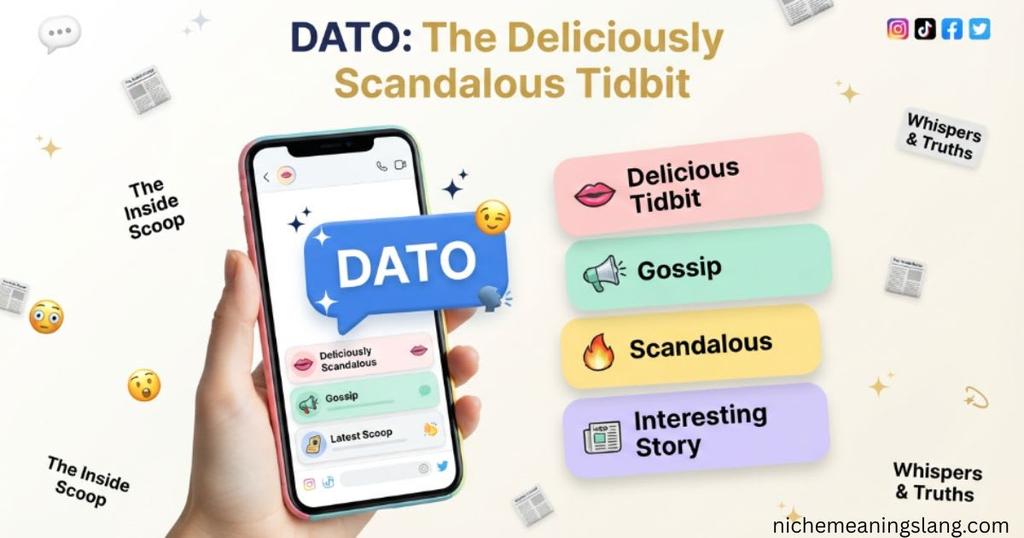
For example, someone might jokingly say, “I have the latest dato,” intending something like “I have the latest scoop.” That usage should not be confused with the ordinary Spanish noun or with the unrelated acronym DATO found in texting databases.
Generational Slang Comparison
Modern internet language changes quickly, especially through social media, gaming communities, memes, and group chats. SlangLoom places its claimed “dato” usage among younger online communities, while its page describes variants such as “Dato Mode” and “Dato Energy.” These should be viewed as emerging or site-specific slang rather than universally recognized Gen Z vocabulary.
| Context | Possible meaning of “dato” | Confidence |
| Spanish | Fact / piece of information / data | High |
| Spanish conversation | Detail or information being passed along | High |
| Gossip-oriented slang | Juicy information or gossip | Emerging |
| Texting acronym | Dining at the Office / other expansions | Rare |
| Meme or inside joke | Context-specific nickname or expression | Highly contextual |
| Tagalog | Has separate dictionary meanings | Language-specific |
The distinction is important for U.S. readers because dato is not one standardized American slang word. Dictionary evidence also records dato as a noun connected with a Filipino/Malay chieftain and other language-specific meanings, showing why language identification should come before slang interpretation.
How to Use Slang Naturally Without Sounding Awkward
The easiest rule is simple: match the word to the community that uses it. Spanish dato is perfectly normal in Spanish-language communication, while an English slang interpretation may be unfamiliar to many American readers. In casual online spaces, context, relationship, tone, and shared vocabulary determine whether a term feels natural.
If you are unsure what someone means, asking is better than guessing. A quick “What do you mean by dato here?” avoids the awkward situation where you interpret a Spanish noun as slang, or an acronym as gossip. Slang is social language, so audience awareness matters as much as dictionary definitions.
Common Slang Mistakes
The biggest mistake with dato meaning is assuming there is one universal answer. Search results currently demonstrate several competing interpretations, including Spanish information/fact, gossip slang, and unrelated DATO acronyms. Treating the first definition you see as absolute can easily produce the wrong interpretation.
Another mistake is presenting emerging internet usage as established mainstream slang. SlangLoom, for example, describes a newer “dato” nickname-style usage and several derivatives, but those claims are not independently corroborated by the stronger dictionary-style sources reviewed here.
Conclusion
The safest answer to dato meaning is that context decides the definition. In standard Spanish, dato means a fact, piece of information, or data point. In some conversational settings it can refer to details or information being passed along. English-language slang sources additionally document gossip-related and acronym meanings, but these are not interchangeable.
So if you saw “dato” in a text, don’t immediately assume it means gossip, “Dining at the Office,” or a Gen Z nickname. Look at the surrounding sentence, the language being used, and the relationship between the speakers. That small amount of context usually reveals the intended meaning.
FAQs
What does “Dato” mean in slang?
Depending on the community, dato may be used for a piece of gossip, juicy information, or a playful online expression. However, this is not a single universally standardized slang definition. Context should determine which meaning applies.
Is “Dato” a Gen Z slang word?
Some recent slang websites describe dato as a newer expression used in younger online communities. However, the evidence is not strong enough to say that it is a universally recognized Gen Z term across the United States.
Can “Dato” be used in professional settings?
If you mean the Spanish noun, dato is completely normal in professional Spanish. If you mean an emerging English slang usage or an obscure texting acronym, it is better avoided in formal English unless your audience clearly understands it.
Why do slang words like “Dato” become popular?
Social media, memes, group chats, gaming communities, and multilingual communication can spread unusual expressions quickly. A word may begin as an inside joke or culturally specific expression before appearing in wider online conversations.
Will “Dato” stay popular in the future?
There is no reliable way to predict whether an emerging slang usage will become mainstream. Slang can disappear quickly, while other expressions move from niche communities into broader internet vocabulary.
Related Slang Words

Ryan Mitchell is a language enthusiast and writer who explores slang, modern expressions, and everyday language. At nichemeaningslang, he helps readers understand slang meanings, usage, and context in a simple and easy-to-follow way.