What Does ISO Mean in Basketball? Complete Guide
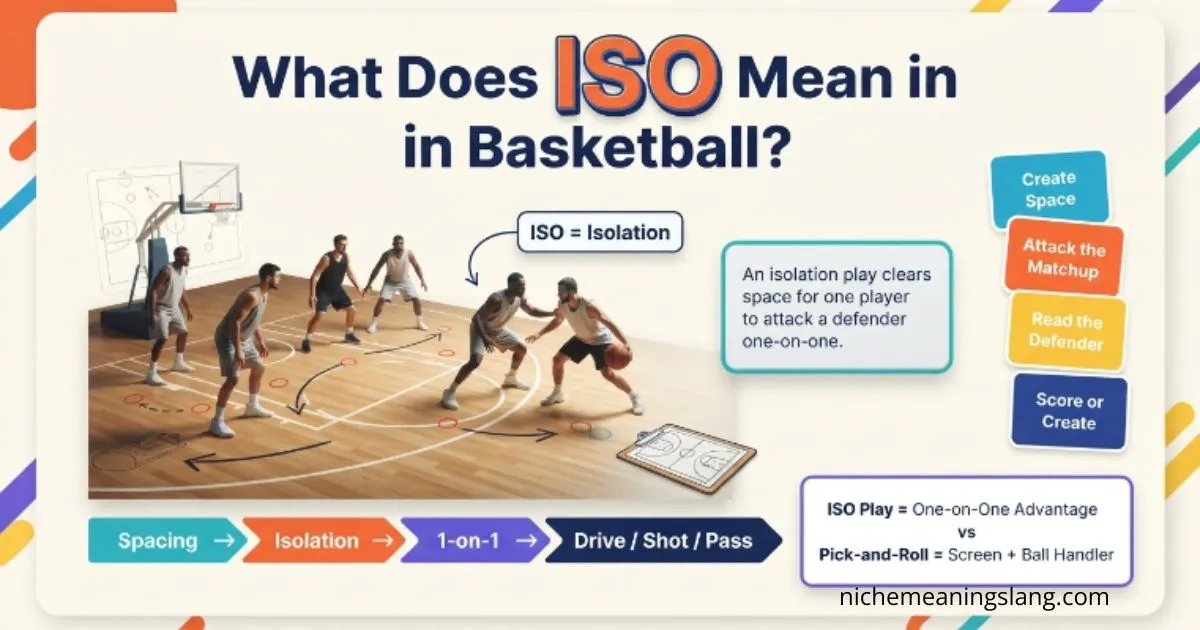
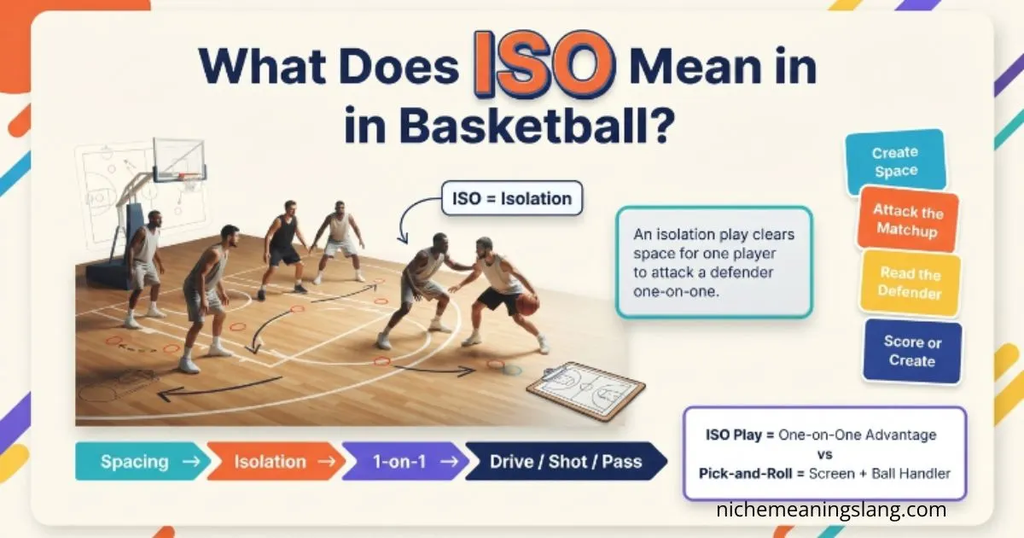
What does ISO mean in basketball? ISO means “isolation,” an offensive play designed to give one player space to attack a defender one-on-one. Teammates spread away from the ball to reduce help defense and create room for a drive, jumper, post move, or pass. This is common basketball terminology in the NBA, college basketball, pickup games, broadcasts, and online fan conversations.
If you’ve ever watched a late-game possession and wondered why four players suddenly move away while one scorer goes to work, you’ve seen an ISO. From a coaching perspective, it isn’t simply “give the ball to the star.” Spacing, matchup selection, court position, ball handling, decision-making, and defensive reactions all determine whether the isolation actually produces a good possession.
Quick Answer: What Does ISO Mean?
In basketball, ISO is short for isolation. It describes an offensive situation in which the ball handler is given room to attack a single defender without a teammate immediately setting a screen or running another major action beside the ball. The remaining players space the floor to make help defense more difficult.
You may hear an announcer say, “They’re going ISO,” or a player might tell a teammate to “clear out.” Both phrases point toward the same basic idea: create space and let a skilled scorer attack the matchup. ISO can be planned, created after a switch, or used when the shot clock is running down.
What is an Iso in Basketball?
An ISO is an offensive strategy where one player receives the ball and attacks their defender in a one-on-one situation. The action can begin on the wing, near the top of the court, or in the post. Teammates move into useful spacing positions rather than crowding the ball handler.
The goal isn’t necessarily for the ISO player to force a shot. A strong isolation possession can produce a drive, pull-up jumper, foul, or open pass if another defender helps. That makes ISO a five-player offensive concept even though the visual focus is usually on one attacker and one defender.
How an ISO Play Actually Works
An isolation possession generally begins by creating enough space for the primary scorer to operate. The other offensive players spread out, often toward the perimeter, so their defenders have farther to travel if they decide to help. That spacing gives the ball handler more room to read the defender.
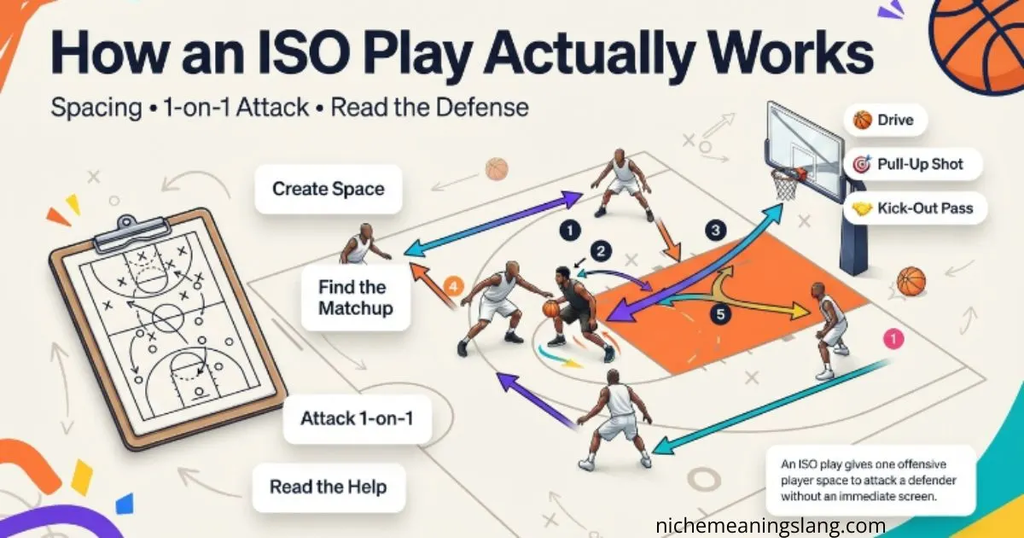
Once the matchup is established, the offensive player may attack with a crossover, hesitation, drive, post move, pull-up, or step-back. The defender must decide how to contain the action without giving up an easy basket. If help arrives, the ISO player can sometimes pass to the open teammate.
The Clear-Out Setup
“Clear out” is common basketball language for moving teammates away from the ball handler. The purpose is to reduce congestion and make it harder for another defender to provide immediate help. Proper spacing also gives the offensive player a clearer driving lane and forces defenders to respect open shooters.
The One-on-One Showdown
Once the floor is spaced, the possession becomes primarily a battle between the ball handler and their defender. The attacker reads the defender’s stance, distance, speed, and positioning before choosing a move. However, the other eight players remain active because help defense, rotations, and passing opportunities can change the outcome.
Key Factors In Isolation Play
Successful isolation basketball depends on more than having a talented scorer. Coaches consider who should attack, where the action should happen, which matchup is available, and how the other four offensive players should space themselves. Team signals can also help initiate the action without making the intention obvious.
The matchup is particularly important. A quick guard against a slower big can create a driving advantage, while a strong post player against a smaller defender can create a different type of mismatch. The best ISO situations usually give the offensive player a clear skill or physical advantage.
The Right Offensive Player
The ideal ISO player usually combines ball-handling ability, shooting, physical strength or speed, and decision-making. A scorer who can attack but cannot recognize help defense may turn a promising matchup into a difficult possession. Coaches therefore value players who can score and make the correct read when the defense changes.
Mismatch Options
A mismatch is one of the biggest reasons teams isolate. The offensive player may be faster, stronger, taller, or simply more skilled than the defender. A switch after a screen can create this situation, which is why teams often use other actions before allowing a star player to attack the resulting matchup.
Court Position
Where the ISO begins matters. Some players are more dangerous from the wing, others from the top of the key, and post scorers may prefer operating closer to the basket. The best position is generally one that matches the attacker’s strengths while preserving enough spacing for teammates.
Team Signals
Organized teams can use signals to tell players that an isolation is coming. Clear communication matters because everyone must understand where to stand and what spacing responsibilities they have. If teammates drift into the ball handler’s driving lane, the defense gets an easier opportunity to provide help.
The Purpose and Best Time To Call Isolation Play
Teams often use ISO when they want a particular player attacking a favorable matchup, especially late in the game or when the shot clock is low. In those moments, a simple isolation can create a shot without requiring a complicated sequence of passes or screens.
ISO can also emerge after a defensive switch. If a star scorer suddenly finds a weaker defender in front of them, the offense may stop running additional actions and let the player attack. This is one reason matchup hunting is such an important part of modern basketball strategy.
Advantages of the Iso in Basketball
One major advantage of ISO is control. The offense can put the ball in the hands of its best creator and allow that player to attack a specific weakness. Isolation can also be useful when there is very little time left on the shot clock and the team needs a shot quickly.
Another benefit is the pressure placed on help defenders. If the primary defender is beaten, another defender may need to rotate toward the ball. That can create an open three-point shot or another passing opportunity. In that sense, a good ISO can still generate team offense even when only one player initially has the ball.
Disadvantages of the Iso in Basketball
ISO becomes problematic when teams depend on it too heavily. Repeated isolation can make an offense predictable, reduce ball movement, and allow defenders to anticipate where the possession is going. Competitors also note that excessive ISO usage can leave teammates feeling less involved.
There is also a physical cost. If one player repeatedly creates the offense through difficult one-on-one possessions, that player can become tired. A tired scorer may lose efficiency late in the game. Against a well-organized defense or zone, the isolation advantage can also become harder to exploit.
ISO vs Other Basketball Plays
ISO is different from a pick-and-roll because the classic isolation setup emphasizes the ball handler attacking without a teammate actively screening the defender. A pick-and-roll instead uses a screen to create an advantage, often through a switch, defensive hesitation, or two-player action.
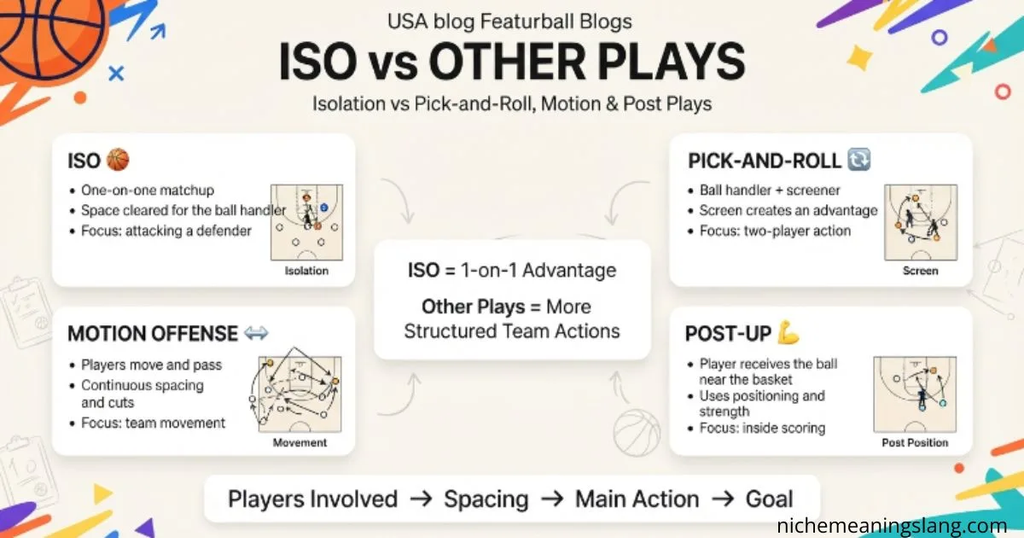
Post-ups and ISO plays can overlap because a post player can isolate against a defender. Likewise, an ISO can develop after a pick-and-roll forces a switch. The distinction is therefore about the action creating the advantage: ISO emphasizes the isolated matchup and available space.
| Basketball term | Basic idea | Main feature |
| ISO | One player attacks a defender | Isolation and spacing |
| Pick-and-roll | Ball handler uses a screen | Two-player action |
| Post-up | Player attacks near the basket | Position, strength, footwork |
| Motion offense | Players continuously move | Ball and player movement |
| One-on-one | Two players directly compete | Individual matchup |
| Hero ball | Player forces individual offense | Usually critical/negative tone |
ISO and one-on-one are closely related, but they aren’t exactly identical. A normal one-on-one game has only two players competing. An ISO happens during a regular five-on-five game, with the offense intentionally creating a one-player-versus-one-defender situation while the other players remain spaced around the court.
The Best ISO Ball Players In The NBA
NBA history contains many elite isolation scorers. Players such as Michael Jordan, Kobe Bryant, Allen Iverson, Kevin Durant, James Harden, and LeBron James have all been highlighted by basketball sources for their ability to create offense individually. Modern examples such as Luka Dončić are also frequently discussed for their matchup-based scoring ability.
What makes an elite ISO scorer special isn’t simply flashy dribbling. The player must read the defender, create separation, recognize help, choose efficient shots, and make a pass when the defense takes away the scoring opportunity. The best isolation players make difficult possessions look surprisingly controlled.
Related Basketball Slang You’ll Hear
ISO rarely exists alone in basketball conversation. Fans may also say “clear out,” “let him cook,” “hero ball,” “iso ball,” or “mismatch.” Some expressions praise individual scoring, while others criticize a team for relying too heavily on one player. Meaning therefore depends heavily on tone and context.
For example, “He cooked him in ISO” is generally praise for beating a defender one-on-one. “They played ISO ball all night” can be neutral, but it can also criticize an offense that stopped moving the ball. The basketball vocabulary around ISO therefore carries both strategic and fan-culture meanings.
Conclusion
So, what does ISO mean in basketball? It means isolation an offensive strategy that creates space for one player to attack a defender one-on-one. The remaining teammates aren’t simply standing around; their spacing helps limit defensive help and can create passing opportunities if another defender rotates.
The best ISO possessions combine a favorable matchup, strong spacing, skilled ball handling, smart decision-making, and good timing. ISO can be especially valuable late in games or against a defensive mismatch, but overusing it can make an offense predictable. Once you understand those pieces, the next time a commentator says “they’re going ISO,” you’ll immediately know what’s happening.
FAQs
What does ISO mean in basketball?
ISO means isolation. It is an offensive play in which one player gets space to attack a defender one-on-one while teammates spread out to make defensive help more difficult.
What does ISO stand for?
ISO stands for isolation in basketball. It refers to creating a one-on-one offensive matchup, usually for a skilled scorer or a player with a favorable matchup.
Is ISO the same as one-on-one?
Not exactly. An ISO is a one-on-one-focused situation within a normal five-on-five game. The other players remain on the court and contribute through spacing and potential passing opportunities.
What does calling ISO mean?
Calling ISO means asking the offense to create an isolation situation. Teammates typically clear space while the designated ball handler attacks their defender.
Why do basketball teams use ISO?
Teams use ISO to exploit a favorable matchup, put the ball in a star player’s hands, create a quick shot, or attack a defender who has difficulty handling the offensive player’s particular strengths.
What is ISO ball?
ISO ball describes an offensive style that relies heavily on isolation plays. The phrase can be neutral, but fans sometimes use it negatively when they believe a team is relying too much on individual scoring.
Is ISO a good strategy?
ISO can be highly effective in the right situation, particularly against a mismatch or late in the shot clock. However, excessive isolation can become predictable and reduce ball movement.
What is a clear-out in basketball?
A clear-out occurs when teammates move away from the ball handler to create space for an individual attack. It is closely associated with isolation basketball.
What is a mismatch in basketball?
A mismatch occurs when an offensive player has an advantage over the defender, such as greater speed, size, strength, or skill. Teams often use ISO to take advantage of these situations.
Who are famous ISO players?
Players frequently associated with elite isolation scoring include Michael Jordan, Kobe Bryant, Allen Iverson, Kevin Durant, James Harden, LeBron James, and Luka Dončić.
Related Slang Words

Ryan Mitchell is a language enthusiast and writer who explores slang, modern expressions, and everyday language. At nichemeaningslang, he helps readers understand slang meanings, usage, and context in a simple and easy-to-follow way.