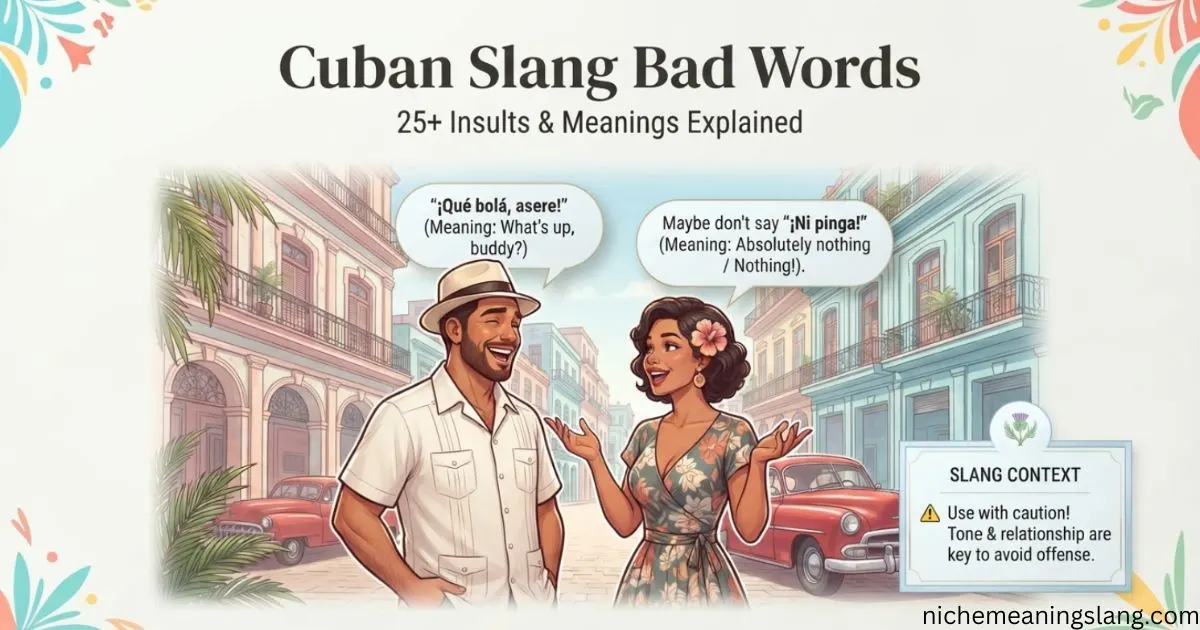
25+Cuban Slang Bad Words Insults & Meanings Explained
Cuban slang bad words are informal Spanish expressions used for anger, surprise, insult, humor, emphasis, and emotional reaction. The most important examples include coño, pinga, carajo, cabrón, comemierda, hijo de puta, and cojones, but their force changes dramatically with context, speaker, tone, and relationship. Linguistic research specifically documents several of these expressions as dysphemistic features of Cuban Spanish.
If you’ve ever watched Cuban media, heard Cuban Spanish in Miami, or encountered an expression online and wondered, “Was that actually an insult?”, the confusion is understandable. After studying slang lists alongside linguistic sources, the pattern becomes clearer: Cuban profanity isn’t just a collection of swear words. It carries emotion, humor, identity, emphasis, and social meaning, so this guide explains what the words mean and when their tone changes.
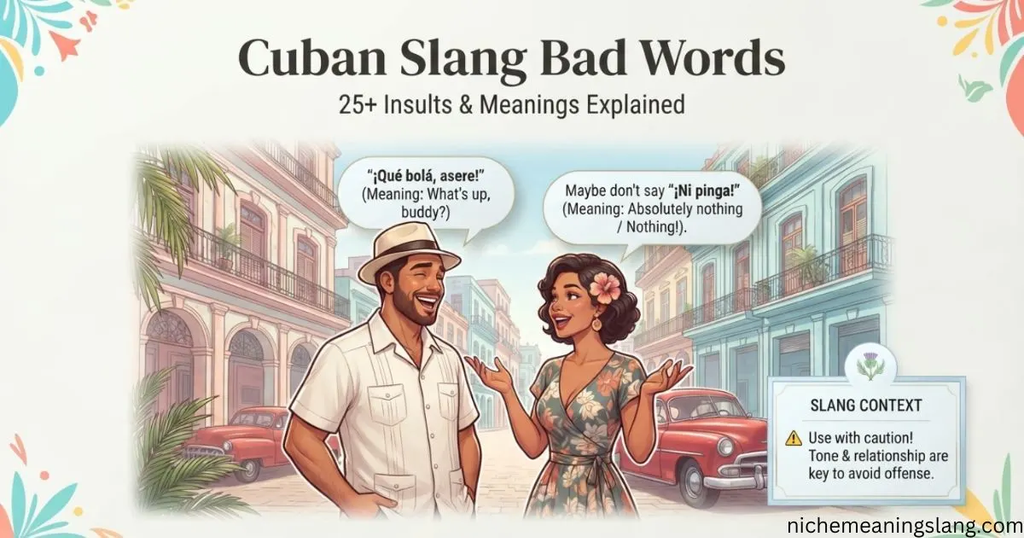
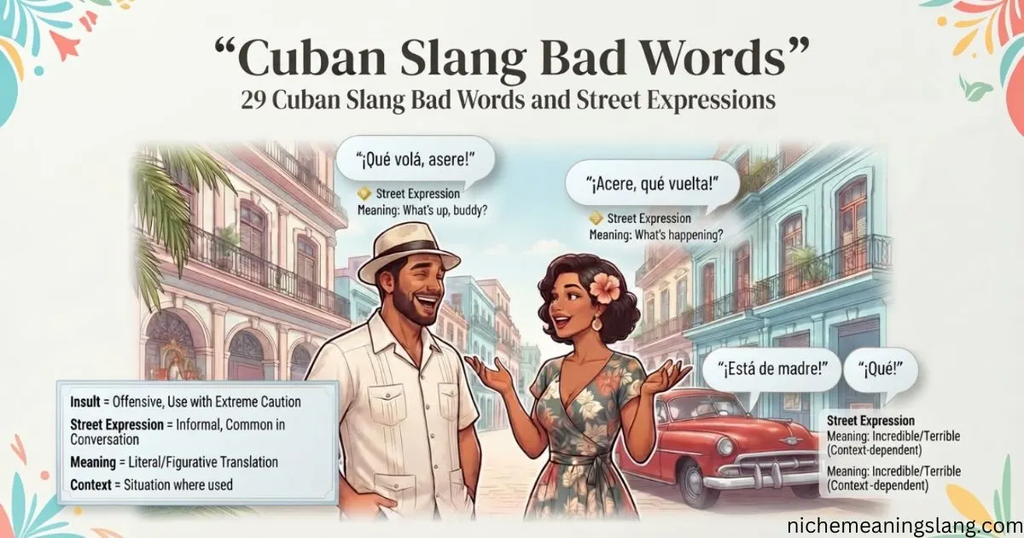
Cuban Slang Bad Words: 29 Cuban Slang Bad Words and Street Expressions
Cuban Spanish has a broad informal vocabulary, but not every slang word is a bad word. Terms such as asere, socio, yuma, guagua, and fula can be casual without being profane. The stronger vocabulary includes coño, pinga, cabrón, comemierda, joder, singao, and related expressions. Competitor lists group these together, but their severity is not identical.
For American readers, the key is separating insults from exclamations. Coño, for example, can function as an emotional outburst rather than an insult directed at a person, while comemierda can directly characterize someone’s behavior. Academic research likewise shows that Cuban profanity can function as insult, interjection, or intensifier rather than retaining only its literal dictionary meaning.
| Cuban expression | Approximate English sense | Typical function | Caution |
| Coño | Damn / fuck / hell | Exclamation, emphasis | Strong profanity |
| Pinga | Dick / fuck, depending on context | Insult, exclamation, intensifier | Very vulgar |
| Cabrón | Bastard / asshole | Insult or characterization | Context-sensitive |
| Comemierda | Asshole / fool / shithead | Insult | Vulgar |
| Hijo de puta | Son of a bitch | Strong insult | Highly offensive |
| Carajo | Damn / hell / fuck | Exclamation | Strong |
| Cojones | Balls / the fuck | Exclamation, emphasis | Vulgar |
| Puñeta | Damn / fuck / go to hell | Exclamation/insult | Context varies |
| Singao | Harsh insult | Insult | Vulgar |
| Joder | Fuck / damn | Exclamation or verb | Not uniquely Cuban |
| Mierda | Shit | Exclamation/noun | General Spanish |
| Maricón | Homophobic slur | Insult | Offensive; avoid |
A particularly important distinction concerns pinga. Research on contemporary Cuban Spanish shows that the word has developed beyond its literal sexual meaning and can work as an insult, interjection, or intensifier. Another study describes the growing productivity of pinga in Cuban expressions alongside words such as mierda, coño, and carajo.
Coño
Coño is one of the most recognizable Cuban profanities and can express anger, surprise, frustration, admiration, or emphasis. NPR’s reporting on Cuban comedian Guillermo Álvarez Guedes describes it as a particularly flexible expletive whose emotional force can strengthen an otherwise ordinary sentence.
Pinga
Pinga literally refers to the male sexual organ, but contemporary Cuban Spanish uses it in several figurative ways. Academic research identifies insult, interjection, and intensifying functions, making the word highly context-dependent. Its vulgarity also makes it inappropriate for formal conversation or unfamiliar audiences.
Cabrón
Cabrón can translate approximately as “bastard,” “asshole,” or another strong insult depending on context. It can characterize a difficult or unpleasant person, but the exact emotional force changes with tone and relationship. It is safer to recognize than casually reproduce unless you understand the speaker’s intent.
Comemierda
Comemierda literally combines come (“eat”) with mierda (“shit”), but the expression functions as an insult rather than a literal description. Sources aimed at Cuban Spanish learners translate it variously as “dumbass,” “fool,” or “asshole.”
Hijo de puta
Hijo de puta is a very strong insult equivalent to “son of a bitch,” although translations can become stronger depending on surrounding language. The feminine form is hija de puta. Because it directly insults someone, it generally carries more interpersonal hostility than a standalone exclamation such as coño.
Ñooo
Ñooo is better understood as an expressive Cuban exclamation than a conventional insult. It can signal surprise, disbelief, admiration, frustration, or shock, depending on delivery. Gritty Spanish gives examples involving heat, attractiveness, and surprise, illustrating how intonation can shape the meaning.
Puñeta
Puñeta can have several uses and is not perfectly captured by one English translation. Gritty Spanish gives examples where it functions as an exclamation, an expression equivalent to “go to hell,” or a disparaging reference to something that does not work. Context is essential.
Cojones
Cojones literally refers to testicles but can operate as a profanity or emphatic expression. In a phrase such as ¿Qué cojones…?, the literal anatomy is less important than the speaker’s frustration or disbelief. The word is vulgar, so it belongs to informal rather than professional communication.
Cuban Slang Bad Words: Cuban Insults
Cuban insults often overlap with humor, exaggeration, and social teasing. Lingopie specifically notes that Cuban insults can combine these elements and connects playful teasing with choteo, showing why a phrase that looks harsh in translation does not always function identically in every interaction.
The safest way to interpret a Cuban insult is to consider who said it, who received it, what happened immediately before it, and how it was delivered. A close friend may use a strong expression jokingly, while the same words from a stranger during an argument can be genuinely hostile. Linguistic research on Cuban dysphemisms similarly emphasizes pragmatic function rather than dictionary meaning alone.
Come Mierda
Come mierda is used to characterize someone as arrogant, foolish, unpleasant, or otherwise objectionable. The literal translation is much more graphic than the everyday interpersonal meaning, which is why translating word-for-word can mislead English speakers. The surrounding sentence and tone determine the intended insult.
Singao
Singao is presented in recent Cuban slang sources as a harsh insult for someone considered irritating, disrespectful, or unpleasant. Because usage can vary among speakers and sources, it is better treated as strong informal language rather than a precise one-word English equivalent.
Cabeciduro
Lingopie’s Cuban-insult section includes cabeciduro, meaning someone who is stubborn or hard-headed. Unlike profanity involving sexual or scatological vocabulary, this expression can function more like a negative personality description. It still belongs to informal speech, but its social force is generally different from a severe curse.
Papelazo
Papelazo is used in Cuban slang for an embarrassing situation, blunder, or spectacle. It demonstrates an important point about Cuban slang bad words: the search intent is not limited to four-letter profanity. Some insulting or negative expressions describe behavior, embarrassment, or social failure rather than simply attacking someone’s character.
Cuban Slang Bad Words: Cuban Phrases That Only Make Sense to Cubans
Some Cuban expressions are difficult for outsiders because their meaning cannot be reconstructed reliably from individual Spanish words. Lingopie highlights phrases such as resolver, pasar trabajo, no cojas lucha, estar en talla, and comerse un cable, which depend heavily on Cuban cultural and conversational context.
The same principle applies to profanity. A learner who translates every word literally can miss the actual communicative purpose. In Cuban Spanish, a taboo term may become an intensifier, interjection, insult, or emotional marker. Research on pinga provides especially strong evidence of this semantic shift and pragmatic flexibility.
| Expression | Literal idea | Contextual function |
| No cojas lucha | Don’t take the struggle | Don’t stress |
| Comerse un cable | Eat a cable | Be broke / struggle financially |
| Resolver | Resolve | Make do / find a solution |
| Estar en talla | Be “in size” | Be on point / in style |
| Qué carajo… | What the hell… | Strong emphasis |
| Qué pinga… | What dick… | Strong Cuban intensifier/question |
This is why Cuban slang bad words should be learned alongside ordinary Cuban expressions. Slang is a system, not a vocabulary dump. Understanding how speakers shift between humor, exaggeration, frustration, affection, and insult gives you a much more accurate picture of Cuban Spanish.
No Cojas Lucha
No cojas lucha is not itself a swear phrase. It illustrates Cuban conversational style by expressing something like “don’t stress yourself” or “don’t worry about it.” Including expressions like this helps distinguish authentic Cuban colloquial vocabulary from a page that simply collects profanity without cultural context.
Comerse un Cable
Comerse un cable is another example of Cuban figurative language. The phrase does not normally mean literally eating a cable; it refers to hardship or financial difficulty. Such expressions reinforce the importance of learning semantic context, idioms, and cultural usage rather than translating Cuban Spanish mechanically.
Cuban Slang Bad Words: Generational Slang Comparison
Slang changes across generations, and Cuban profanity is no exception. A recent competitor separates Gen Z, millennials, and older generations, suggesting that younger speakers mix established Cuban expressions with internet culture, while older speakers may rely more heavily on traditional neighborhood vocabulary.
However, a webpage’s “trending” label should not automatically be treated as linguistic measurement. A better evidence-based approach is to distinguish documented long-standing profanity from newer social-media usage. Academic research demonstrates that established words such as pinga continue to develop new functions through semantic reanalysis and productive expressions.
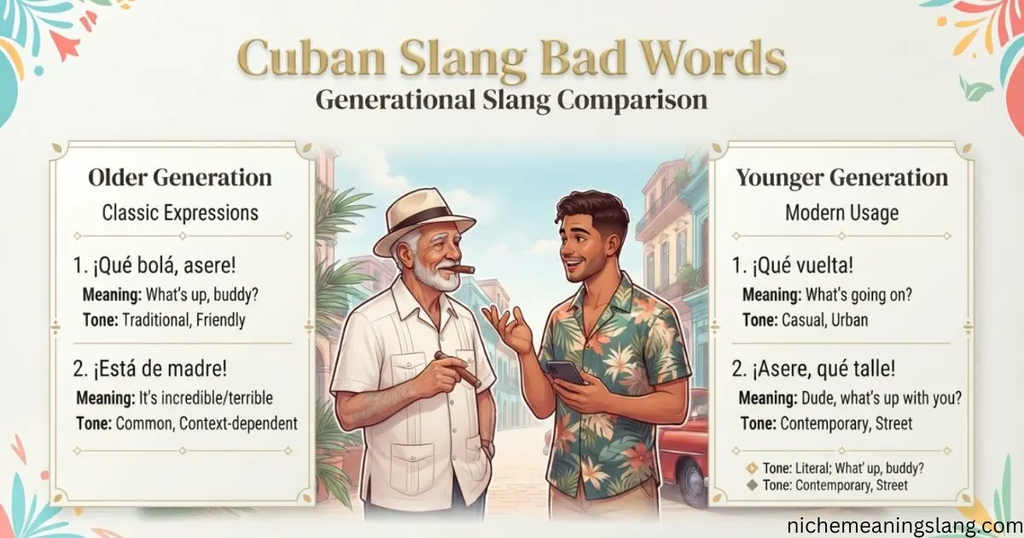
Gen Z Cuban Slang
Younger Cubans encounter slang through traditional conversation as well as memes, music, TikTok, messaging, and online communities. That does not mean every internet expression is uniquely Cuban. Digital culture can accelerate the spread of broader Spanish slang while local speakers give familiar terms new humorous or ironic uses.
Millennial Slang
Millennial Cuban speakers may occupy an interesting middle ground between older street vocabulary and contemporary digital language. Expressions learned through family, neighborhood conversation, music, television, and migration communities can coexist with newer internet terminology, particularly in Cuban-American communities.
Older Generations
Older speakers may preserve expressions with long conversational histories that younger speakers use differently or less frequently. For learners, this creates an important warning: a word appearing in an old Cuban movie does not automatically represent the way every Cuban speaker talks today.
Cuban Slang Bad Words: How to Use Slang Naturally Without Sounding Awkward
The simplest rule is to listen before speaking. Lingopie recommends paying attention to tone, rhythm, setting, and accent rather than memorizing isolated expressions. This matters especially with profanity because the same lexical item can sound playful among friends and aggressive during an argument.
For American Spanish learners, restraint is often the most natural approach. You do not need to insert a Cuban swear word into every sentence to sound authentic. Recognizing an expression accurately, understanding its emotional force, and knowing when not to repeat it demonstrates more linguistic awareness than forced slang.
Match the Tone
Tone can completely change how a strong expression is received. A joking delivery between close friends may soften a phrase, while anger, volume, or direct eye contact can make the same vocabulary confrontational. Cuban profanity therefore has a strong pragmatic dimension, not merely a dictionary definition.
Pay Attention to Context
Context includes age, relationship, location, setting, topic, and conversational purpose. A phrase used between longtime friends should not automatically be copied into a workplace or first meeting. This is particularly important with insults because social meaning can be more consequential than literal translation.
Know the Social Environment
Cuban slang differs across communities, generations, and diaspora settings. A phrase heard in Havana, Miami, a Cuban-American family, or an online community may carry slightly different associations. The safest strategy is to observe how native speakers use it before adopting it yourself.
Cuban Slang Bad Words: Common Slang Mistakes
One common mistake is assuming that every Spanish profanity has the same force everywhere. Cuban Spanish is not simply generic Spanish with a Cuban accent. Research into Cuban dysphemisms shows that certain expressions develop specialized functions and semantic extensions within the Cuban variety.
Another mistake is treating a slang website’s English translation as a perfect dictionary definition. Words such as pinga and coño can function differently depending on syntax and discourse. A translation such as “fuck” may capture the emotional effect while completely missing the original word’s literal and cultural dimensions.
Using Outdated Slang
Slang evolves. A word can remain recognizable while becoming old-fashioned, humorous, regional, or associated with a particular generation. Before repeating something heard in an older movie or decades-old language guide, check whether contemporary Cuban speakers still use it in comparable situations.
Using Slang in Formal Writing
Profanity and street slang generally do not belong in job applications, academic papers, professional emails, legal documents, or formal presentations. Even when a term is culturally interesting, explain it rather than casually inserting it into formal prose.
Overusing Slang
Using ten Cuban slang expressions in every sentence is one of the fastest ways to sound unnatural. Native speakers usually switch registers according to context. A learner who understands when to use standard Spanish and when to recognize Cuban slang will sound more linguistically aware than someone trying to perform an exaggerated “street” style.
Conclusion
Cuban slang bad words are more than a list of Spanish swear words. Expressions such as coño, pinga, carajo, cabrón, and comemierda can communicate anger, surprise, frustration, insult, humor, or emphasis, and their meaning can shift according to tone and context. Academic research confirms that Cuban Spanish gives some taboo terms specialized pragmatic functions.
For American learners, the smartest approach is to recognize before reproducing. Learn the literal meaning, understand the Cuban context, notice how native speakers use the expression, and remember that a word that sounds playful in one relationship may be seriously offensive in another. That distinction is what turns a basic slang list into genuine understanding of Cuban Spanish.
FAQs
Are Cuban bad words always offensive?
No. Cuban profanity can function as an insult, an exclamation, an intensifier, or a humorous expression. Tone and relationship matter. Academic research on Cuban pinga specifically identifies insult, interjection, and intensification as distinct dysphemistic uses.
What is the strongest Cuban swear word?
There is no objective universal “strongest” Cuban swear word. Pinga, coño, carajo, and other profanities can carry different force depending on speaker, context, and construction. Research indicates that pinga has particularly strong dysphemistic force in some Cuban uses.
What does coño mean in Cuban Spanish?
Coño is a vulgar expression that can communicate anger, surprise, frustration, emphasis, or other strong emotion. NPR’s reporting on Cuban comedian Guillermo Álvarez Guedes describes its ability to intensify an otherwise ordinary statement.
What does pinga mean in Cuban slang?
Literally, pinga refers to the penis. In contemporary Cuban Spanish, research documents additional uses as an insult, interjection, and intensifier, meaning its translation depends heavily on the sentence.
What does comemierda mean?
Comemierda literally refers to someone who “eats shit,” but as Cuban slang it functions as an insult that can be translated approximately as asshole, fool, dumbass, or shithead, depending on context.
What does cabrón mean in Cuban Spanish?
Cabrón is a strong insult that can approximate bastard, asshole, or jerk depending on context. It can also appear in expressions where the English translation changes substantially, so literal translation alone is unreliable.
Are Cuban slang words different from standard Spanish?
Yes. Cuban Spanish contains vocabulary, meanings, pronunciations, expressions, and pragmatic patterns that distinguish it from formal or generalized Spanish. Linguistic research specifically identifies Cuban-specific developments in taboo vocabulary such as pinga.
Can tourists use Cuban swear words?
They can recognize them, but using them requires caution. A learner may understand the dictionary meaning without understanding the social force, regional nuance, or relationship between speakers. Listening first and asking a trusted native speaker about context is safer than experimenting with strong insults.
Is Cuban profanity used in Miami?
Cuban-American communities in Miami have maintained and reshaped Cuban Spanish across generations. NPR’s reporting on Álvarez Guedes describes how Cuban-American audiences connected with his use of Cuban obscenities and bilingual humor.
Related Slang Words

Ryan Mitchell is a language enthusiast and writer who explores slang, modern expressions, and everyday language. At nichemeaningslang, he helps readers understand slang meanings, usage, and context in a simple and easy-to-follow way.