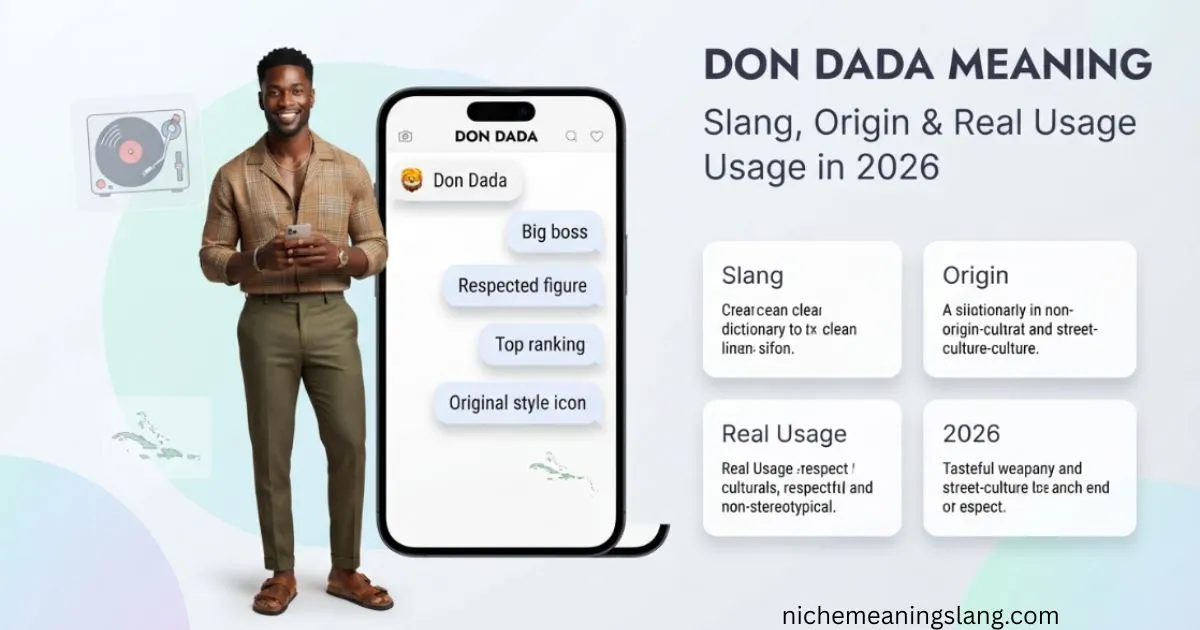
Don Dada Meaning Slang, Origin & Real Usage in 2026
Don dada meaning usually refers to a highly respected, powerful, or top-ranking person the “big boss” of a situation. The expression is strongly associated with Jamaican Patois and dancehall culture, although it has traveled into broader music, street slang, social media, and casual English.
If you encountered the phrase in a song, caption, text, or conversation, the confusing part is its tone: don dada can be serious praise, playful hype, or a reference to someone with street authority. Understanding the surrounding context makes the meaning much easier to read.
What Does Don Dada Mean
In everyday slang, don dada describes someone who is at the top: respected, influential, confident, or clearly in charge. Jamaican Patois sources define it around the ideas of highest-ranking boss and most respected person. In modern American slang, that can extend metaphorically to business, sports, music, friendship groups, or online communities.
The easiest mental translation is “top boss,” “boss of bosses,” or “the person everyone respects.” It does not automatically mean someone is a criminal. Historical street usage can carry that association, but casual speakers may simply use don dada to praise somebody who dominates their field or handles a situation confidently.
Examples
Imagine a friend closes a difficult business deal that nobody else could land. Someone might joke, “You’re the don dada now.” The phrase works as exaggerated praise for success, leadership, confidence, influence, and status. Similarly, a talented DJ, athlete, entrepreneur, or team captain might receive the label when others recognize their ability.
In another setting, the expression can sound more serious. A lyric or discussion about street hierarchy may use don dada for a person with real authority or reputation. That is why context matters more than a single dictionary translation: the same phrase can be playful praise in one conversation and a heavier cultural reference in another.
Slang: Don Dada
SlangLoom describes Don Dada as a confident or dominant person who appears powerful, respected, or in control, sometimes with a joking “boss of the group” meaning. Its examples place the expression in casual situations rather than formal language.
That makes don dada especially useful as a status expression. If somebody consistently leads, performs exceptionally, or commands attention, calling them don dada can communicate admiration without giving a literal job title. The phrase is informal, so its impact comes largely from personality, relationship, and tone.
Slang: Big Boss
Big boss is one of the clearest modern English equivalents because both expressions emphasize authority and leadership. The difference is cultural flavor: big boss sounds broadly understandable, while don dada carries stronger Jamaican, Caribbean, dancehall, and street-slang associations.
For example, “She’s the big boss around here” simply identifies the person making decisions. “She’s the don dada” sounds more colorful and celebratory. It can suggest not only authority but also reputation, confidence, style, influence, and respect within a particular social environment.
Slang: OG
OG overlaps with don dada because both can communicate respect for someone established, authentic, experienced, or influential. But OG often emphasizes longevity or originality, whereas don dada places more emphasis on being the top authority or dominant figure.
Someone might be an OG because they helped establish a scene years ago. Calling that person don dada pushes the meaning toward “the one at the top.” In casual American slang, both can be compliments, but their cultural histories and exact shades of meaning are different.
Slang: King Mode
“King mode” is a newer confidence-oriented expression found alongside other dominance and leadership slang. It describes someone acting with confidence or succeeding impressively. SlangLoom places it among expressions that overlap with Don Dada in modern informal communication.
The important difference is that king mode describes a state or behavior, while don dada more naturally labels a person. Saying “He’s in king mode” highlights what someone is doing right now. Saying “He’s the don dada” suggests a broader reputation, authority, or status.
Slang: Boss Move
A boss move is an impressive or confident decision rather than a person. That distinction makes it a useful comparison with don dada. If someone negotiates a difficult deal brilliantly, you might call the decision a boss move and the person who made it a don dada.
Both expressions carry positive associations such as confidence, intelligence, success, leadership, and control. However, boss move focuses on one action, while don dada can describe the person’s overall reputation or position within a group.
Don Dada Meaning Slang The Jamaican Term for Top Boss
The Jamaican connection is central to don dada meaning. Jamaican Patois resources define the expression as the highest-ranking boss or most respected person in an activity. Another Patois dictionary describes it as a top boss and records more serious kingpin or crime-lord senses in particular contexts.
The phrase also has an important history in Jamaican dancehall. Super Cat released the album Don Dada in 1992, and the title reflected his nickname; Louie Rankin was also famously associated with the “Original Don Dada” title. This music history helped carry the phrase beyond Jamaica and into international hip-hop and pop culture.
Origin of Don Dada
The phrase is rooted in Jamaican language and dancehall culture, rather than being a newly invented TikTok expression. Jamaican Patois references define don dada around leadership and respect, while historical music sources show the phrase circulating in Jamaican dancehall before becoming more visible internationally.
Super Cat’s 1992 Don Dada album is an especially useful cultural marker. The album was released by Columbia and reached the U.S. market, while Louie Rankin also used “Original Don Dada” as part of his musical identity.
Tone Matching
Tone determines whether don dada sounds like sincere respect or playful exaggeration. Among friends, “You’re the don dada today” can simply mean someone handled a situation brilliantly. In music or street-oriented conversation, however, the expression may carry heavier associations with status, reputation, authority, and hierarchy.
A good rule is to listen before copying the phrase. If the surrounding conversation is humorous, don dada probably functions as hype. If people are discussing Jamaican music, dancehall history, or street reputation, the cultural meaning may be much more specific.
Context Awareness
Context is essential because don dada does not have one universal English equivalent. A sports fan might use it for a dominant athlete, a music fan for a legendary performer, and friends might use it sarcastically after someone takes control of a group decision.
The safest interpretation is therefore “highly respected or powerful person”, then refine that meaning using the surrounding conversation. Jamaican Patois sources support the top-boss interpretation, while modern slang pages broaden it into confidence and social status.
Social Setting Awareness
Don dada belongs naturally in informal conversation, music discussion, social media, jokes, and slang-heavy communities. It is not a phrase you would normally choose for a formal business email, academic paper, résumé, or professional presentation.
That distinction matters because slang communicates social identity as well as literal meaning. Using a Jamaican expression without understanding its cultural context can feel forced. In casual settings, however, recognizing the phrase can help you understand lyrics, captions, memes, and conversations without assuming that every use refers to criminal activity.
Is “Don Dada” a compliment?
Usually, yes. Calling someone don dada generally praises their authority, reputation, confidence, success, or influence. Competitor sources consistently frame it as positive recognition, although the exact tone can shift according to context.
There is an important caveat: historical and street contexts can make the phrase sound more intimidating. Jamaican Patois references include kingpin and crime-lord interpretations, while dancehall history also connects the phrase with street hierarchy. So “compliment” is the default not an absolute rule.
Where did “Don Dada” slang come from?
Don dada comes from Jamaican Patois and Jamaican cultural usage, with particularly strong connections to dancehall. Jamaican dictionary material defines it around the highest-ranking or most respected boss.
Its wider cultural visibility grew through Jamaican music. Super Cat’s Don Dada appeared in 1992, while Louie Rankin became known as the “Original Don Dada.” From there, the expression became recognizable in broader Caribbean, hip-hop, and English-language popular culture.
Is “Don Dada” used online or offline?
Yes. Modern slang references describe Don Dada as usable both online and offline, including casual conversations, captions, chats, and gaming or social communities.
Online, it is especially easy to use the phrase metaphorically: “Don dada energy,” for example, can hype someone who just won, succeeded, dressed confidently, or took control. Offline, the meaning depends more heavily on the speakers and their familiarity with Jamaican or broader slang culture.
Is the slang still popular in 2026?
Don dada remains recognizable in 2026, but it is better described as established cultural slang with ongoing online visibility than as a universally dominant Gen Z trend. Current slang pages continue to list it in modern usage, while its deeper identity comes from Jamaican music and dancehall history.
That distinction is useful for U.S. readers. You may encounter the phrase in music, memes, captions, or casual speech without it being a person’s everyday vocabulary. Its meaning has survived because the underlying ideas respect, status, confidence, leadership, and being at the top remain easy to communicate.
Quick Don Dada Meaning Table
| Context | Likely meaning | Tone |
| Friend joking with friend | Big boss / top person | Playful |
| Music or dancehall | Respected top figure | Cultural |
| Sports | Dominant or highly respected player | Praise |
| Business | Powerful or successful leader | Informal |
| Street context | High-ranking or influential figure | Serious |
| Social media caption | Boss energy / confident person | Playful |
| Historical Jamaican usage | Top boss / most respected | Cultural |
Don Dada vs. Similar Slang
| Expression | Main idea | How it differs |
| Don Dada | Top boss / highly respected person | Strong Jamaican/dancehall association |
| Big Boss | Person in charge | More general English |
| OG | Respected original/experienced person | Emphasizes experience or authenticity |
| Kingpin | Powerful leader | More strongly associated with criminal hierarchy |
| Big Shot | Important or influential person | Less culturally specific |
| GOAT | Greatest of all time | Focuses on exceptional achievement |
| Boss Move | Impressive decision | Describes an action, not necessarily a person |
The distinctions matter because slang is rarely a perfect synonym game. Don dada has a specific cultural history that “boss” or “big shot” cannot fully reproduce.
Conclusion
Don dada meaning centers on respect, authority, influence, and being at the top of your game. In Jamaican Patois and dancehall culture, the phrase can refer to a highest-ranking or highly respected boss; in modern casual English, it can also work as playful praise for someone confident, successful, or clearly in control.
The cultural background is important. Super Cat’s Don Dada and Louie Rankin’s “Original Don Dada” identity helped make the expression recognizable far beyond Jamaica.
So if someone calls you don dada, the safest everyday interpretation is usually: “You’re the boss, you’re highly respected, or you’re running the show.” Just remember that the phrase can sound more serious in music or street contexts, so tone and setting always matter.
FAQs
These FAQ questions are based primarily on the questions repeatedly surfaced in the competitor SERPs, rather than being presented as independently verified Google PAA results.
What does Don Dada mean in slang?
Don Dada usually means a powerful, respected, or top-ranking person. Jamaican Patois references define it around the highest-ranking boss or most respected person, while modern slang usage can be more playful.
Is Don Dada a compliment?
Usually, yes. It commonly praises someone’s authority, confidence, reputation, leadership, or success. However, the phrase can carry a more serious street or criminal association in certain contexts, so tone matters.
Where did Don Dada come from?
Don Dada is associated with Jamaican Patois and Jamaican dancehall culture. The expression was established in Jamaican music before becoming more widely recognizable through international reggae, dancehall, and hip-hop culture.
What does Don Dada mean in music?
In music, particularly dancehall-influenced contexts, Don Dada can refer to a top figure, respected boss, influential artist, or dominant personality. Super Cat’s 1992 album Don Dada is one prominent cultural reference.
Is Don Dada the same as “big boss”?
Not exactly. Both suggest authority, but Don Dada has stronger Jamaican and dancehall cultural associations, while “big boss” is a much broader English expression.
Is Don Dada a gangster term?
It can be used in a street or criminal context, and Jamaican Patois references include kingpin and crime-lord senses. But it does not automatically mean gangster. It can also simply be playful praise for a respected or successful person.
Can you call a friend Don Dada?
Yes, in an informal setting, especially if you are using it jokingly to praise their confidence, leadership, or success. Avoid forcing it into formal or professional communication.
Is Don Dada still used in 2026?
Yes, current slang references continue to describe it as a usable expression, particularly in informal online and offline contexts. Its modern usage is more niche than universal, while its Jamaican dancehall roots remain important to understanding the phrase.
Related Slang Words

Ryan Mitchell is a language enthusiast and writer who explores slang, modern expressions, and everyday language. At nichemeaningslang, he helps readers understand slang meanings, usage, and context in a simple and easy-to-follow way.