50+Ghetto Slang Words, Meanings & Modern Usage Guide
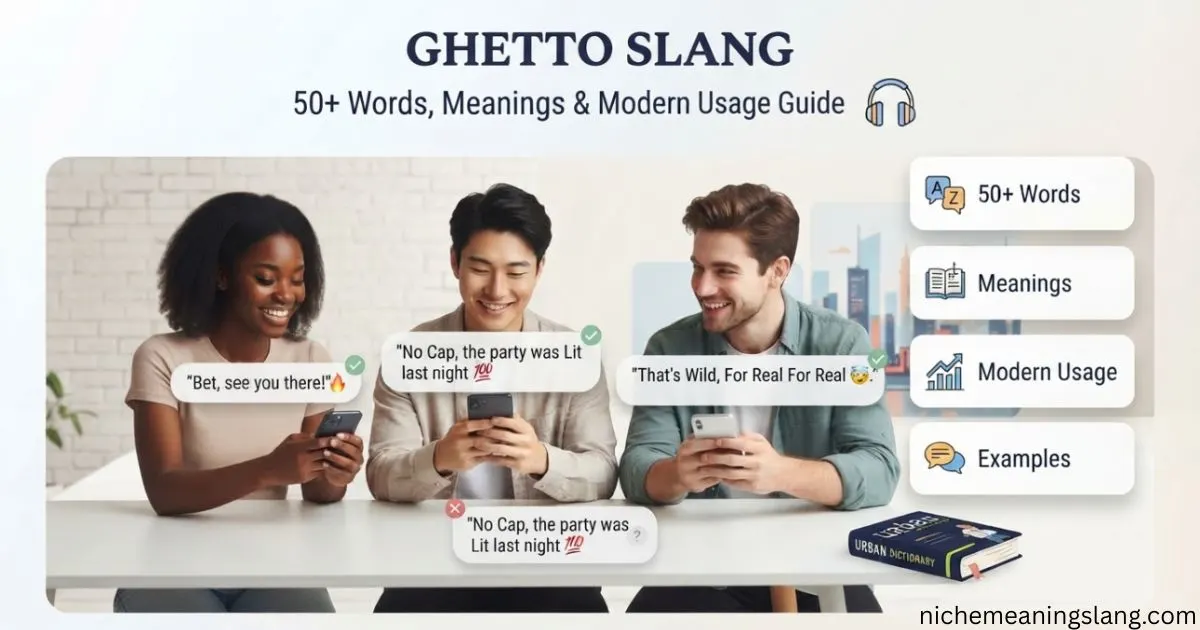
Ghetto slang is a broad, informal label people sometimes use for urban, street, hip-hop, or Black American expressions, but it is not a precise linguistic category. In everyday searches, it can include words such as lit, dope, cap, no cap, flex, homie, bet, OG, and drip, depending on the speaker and context.
The tricky part is that language, culture, and identity overlap. Some expressions began in particular communities before spreading through rap, television, memes, TikTok, and everyday conversation. Others are simply modern slang with no reason to call them “ghetto.” This guide separates common usage from linguistic terminology so you can understand the words without flattening their origins or using a label that may sound disrespectful.
Ghetto Slang Meaning at a Glance
| Expression | Common meaning | Typical context | Tone |
| Lit | Exciting or energetic | Parties/events | Positive |
| Dope | Excellent or impressive | Style/music | Positive |
| Cap | Lie or false claim | Texting/social media | Casual |
| No cap | Seriously/truthfully | Conversation | Emphatic |
| Flex | Show off | Social media | Casual |
| Homie | Close friend | Informal speech | Friendly |
| Bet | Okay/agreed | Texting/conversation | Casual |
| OG | Respected or experienced person | Culture/social groups | Respectful |
| Drip | Stylish clothing/look | Fashion/social media | Complimentary |
| Bussin | Extremely good, especially food | Informal speech | Enthusiastic |
| Slaps | Very good, especially music | Music/social media | Positive |
| Fam | Close friend/group | Informal speech | Friendly |
The label ghetto slang does not tell you exactly where a word originated. A phrase may come from African American English, hip-hop culture, a particular city, youth culture, internet communities, or several overlapping influences. Treating the label as a dictionary category can therefore hide more than it explains.
Understanding the Origins of Ghetto Slang
Slang develops inside communities before it travels outward. In the United States, African American English has its own vocabulary, pronunciation, grammar, and interactional patterns; linguistic scholarship treats it as a systematic language variety rather than random “incorrect English.”
The history becomes more complicated because music, migration, neighborhoods, television, and the internet constantly move vocabulary between groups. A word can start in one community, become strongly associated with hip-hop, enter mainstream media, and eventually be used by people who know little about its original context.
Common Examples of Ghetto Slang
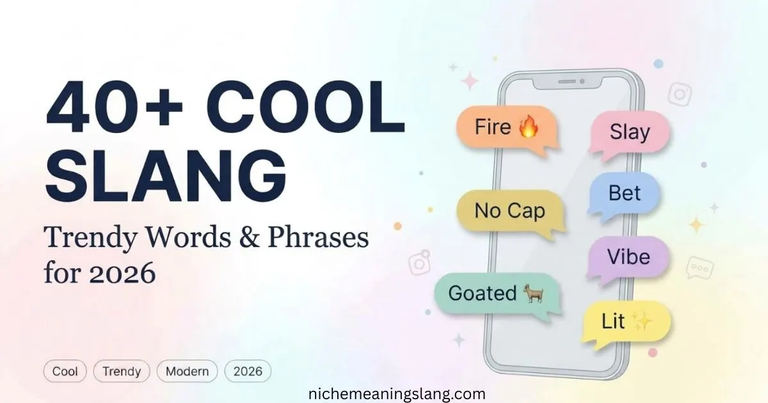
Lit usually describes something exciting, energetic, or memorable. Dope can mean excellent or impressive. Flex means showing off possessions, success, or status, while cap and no cap contrast falsehood with sincerity. These expressions can appear in conversation, lyrics, captions, memes, and text messages.
Other widely recognized terms include homie for a close friend, bet for agreement, OG for a respected or experienced person, drip for stylish clothing, and slaps for music that sounds exceptionally good. Their popularity does not mean every term should automatically be classified as “ghetto slang.”
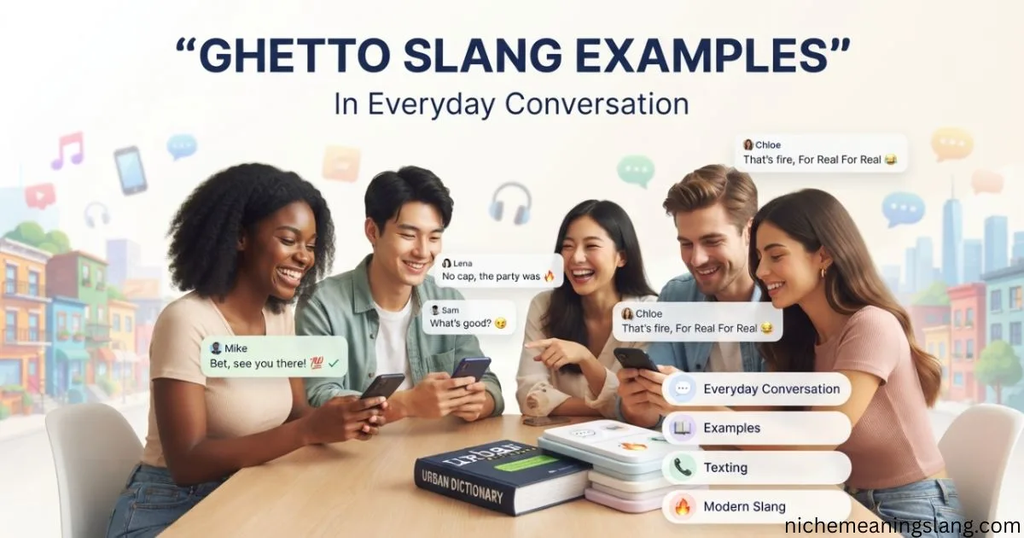
Ghetto Slang Examples in Everyday Conversation
Example for a DIY Fix
A person might describe an improvised repair as “ghetto” in casual speech, meaning makeshift or unconventional. The same wording can become insulting when directed at someone’s identity, neighborhood, clothing, or background, so the object being described and the speaker’s relationship with the listener both matter.
Example for an Old Setup
Someone might jokingly describe an outdated gaming setup as “ghetto” because it uses mismatched equipment or improvised solutions. In another context, calling a person or community “ghetto” can carry a much more negative judgment. The same word therefore cannot be understood without its target and surrounding conversation.
Example for a Style
The phrase ghetto fabulous can describe an intentionally bold, flashy, glamorous, or over-the-top aesthetic. It has appeared in fashion and popular culture, but interpretations vary. Some speakers use it playfully or positively, while others hear class or racial stereotypes in the expression.
Example in a Joke
A friend might jokingly call a homemade solution “ghetto” because it works despite looking unconventional. That is different from using the term to stereotype a neighborhood or group. Context can soften an expression between close friends, but familiarity does not automatically remove every possible negative connotation.
Example as Criticism
Calling a neighborhood, person, hairstyle, or family “ghetto” can sound judgmental because the word may imply low status, poor quality, or undesirable social background. If the actual issue is a broken repair, cheap material, or temporary setup, a more precise description often communicates the point without the extra social baggage.
Ghetto Slang Words and Related Terms
| Related term | Common association | Important distinction |
| Janky | Poorly made or unreliable | Focuses on quality |
| Sketchy | Questionable or unsafe | Focuses on uncertainty |
| Hood | Neighborhood/community | Not a direct synonym |
| Bootleg | Unauthorized or unofficial | Often concerns products/media |
| Street slang | Informal community speech | Broader category |
| Urban slang | City-associated informal language | More general label |
| AAE | African American English | Linguistic variety |
| Internet slang | Online-created/spread expressions | Digital context |
| Hip-hop slang | Language associated with hip-hop | Cultural context |
These terms overlap semantically, but they are not interchangeable. Janky may describe an unreliable object without referring to a community. Bootleg usually concerns something unauthorized. Hood can refer to a neighborhood. AAE, meanwhile, is a linguistic term rather than a synonym for slang.
When Using Ghetto Slang Can Be Tricky
The biggest problem is not understanding a word; it is assuming that every audience will interpret it the same way. Casual slang may sound perfectly natural among close friends but inappropriate in a job interview, academic paper, professional email, or unfamiliar social setting.
The word ghetto deserves particular care. Major dictionaries record an informal adjective sense involving something viewed as cheap, crude, unrefined, or stereotypically associated with impoverished urban life, and some dictionaries explicitly flag that sense as disparaging or offensive.
Ghetto Slang Versus Hood Slang
Hood slang and ghetto slang are often treated as synonyms in casual conversation, but they do not describe a precise linguistic system. “Hood” can refer to a neighborhood or community, while “ghetto” has a separate historical meaning connected to segregated communities and later acquired broader social meanings.
A useful rule is to name the actual language variety or cultural context whenever possible. If you mean African American English, say AAE or AAVE. If you mean internet language, say internet slang. If you mean language associated with hip-hop, say hip-hop slang. Precision prevents unnecessary stereotyping.
Ghetto Slang and American Pop Culture
Music and entertainment are major routes through which slang travels. Hip-hop and rap have introduced or popularized countless expressions for audiences outside their original communities, while television, movies, YouTube, TikTok, Instagram, and memes accelerate the process even further.
Once an expression becomes mainstream, its meaning can shift. People may recognize a word from a song without knowing its original social context. A phrase that once carried a specific community identity can eventually become ordinary internet vocabulary, which is why tracing origin separately from modern popularity matters.
Common Misunderstandings About Ghetto Slang
All Slang Is Uneducated Language
Slang is informal language, not evidence of intelligence or education. People with extensive formal education use slang with friends, family, coworkers, and online communities. African American English is also a rule-governed language variety with identifiable grammatical, phonological, and lexical patterns.
Slang Has No Rules
Slang follows patterns just like other forms of language. Speakers know which expressions fit particular relationships, generations, regions, and situations. A person can understand every word in a sentence yet still miss its social meaning because tone, timing, audience, and cultural knowledge influence interpretation.
Every Urban Phrase Is “Ghetto”
This is perhaps the most important misconception. Urban communities are not linguistically identical, and not every expression associated with a city comes from the same culture. Some words belong to AAE, others to regional youth culture, immigrant communities, hip-hop, gaming, or internet culture.
Ghetto Slang Versus African American Vernacular English
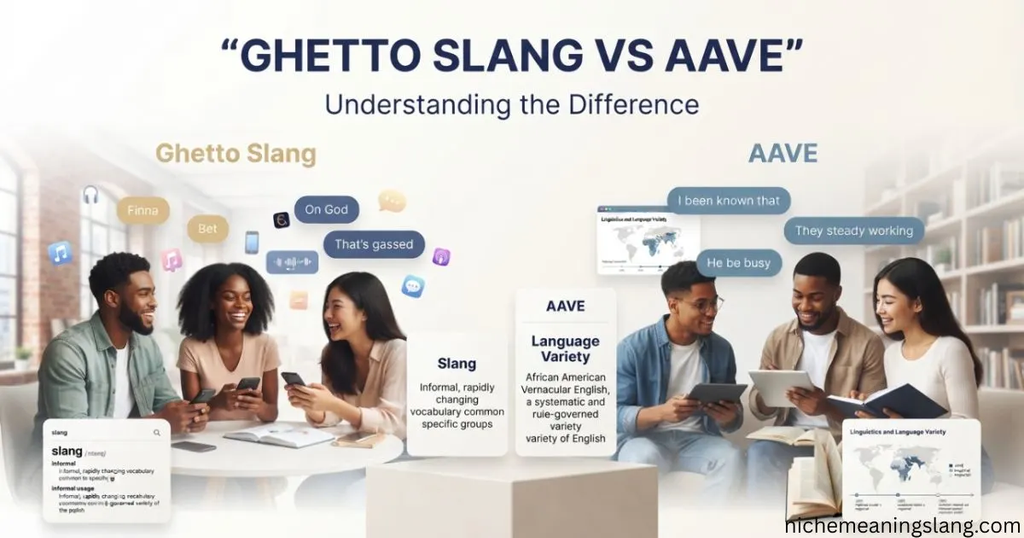
African American Vernacular English (AAVE) is commonly used to describe a variety of African American English, although terminology preferences vary among linguists and speakers. It encompasses systematic patterns of grammar, pronunciation, vocabulary, and discourse; it is not simply a list of slang words.
That distinction matters because calling all AAE “ghetto slang” reduces a complex language variety to a stereotype. Some AAE expressions are slang, but AAE also contains ordinary grammatical structures and vocabulary used in everyday communication. The two concepts overlap in places without being equivalent.
What Is AAVE
AAVE refers to a variety of English associated with African American communities in the United States. Linguistic research examines its grammar, phonology, lexicon, discourse practices, history, and use in literature and media. It should therefore be understood as a legitimate language variety rather than simply informal speech.
Is All AAVE Ghetto Slang
No. AAE contains formal and informal language, grammatical structures, pronunciation patterns, vocabulary, and discourse conventions. Some expressions may function as slang, but the entire language variety cannot accurately be reduced to slang. Treating the terms as interchangeable creates an incomplete picture of how African American English works.
Why the Terms Should Not Be Used Interchangeably
The phrase ghetto slang is a loose social label, whereas AAE is a linguistic category. One describes how people may characterize certain speech; the other describes a language variety studied systematically by linguists. Keeping those meanings separate produces clearer and more respectful explanations.
How to Discuss Slang Without Stereotyping
Start with the actual word, community, region, or linguistic variety involved. Instead of calling an expression “ghetto,” identify whether it is associated with AAE, hip-hop, a particular city, youth culture, or online communities. That approach gives readers useful information without assigning an entire speech style to one stereotype.
Conclusion
Ghetto slang is best understood as a loose popular label rather than a formal linguistic category. The words people place under it can come from African American English, hip-hop, regional speech, youth culture, urban communities, internet culture, and many other sources.
The most important distinction is between slang and language variety. AAE/AAVE has systematic linguistic structure and cannot accurately be reduced to “ghetto slang.” Likewise, the word ghetto itself has a complicated historical trajectory, beginning with the Venetian Jewish quarter and developing substantially different meanings over centuries.
FAQs
What does ghetto slang mean?
Ghetto slang is a loose informal label for slang that someone associates with urban, street, hip-hop, or Black American speech. It is not a precise linguistic category, and many expressions commonly given this label have more specific cultural or linguistic origins.
Is ghetto slang the same as urban slang?
Not exactly. Urban slang is a broader description of informal expressions associated with urban communities, while “ghetto slang” is a more loaded label that can imply stereotypes about race, class, or neighborhood.
Why is ghetto slang popular?
Expressions can spread through music, movies, television, social media, memes, and everyday conversation. Hip-hop has been particularly influential in bringing vocabulary from specific communities to much wider audiences.
Can ghetto slang meanings change over time?
Yes. Slang changes with generation, region, culture, media exposure, and online usage. A term may begin with a narrow meaning and later acquire broader or different meanings.
Is it okay to use ghetto slang?
It depends on the specific expression, audience, relationship, and context. Understanding a term does not necessarily mean it is appropriate to imitate the speech style of another community. Precise wording is usually safer in unfamiliar or professional settings.
Is ghetto a slang word?
Ghetto has both a standard historical noun meaning and an informal adjective/slang sense. The noun refers to a segregated or socially separated urban area, while the slang adjective can describe something as cheap, crude, makeshift, or unrefined and may be disparaging.
Is calling someone ghetto offensive?
It can be. When applied to a person, appearance, neighborhood, or cultural background, the word may imply negative judgments about race, class, education, or social status. The exact interpretation depends on speaker, audience, target, and context.
What is the difference between ghetto and hood?
They overlap in casual usage but are not exact synonyms. Hood can refer informally to a neighborhood or community, while ghetto has a longer historical meaning connected to segregation and later developed broader social and slang meanings.
What is another word for ghetto?
There is no single universal substitute. Depending on what you actually mean, alternatives might include makeshift, improvised, low-budget, rough, unpolished, unconventional, under-resourced, or urban neighborhood. Choosing a precise description is better than replacing one broad label with another.
What does ghetto fabulous mean?
Ghetto fabulous generally describes an intentionally bold, flashy, glamorous, or extravagant aesthetic. The phrase has cultural and historical associations that make its interpretation highly dependent on speaker, audience, and context.
Related Slang Words

Ryan Mitchell is a language enthusiast and writer who explores slang, modern expressions, and everyday language. At nichemeaningslang, he helps readers understand slang meanings, usage, and context in a simple and easy-to-follow way.