50+Louisiana Slang Words, Phrases & Meanings Locals Use
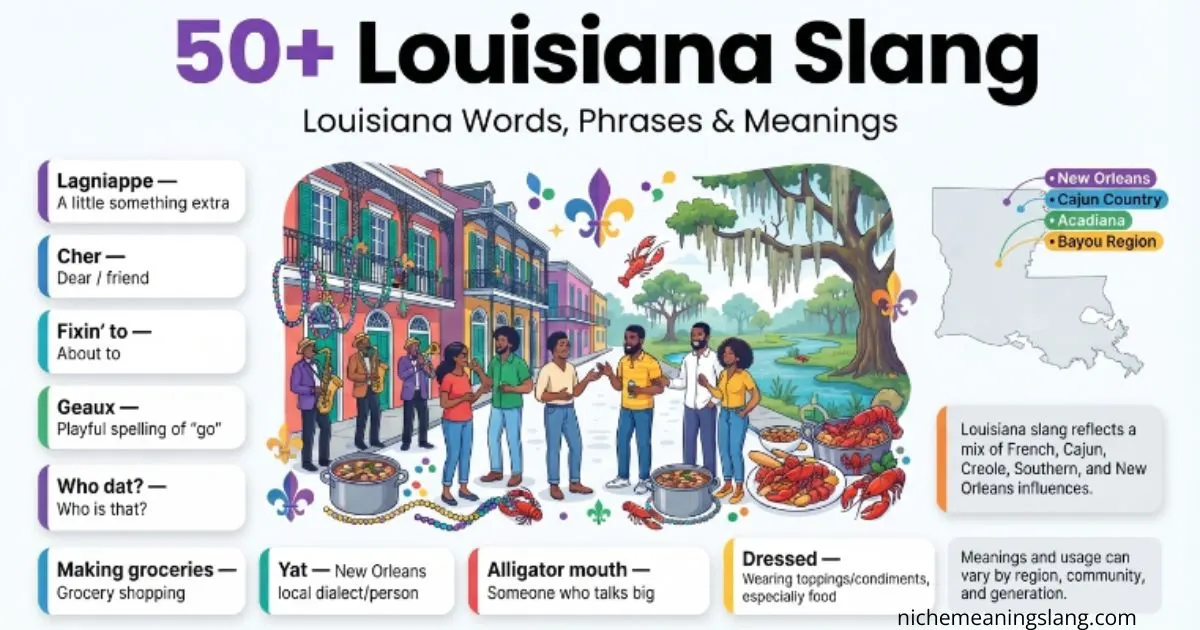
Louisiana slang is a colorful mix of Cajun, Creole, French, Southern, and New Orleans traditions, with phrases that can change noticeably from one part of the state to another. Words like cher, lagniappe, where y’at, making groceries, dressed, and neutral ground can leave visitors puzzled at first.
After researching current Louisiana language guides and local discussions, one thing becomes clear: there is no single “Louisiana accent” or universal slang list. New Orleans, Acadiana, Baton Rouge, and North Louisiana each have their own flavor. This guide helps you understand the words in context rather than simply memorizing a dictionary.
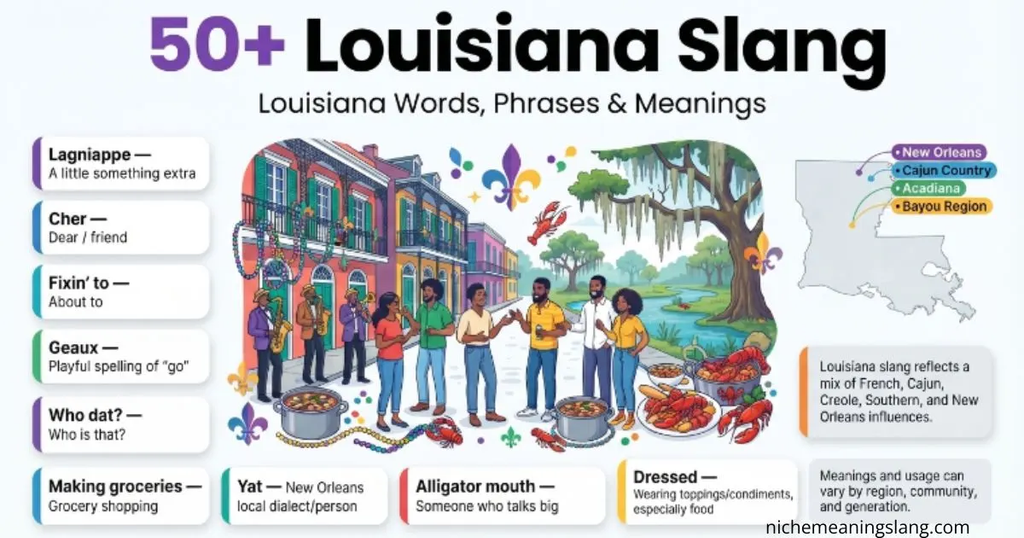
Louisiana Slang Words Cheat Sheet A Quick Reference Table
The fastest way to learn Louisiana slang is to see the words beside their meanings, pronunciation, region, and everyday use. Cher means dear or sweetheart, lagniappe means something extra, making groceries means grocery shopping, and neutral ground means the median in New Orleans.
Some expressions are statewide, while others are strongly associated with particular communities. Where y’at belongs especially to New Orleans, while envie, couyon, and fais do-do are strongly associated with Cajun Country. That regional distinction matters because locals do not necessarily use every famous Louisiana phrase in ordinary conversation.
| Louisiana term | Meaning | Common association |
| Cher / Sha | Dear, sweetheart | Cajun / South Louisiana |
| Where y’at? | How are you? | New Orleans |
| Lagniappe | Something extra | Louisiana-wide |
| Making groceries | Grocery shopping | Louisiana |
| Neutral ground | Road median | New Orleans |
| Dressed | Fully topped po-boy | Louisiana food culture |
| Fais do-do | Cajun dance party | Acadiana |
| Couyon | Foolish or silly person | Cajun |
| Envie | Craving | Cajun |
| Who Dat | Saints-related chant | New Orleans / Louisiana |
| Geaux | “Go,” especially LSU-related | Louisiana |
| Parish | County equivalent | Louisiana |
Where Louisiana Slang Words Come From
Louisiana slang developed from several linguistic and cultural streams rather than one source. French settlers, Acadian immigrants, Creole communities, African influences, Spanish history, Native place names, and Southern American English all contributed to the vocabulary heard across the state today.
The result is why Cajun French, Louisiana Creole, Yat speech, Southern expressions, food vocabulary, and modern internet slang can exist side by side. The important distinction is that Cajun and Creole are not interchangeable labels. Their histories and cultural contexts differ, even when their vocabulary overlaps.
Why Louisiana Sounds Different From One Region to Another
New Orleans has its Yat tradition, Acadiana retains strong Cajun French influence, Baton Rouge blends several Southern and Louisiana identities, and North Louisiana tends to sound more conventionally Southern. Even the vocabulary can change as you travel across the state.
New Orleans Slang and the Yat Accent Louisiana Slang
New Orleans slang is closely connected with the city’s distinctive Yat speech. Where y’at? means essentially “How are you?”; neutral ground refers to the median between roads; and who dat is deeply connected with New Orleans Saints culture. These expressions carry strong local identity rather than simply being random slang.
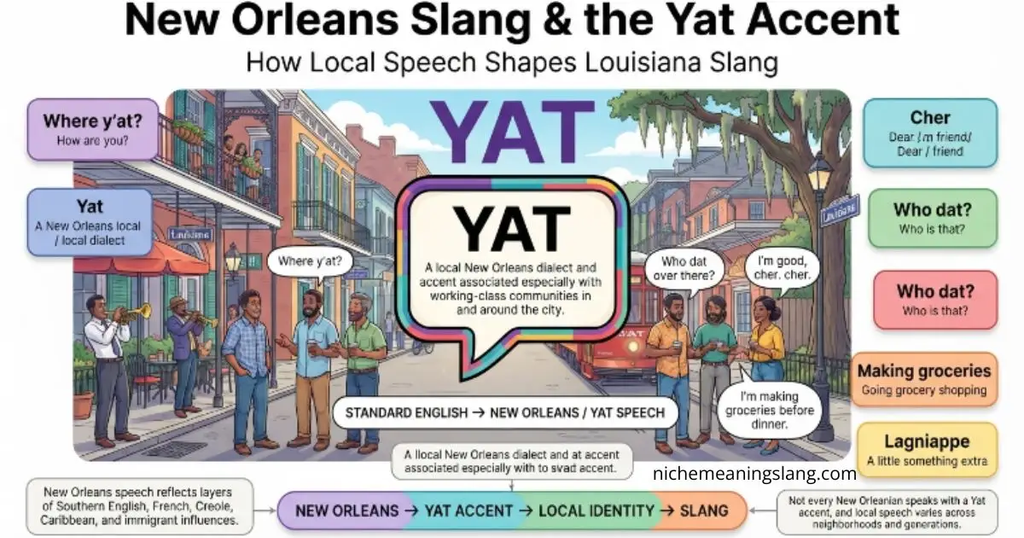
You may also encounter baby, dawlin’, da, backatown, and making groceries in New Orleans conversations, although frequency varies by speaker, neighborhood, age, and situation. The biggest mistake is assuming every person in Louisiana speaks like a New Orleanian. Local Reddit discussion makes exactly this point: regional speech differs significantly.
Where Y’at?
Where y’at? is one of the best-known New Orleans expressions. Despite sounding like a question about location, it functions as a greeting meaning roughly “How are you?” or “How’s it going?” Matador identifies it particularly with southeast Louisiana and New Orleans.
Cajun Country and Acadiana Slang Louisiana Slang
Travel west into Acadiana and the language flavor changes. Cher, sha, couyon, envie, fais do-do, and down the bayou are associated with Cajun Country and reflect the region’s long relationship with Cajun French and rural South Louisiana culture.
For example, calling someone a couyon can be playful rather than hostile when the relationship and tone are right. Likewise, envie can describe a craving, especially for food. These words make more sense when heard around family gatherings, kitchens, festivals, and everyday Cajun conversation rather than treated as vocabulary flashcards.
Cher and Sha
Cher, pronounced roughly “sha” in Louisiana usage, is a term of affection comparable to “dear,” “honey,” or “sweetheart.” It is traditionally associated with Cajun speech, although usage varies. Context matters because an affectionate word does not automatically imply romance.
Food, Crawfish, and Kitchen Slang Louisiana Slang
Food is one of the easiest gateways into Louisiana vocabulary. If a restaurant asks whether you want a po-boy dressed, they are asking whether you want toppings such as lettuce, tomato, pickles, and mayonnaise not commenting on your clothing. Boudin, roux, Holy Trinity, crawfish, and snoball belong to the same cultural vocabulary.
Visitors can also encounter making groceries, meaning grocery shopping, and cold drink, which can mean soda in Louisiana usage. Crawfish culture brings phrases such as pinch the tail and suck the head, describing how the crustacean is eaten. These expressions are memorable because they come directly from everyday Louisiana life.
Dressed
In Louisiana food vocabulary, dressed usually means a po-boy served with its standard toppings. Matador specifically explains that the term refers to lettuce, tomatoes, pickles, and mayonnaise. So when ordering a po-boy, “dressed” is about the sandwich, not your clothes.
Mardi Gras and Festival Season Slang Louisiana Slang
Mardi Gras adds another layer to Louisiana expressions. Throw me somethin’, Mister! is associated with parade spectators asking float riders for throws such as beads and other trinkets. Krewe refers to the organization behind a Mardi Gras parade, while second line describes the celebratory procession associated with New Orleans traditions.
Then there is laissez les bons temps rouler, the famous French expression meaning “let the good times roll.” You may hear it around Mardi Gras, family gatherings, festivals, and other celebrations. These phrases are not merely slang; they connect language with Louisiana’s festival culture and communal traditions.
Throw Me Somethin’, Mister!
During Mardi Gras, “Throw me somethin’, Mister!” is a request from people watching a parade for something thrown from a float. The phrase is especially associated with Mardi Gras culture and helps explain why Louisiana slang often makes the most sense when connected to a real local tradition.
Who Dat Nation Sports Slang in Louisiana
Louisiana sports culture has created some of the state’s most recognizable expressions. Who Dat is closely associated with New Orleans Saints fans, while Geaux Tigers is associated with LSU. The spelling Geaux visually reflects Louisiana’s French heritage, although it is pronounced like “go.”
These expressions can move beyond stadiums and into everyday identity. A Saints fan may use “Who Dat” as a greeting or celebration, while LSU supporters use “Geaux Tigers” as both encouragement and school pride. This is a good example of how sports vocabulary can become part of regional culture.
Gen Z and TikTok Louisiana Slang
Modern Louisiana slang is not frozen in the past. Younger speakers combine traditional regional vocabulary with broader internet culture. SlangVibes identifies terms such as wodie, throwed, gumbo vibes, boogie, clownin, and 225 within its current Gen Z/TikTok-oriented discussion.
The important distinction is that newer online terms should not automatically be treated as centuries-old Louisiana dialect. Some are modern regional slang, some come from hip-hop and social media, and others are older expressions being reused online. Digital platforms can spread a local word far beyond the place where it originated.
Cajun French Sayings and Playful Louisiana Expressions
Cajun French contributes more than isolated vocabulary. Expressions such as lâche pas la patate demonstrate how French-language heritage can survive inside everyday cultural sayings. Roughly interpreted as “don’t give up,” the phrase illustrates how Louisiana expressions can carry both literal imagery and a broader cultural message.
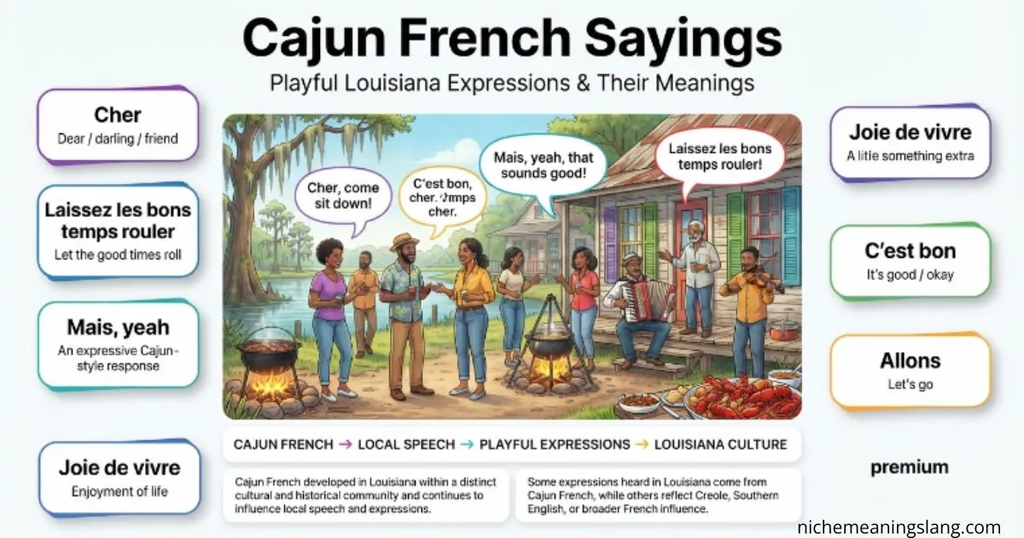
Other terms are playful. Couyon can describe someone acting foolishly, while fais do-do refers to a Cajun dance party. The tone is essential: Cajun expressions may sound surprisingly sharp when translated literally but function affectionately among family and friends.
Fais Do-Do
A fais do-do is a Cajun dance party. Matador explains that the phrase literally relates to “going to sleep,” reflecting the tradition of children falling asleep while adults continued dancing. Today, the term is strongly associated with Cajun social and music culture.
North vs South Louisiana: Regional Slang Differences
Louisiana slang changes considerably by geography. New Orleans leans toward Yat vocabulary and distinctive local expressions, Acadiana retains stronger Cajun French influence, Baton Rouge has its own blend of regional and LSU-related language, while North Louisiana generally has fewer French-derived expressions and sounds more conventionally Southern.
That is why a statewide list can be misleading. Someone from Shreveport may recognize a famous New Orleans expression without using it personally. Likewise, a Cajun speaker may understand a New Orleans term while preferring vocabulary rooted in Acadiana. Language follows communities, not state borders.
| Region | Common linguistic associations |
| New Orleans | Yat, where y’at, neutral ground, Who Dat |
| Acadiana | Cajun French, cher, envie, couyon |
| Baton Rouge | 225, LSU, Geaux Tigers |
| North Louisiana | Southern English, y’all, mama and them |
| South Louisiana | Cajun, Creole, French-influenced expressions |
How to Sound Like a Local, Not a Tourist: Louisiana Slang
The easiest way to use Louisiana slang naturally is not to force an accent. Listen first, learn what a phrase means in its actual setting, and use vocabulary only when it fits the conversation. Current competitor research repeatedly emphasizes that regional awareness matters more than memorizing a giant list.
It also helps to understand cultural boundaries. Cajun and Creole should not be casually treated as identical, and certain historically loaded expressions should be avoided by outsiders. You will sound far more respectful by asking how a local uses a term than by imitating an exaggerated television version of Louisiana speech.
Common Mistakes With Louisiana Slang
The biggest mistake is assuming that all famous Louisiana expressions are equally common everywhere. Another is confusing Cajun and Creole culture or forcing a local accent. Reddit users discussing Louisiana slang similarly point out that many popular lists mix actual regional dialect with stereotypes and terms that are not universally used.
Conclusion
Louisiana slang is much more than a collection of funny words. It is a living reflection of Cajun, Creole, French, Southern, African, Caribbean, New Orleans, food, music, Mardi Gras, and sports culture. Words such as cher, lagniappe, where y’at, making groceries, dressed, neutral ground, and Who Dat each point toward a particular part of Louisiana life.
The biggest lesson is to think regionally. New Orleans is not Acadiana, Acadiana is not Baton Rouge, and North Louisiana is not simply a Cajun version of the South. Learn the words, but more importantly, learn where, when, and how locals actually use them. That is what turns a slang list into genuine cultural understanding.
FAQs
What are Louisiana slang words?
Louisiana slang includes regional words and expressions influenced by Cajun, Creole, French, African American, Spanish, Native, and Southern linguistic traditions. The vocabulary differs by location, with New Orleans, Acadiana, Baton Rouge, and North Louisiana showing distinct patterns.
What does “Cher” mean in Louisiana?
Cher is a term of affection meaning roughly “dear,” “honey,” or “sweetheart.” It is traditionally associated with Cajun speech. The word is not necessarily romantic; it can be used affectionately among family, friends, and other familiar relationships.
What does “Lagniappe” mean?
Lagniappe means something extra, usually a small bonus or unexpected addition. For example, receiving an extra item from a shopkeeper can be described as lagniappe. The word has French and Spanish historical connections and is strongly associated with Louisiana culture.
What does “Where y’at?” mean?
Where y’at? is a New Orleans-area greeting meaning approximately “How are you?” or “How’s it going?” It is not normally asking for your physical location.
What does “making groceries” mean?
Making groceries means going grocery shopping. It is a distinctive Louisiana expression with French influence and remains recognizable across generations.
What does “neutral ground” mean?
In New Orleans, neutral ground means the median or strip separating lanes of a road. The expression has historical roots and remains part of everyday local vocabulary.
What does “Who Dat” mean?
Who Dat is strongly associated with New Orleans Saints culture. It comes from the team’s famous fan chant and has become an important part of New Orleans sports identity.
Is Louisiana slang influenced by French?
Yes. French influence is a major part of Louisiana’s linguistic history, especially in Cajun and Creole communities. However, Louisiana speech also reflects Spanish, African, Native American, Caribbean, and broader Southern American influences.
Do locals still use Louisiana slang online?
Yes. Traditional Louisiana expressions continue to appear in social media and group chats, while younger users also combine regional language with contemporary internet slang. TikTok and Instagram have helped newer Louisiana expressions reach wider audiences.
What is the difference between Cajun and Creole slang?
Cajun speech is strongly associated with the descendants of Acadian settlers and remains particularly influential in Acadiana. Louisiana Creole developed through a different, multicultural history involving French, Spanish, African, Caribbean, and other influences, especially around New Orleans.
Is “coonass” okay for outsiders to use?
It is best for outsiders to avoid the term. Some Cajuns have historically used it as a self-description, but the word has a complicated and offensive history. Current Louisiana-focused sources specifically advise outsiders not to casually adopt it.
Related Slang Words

Ryan Mitchell is a language enthusiast and writer who explores slang, modern expressions, and everyday language. At nichemeaningslang, he helps readers understand slang meanings, usage, and context in a simple and easy-to-follow way.